
Plan and manage communication
In the app: Project → Planning → Comms Plan (Overview · Plan · Schedule)
PMP ECO · People (33%) · Task P8. Get the right information to the right people, in the right form, at the right time, by design rather than by habit.
What it is
Communication planning answers, for each stakeholder: what they need to know, why they need it, how it reaches them, how often, and who sends it. The answers go in the communications management plan, and its working core is the communications matrix: one line per audience and message.
PMBOK® names three communication methods. Picking the right one is the most-tested idea in this task:
| Method | How it works | Use it for | Examples |
|---|---|---|---|
| Interactive | Two-way, in real time | Decisions, bad news, anything that needs a reply | Meetings, presentations, calls |
| Push | Sent to specific people; no proof it was read or understood | Routine status, formal records | Reports, emails, memos |
| Pull | People look it up when they need it | Large audiences, reference information | Dashboards, portals, a knowledge base |
Behind the methods sits the sender–receiver model: the sender encodes a message and sends it through a medium; the receiver decodes it; noise (language, jargon, distance, mood) distorts it on the way; and feedback confirms it landed. Sent is not the same as understood. That gap is why the plan exists.
Then there are two activities to run against the plan. Manage communications means producing and delivering the messages. Monitor communications means checking they reached the right people and had the intended effect, and adjusting the plan when they didn't.
Why it matters
- Project managers spend most of their working time communicating, and many project failures trace back to a message that never arrived, arrived late, or was misread.
- Audiences differ. The investor needs cost and schedule; the regulator needs evidence against conditions; the community needs plain-language answers in its own language. One report for everyone serves no one.
- A plan prevents both over-communication (noise people learn to ignore) and under-communication (the surprise that destroys trust).
- The number of possible channels grows fast: N(N−1)/2. Eight stakeholders means 28 channels (P4). A deliberate matrix is how you avoid trying to keep all 28 open.
Where you do it in VanillaPM
Planning → Comms Plan is the communications workspace:
- Overview shows the plan's status, the channel count, stakeholder coverage (who has no line yet), the mix of methods, and the next communication due. Below it is the communications matrix: message, audience, channel and method, cadence, owner, and what the audience needs.
- Plan is the governed communications management plan. Its Communications matrix section is filled from the matrix and stays in step with it while the plan is a draft.
- Schedule turns each line's cadence into real upcoming dates.
- Guideline is the method reference.
The audience on each line is a stakeholder from the register, so the plan stays tied to P4–P6. What actually happened with each stakeholder (the calls, meetings and commitments) goes in the stakeholder's interaction log. That log is where you check whether the plan is working.
Free tools: Communications plan template (Word, Markdown) · Communication channels calculator.
Walked example — Coral Ridge Resort
The owner gets two lines, on purpose. The monthly steering committee is interactive: decisions on cost, schedule and change, and the place bad news is raised first, face to face. The weekly project dashboard is pull: the board checks cost, schedule and EVM between meetings without having to ask. The bank, the regulator, the municipality and the contractor get push reports on a fixed rhythm. The local community gets a monthly town hall in Bangla, because a written notice can't answer questions or hear concerns. Future guests have no line yet. That is a deliberate choice: they matter at pre-opening marketing, not now (P5).
The workspace — the theory behind each screen
Every screenshot is the actual sample project, not a mock-up.
1 · One line per audience, with the method chosen on purpose
The theory: the communications matrix and the three methods. For each audience, choose the method that fits the message. Decisions and bad news need interactive. Routine status can be push. Information many people need at different times works best as pull.
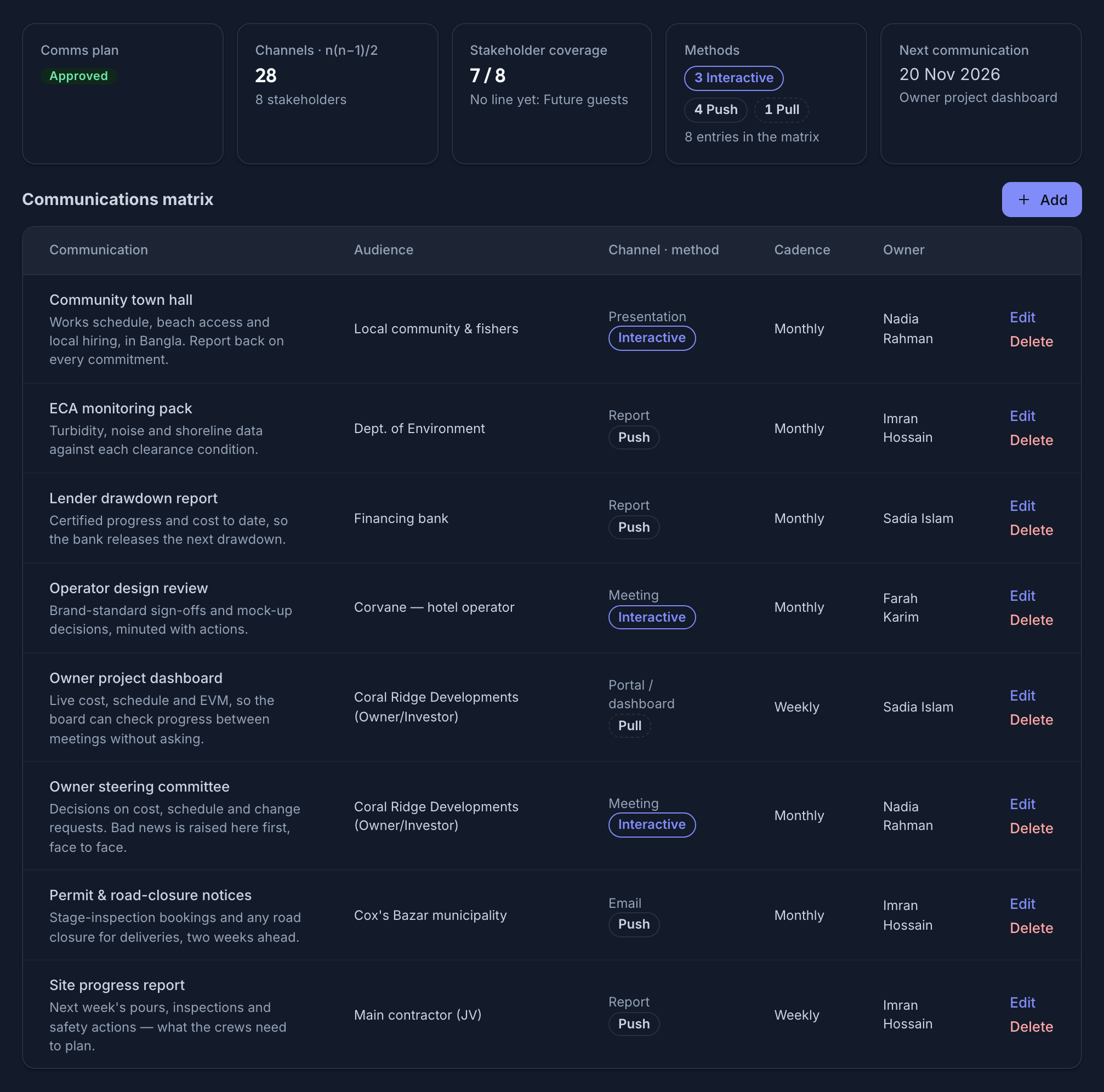
Reading the screenshot: start with the tiles. 28 channels among 8 stakeholders, yet only 8 planned lines, because a plan narrows the possible down to the necessary. Coverage 7 / 8: the tile names the one stakeholder without a line, so a gap is a decision, not an accident. Methods: 3 interactive, 4 push, 1 pull. In the matrix, every line has an owner, and the grey text under each message says what the audience needs and why. The Owner steering committee (interactive) and the Owner project dashboard (pull) serve the same stakeholder in two different ways.
✅ Do write down what each audience needs, not just the name of the report.
❌ Avoid one owner for every line. The PM can't personally send everything, and shouldn't.
2 · The channel decides the method
The theory: interactive vs push vs pull. The method follows from the channel: a meeting is interactive, an email or report is push, a dashboard is pull. Push is efficient but gives no proof of understanding, so anything that needs a decision or a reaction belongs in an interactive channel.
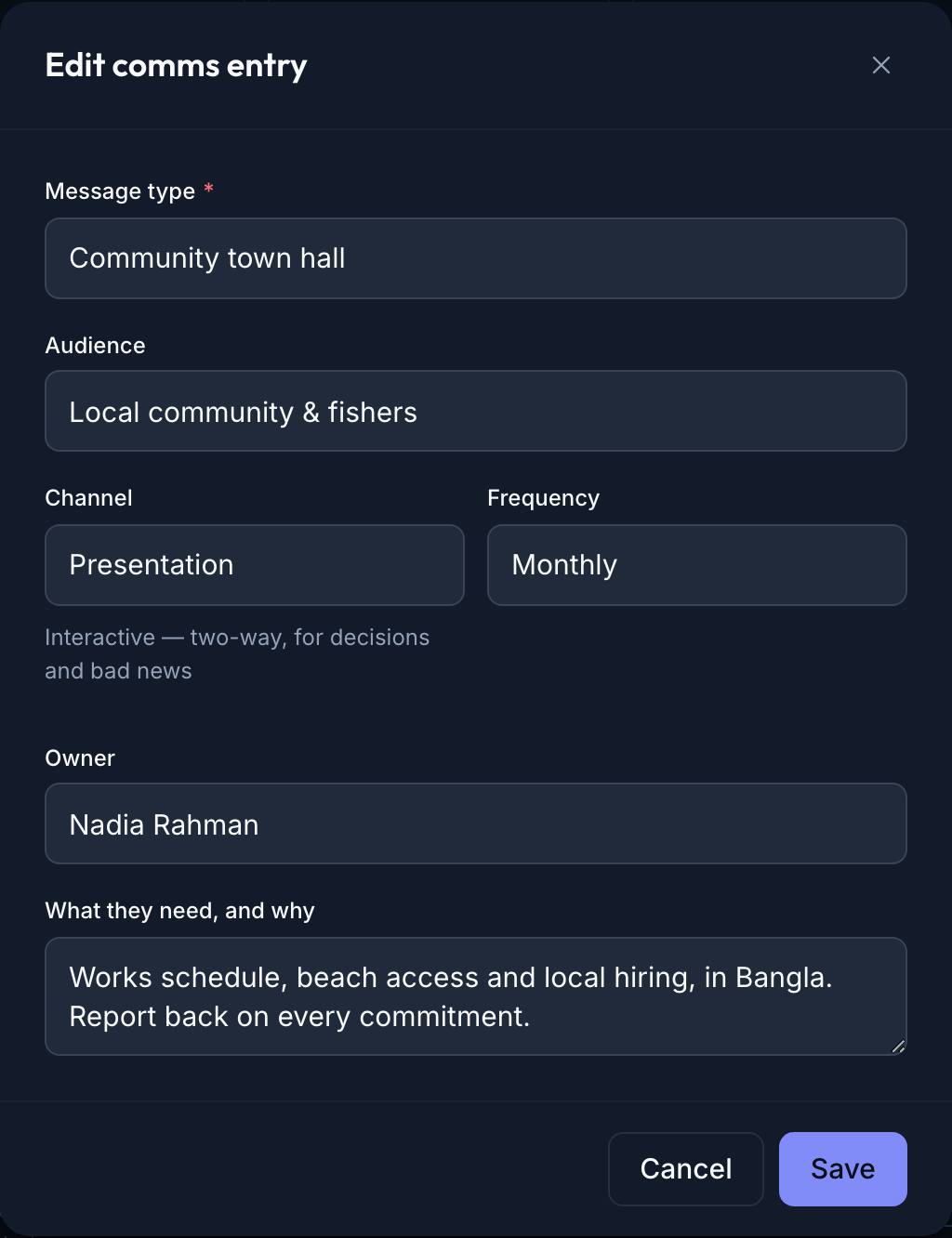
Reading the screenshot: the Community town hall line. Audience is picked from the stakeholder register. The channel is Presentation, and the hint underneath names the method: Interactive — two-way, for decisions and bad news. Switch the channel to Report and the hint changes to Push — sent to them; no proof it was read. What they need, and why records the purpose: the works schedule, beach access and local hiring, in Bangla, with a report back on every commitment from the stakeholder log.
✅ Do pick an interactive channel when you need a decision or are delivering bad news.
❌ Avoid sending bad news by email because it's easier for you.
3 · The plan is a governed document that can't drift from reality
The theory: the communications management plan. The matrix is one part of the plan. The plan also covers objectives, methods and format, cadence, and escalation: how issues move up and how feedback comes back. It is reviewed and approved like any other management plan, and updated when stakeholders change.
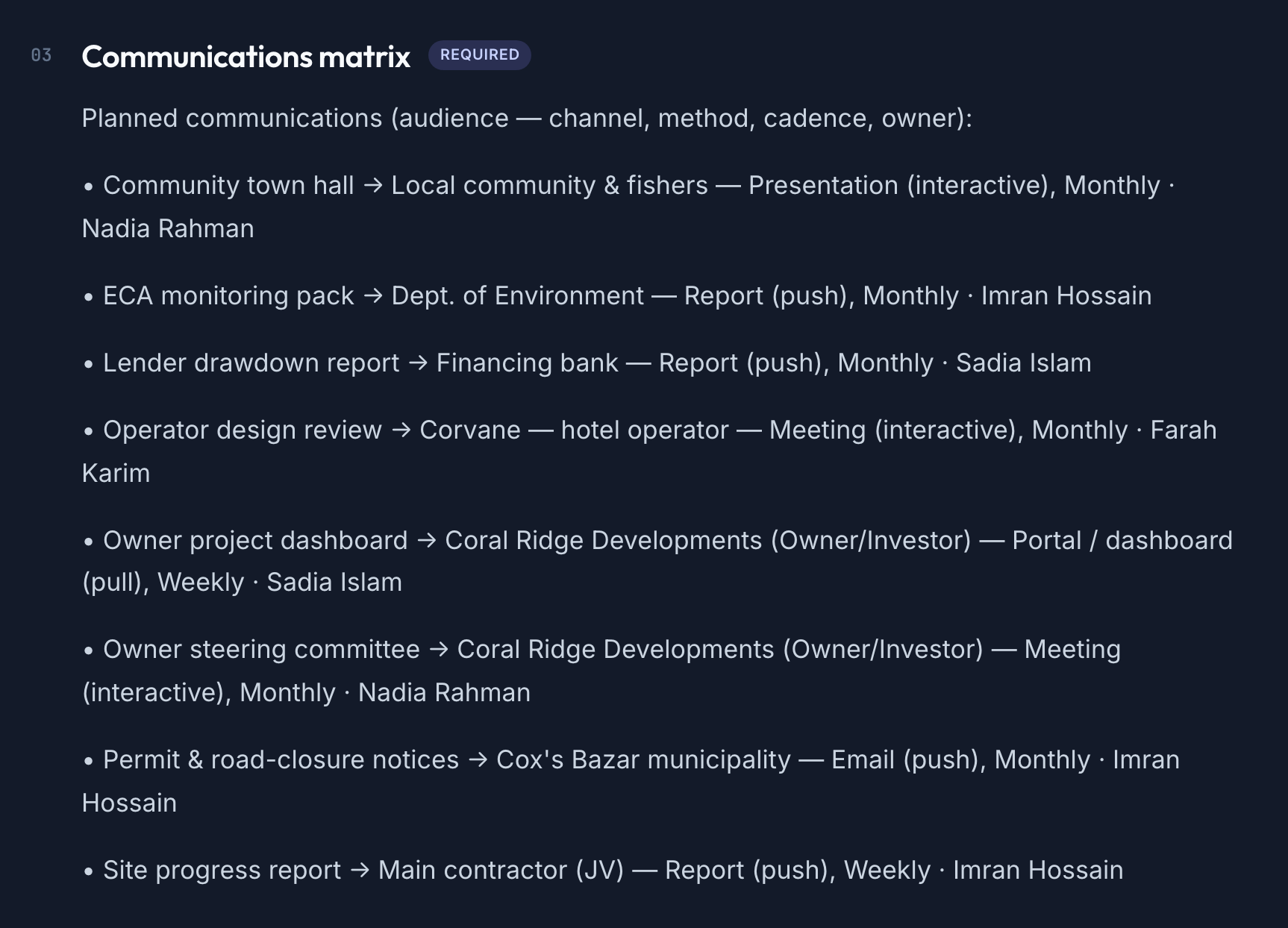
Reading the screenshot: section 03 of the governed plan lists all eight lines, each with its audience, channel, method, cadence and owner. It is generated from the matrix, so the document and the working list can't disagree. While the plan is a draft, adding a line in the Overview updates this section. Once the plan is submitted or approved it is frozen, and a change goes through a new revision.
✅ Do revisit the plan when a stakeholder is added or someone's attitude changes.
❌ Avoid a plan written at kickoff and never opened again.
Best practices & pitfalls
- Do match method to message: decisions and bad news interactive, routine status push, shared reference pull.
- Do derive the plan from the stakeholder register, and check coverage when someone new appears.
- Do check the effect, not just delivery. The interaction log tells you whether a message landed; silence is not agreement.
- Do translate and simplify for audiences outside the project. Jargon is noise.
- Pitfall: one big report to everyone. People stop reading what isn't for them.
- Pitfall: treating a sent email as communication done. Push has no proof of understanding.
On the PMP exam
Expect the N(N−1)/2 formula and questions that ask you to match interactive / push / pull to a situation (a large dispersed audience points to pull; an urgent decision or bad news points to interactive). Know the sender–receiver model, including noise and feedback. When a scenario says a stakeholder is confused, out of the loop or getting the wrong information, the best answer is to review the communications management plan (and the stakeholder register behind it), not simply to send another email or hold an extra meeting.