
Plan and manage compliance
In the app: Project → Compliance
PMP ECO · Business Environment (26%) · Task B2. Identify every requirement the project must meet — legal, regulatory, safety, contractual — plan how you'll meet it, and prove you did.
What it is
Compliance is about the requirements the project has no choice but to satisfy: laws, regulations, codes, standards, safety rules, and contractual obligations. The task is to identify applicable requirements, classify them, plan how each is met, track status with evidence, and understand the consequence of non-compliance — then measure how compliant the project actually is. This is a domain the 2026 ECO expanded.
Why it matters
- Non-compliance isn't a variance you can absorb — it can stop the job (a pulled permit), incur penalties, or create personal and corporate liability.
- Evidence matters as much as the act: on an audited build, "we complied" is only as good as the record that proves it.
Where you do it in VanillaPM
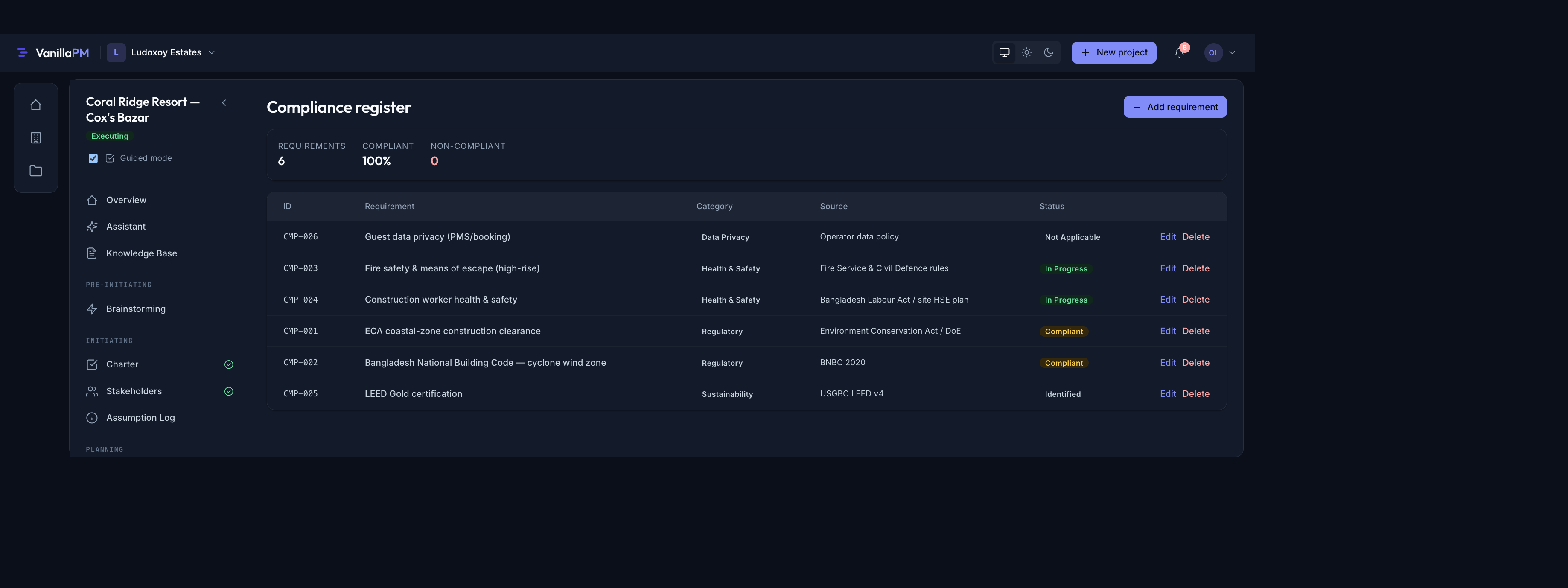
The Compliance register records each requirement (with its category — regulatory, health & safety, environmental, data-privacy…), its source, applicability, status, evidence, the consequence of non-compliance, and an owner. An extent-of-compliance % summarises where the project stands.
Walked example — Coral Ridge Resort
Coral Ridge carries heavy compliance: coastal/ECA environmental clearance, the national building code, fire & life-safety, occupational health & safety for high-rise/coastal work, and ongoing environmental monitoring conditions. Each is a register entry with its evidence (the clearance certificate, cube-test records, safety audits) and its consequence (non-compliance on ECA conditions → clearance revoked → work stops). The compliance-extent % gives the sponsor a one-glance read of regulatory health.
The artefact
- Compliance register — requirement · category · source · status · evidence · consequence · owner, with an extent-of-compliance measure.
Best practices & pitfalls
- Do capture the evidence alongside the status — compliance you can't prove is a finding waiting to happen.
- Do record the consequence so priority is obvious — a "work stops" requirement outranks a "minor fine" one.
- Pitfall: treating compliance as a one-time permit exercise; many obligations (monitoring, safety) are continuous through delivery.
On the PMP exam
Compliance is a growing Business-Environment theme. Expect to classify and prioritise requirements, weigh consequences of non-compliance, and treat compliance as continuous, evidenced, and non-negotiable. Answers that trade compliance away for schedule or cost are traps.