
Manage conflicts
In the app: Project → Team → Conflicts
PMP ECO · People (33%) · Task P2. Surface disagreement early, get to the root cause, and resolve it in a way that keeps the relationship and the work intact.
What it is
Conflict on a project is normal and often useful — it exposes hidden assumptions and better options. The task is to manage it, not suppress it: interpret the source, keep it focused on the issue (not the person), and drive to a resolution the parties own. PMBOK® 8e leans on collaborate / problem-solve as the healthiest default among the classic modes (withdraw, smooth, compromise, force, collaborate).
Why it matters
- Unmanaged conflict festers into schedule slips, silent non-compliance, and attrition.
- The way a PM handles conflict sets the team's norms — resolve one fairly and openly and the team learns it's safe to raise the next one.
Where you do it in VanillaPM
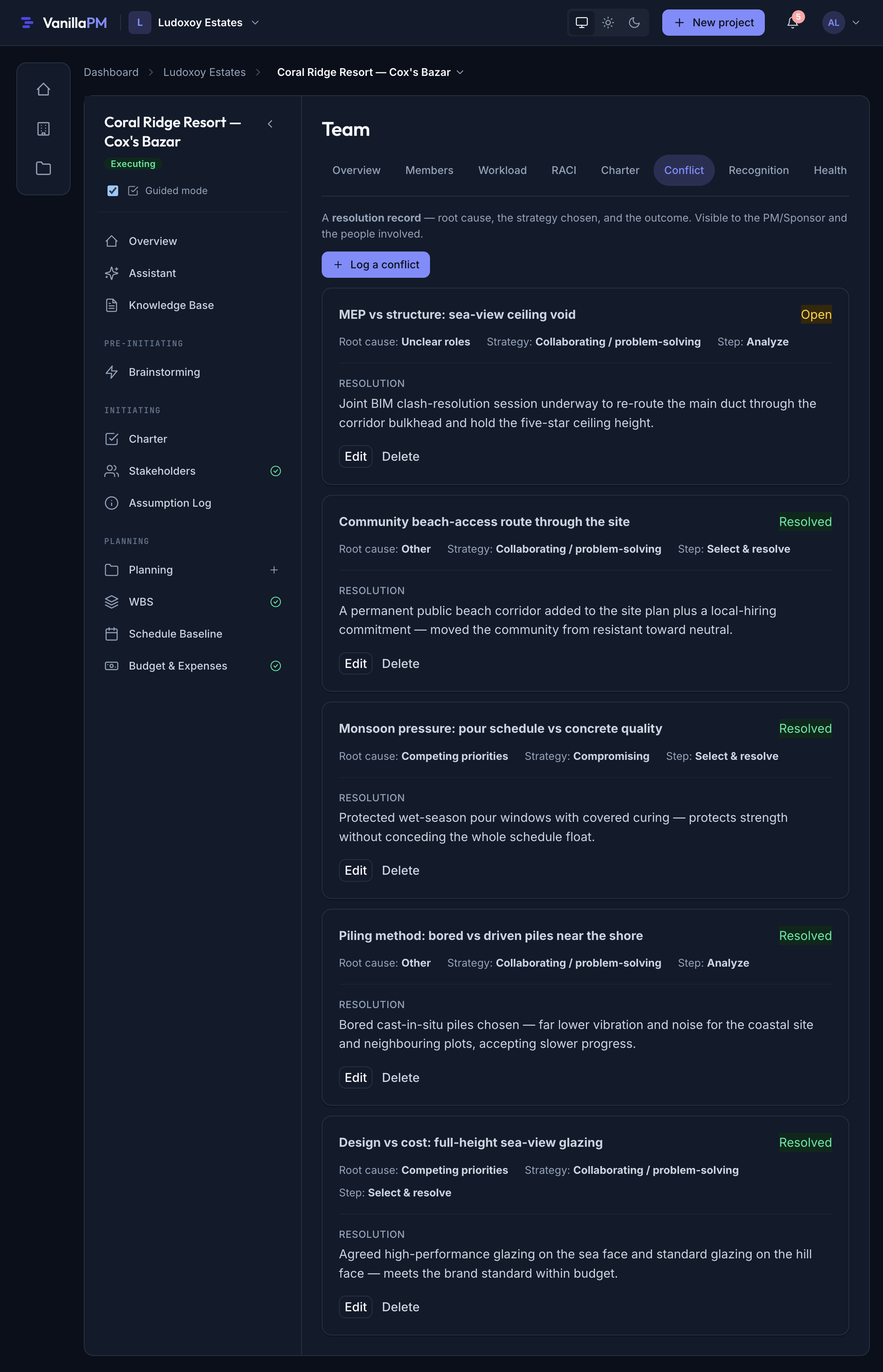
Use the Team → Conflicts log. Each entry records the parties, the root cause, the resolution strategy (the mode chosen), the steps taken, and the status — so a disagreement becomes a tracked, closeable item rather than a corridor grievance.
Walked example — Coral Ridge Resort
On Coral Ridge, the site engineer and the MEP lead clash over the ceiling void on the sea-view floors: MEP needs depth for ducting; the architect's five-star ceiling height is sacrosanct to the brand standard. Logged as a conflict, the root cause is a coordination gap between the structural and MEP models, not a personality issue. Strategy: collaborate — a joint BIM clash-resolution session. Steps: re-route the main duct through the corridor bulkhead; outcome recorded and the conflict closed, with the fix feeding a design note.
The artefact
- Conflict log — parties · root cause · resolution mode · steps · status, kept in the team workspace so patterns (e.g. recurring design-coordination clashes) become visible.
Best practices & pitfalls
- Do address conflict early and directly — cost of resolution rises the longer it sits.
- Do separate the person from the problem; log the root cause, not blame.
- Do prefer collaborate/problem-solve; reserve compromise for genuine trade-offs and force for safety/ethics red lines.
- Pitfall: smoothing ("let's not make a fuss") — it hides the issue and it comes back bigger.
On the PMP exam
Conflict questions are a staple of the People domain. The exam almost always rewards the face-to-face, collaborate-first response, and expects the PM to get to the root cause before proposing a fix. Watch for answers that escalate to the sponsor immediately or avoid the conversation — those are usually the distractors.