
Remove impediments and manage issues
In the app: Project → Issues
PMP ECO · Business Environment (26%) · Task B4. Track the problems happening now, give each one an owner and a date, clear what's blocking the team, and escalate what you can't clear yourself.
What it is
An issue is a problem happening now. A risk is one that might happen. When a risk happens, it becomes an issue, and the risk register should say so. Not every issue was a risk: some were never foreseen, and those are worth a look at the next risk review (B5).
Managing issues means:
- Log each one in the issue log: what's happening, its category and priority.
- Give it one owner and a date to clear it by. An issue owned by "the team" doesn't move.
- Say what it's blocking. An issue that stops work is an impediment, and clearing impediments is a core part of the project manager's job as a servant leader.
- Act, or escalate. Clear it within your authority, or take it through the governance path to whoever can (B1), with the impact stated.
- Close it with a resolution, so the log records what fixed it, and review the log in the team's regular cadence (the daily huddle or stand-up).
Why it matters
- An unowned issue doesn't get resolved. Somebody has to have it on their list.
- An issue without a date is never late, so nobody notices it is.
- Blockers cost the most. An idle crew, or a pour on hold, costs money every day. The impediments go to the top of the list, ahead of things that are only annoying.
- The resolution is a lesson. "What fixed it" is what the next project needs (B6).
Where you do it in VanillaPM
- Issues opens on the live picture: open issues by priority, overdue, blocking work, no owner, and resolved with the average days to clear.
- Needs action now lists the open issues, overdue first, then by priority. Each one says why it needs action: overdue by N days, no owner, no date to clear it by, or blocking a task and that task's due date.
- The log (Open · Resolved · All) shows each issue's owner, clear-by date (red when late), and links: From risk (the register risk it came from), Blocks (the task it's stopping), Escalated / Decided (the decision-log entry that cleared it, and at which level), and the Resolution.
- Log issue asks for the owner, the clear-by date, the task it blocks, the risk it came from (with mark the risk as occurred), and the decision it was escalated to.
Free download: Issue log template (Excel, CSV).
Walked example — Coral Ridge Resort
Seven issues so far: three resolved, four open.
The resolved ones show the three ways an issue gets cleared:
- By the team: tides flooded the sea-wall formwork (ISS-001). The site lead re-timed the pours to low tide. It was cleared in 11 days, inside its date.
- By the PM, within authority: the monsoon washed out the access road (ISS-002). The monsoon risk had happened. The road was critical: no deliveries could reach the site. A USD 120k temporary road was inside the PM's contingency limit, so Nadia decided it the same day. It was cleared in 14 days. The monsoon risk stays on monitoring, because it can happen again.
- By escalation: the ECA clearance was late (ISS-003) and held up the start of the frame. Only the owner can engage the regulator, so the issue went to the steering committee. The clearance came 47 days after the date set: escalating was right, but it wasn't fast.
The open ones are the huddle's agenda:
- ISS-005, the structural engineer hasn't answered RFI-047 on the level-5 transfer beam. It's 7 days overdue and blocking the frame: the floor-5 pour is on hold, and the crew's fill-in work runs out next week. This is the PM's impediment to clear. Chase the engineer today, and if there's no answer, escalate to the design manager. Don't wait for the next report.
- ISS-006, the lift rails and machines are held at customs. The register had this risk; it has now occurred. It's blocking the lift shafts, and demurrage is being charged every day.
- ISS-007, eight rebar fixers didn't come back after the holidays. It was raised at the huddle four days ago, and nobody owns it and it has no date. Triage it first: an owner, a date, and whether it blocks the frame.
The workspace — the theory behind each screen
Every screenshot is the actual sample project, not a mock-up.
1 · Needs action now: the impediment list
The theory: remove impediments. The servant-leader PM keeps a short list of what's stopping the team and works it every day, most damaging first.
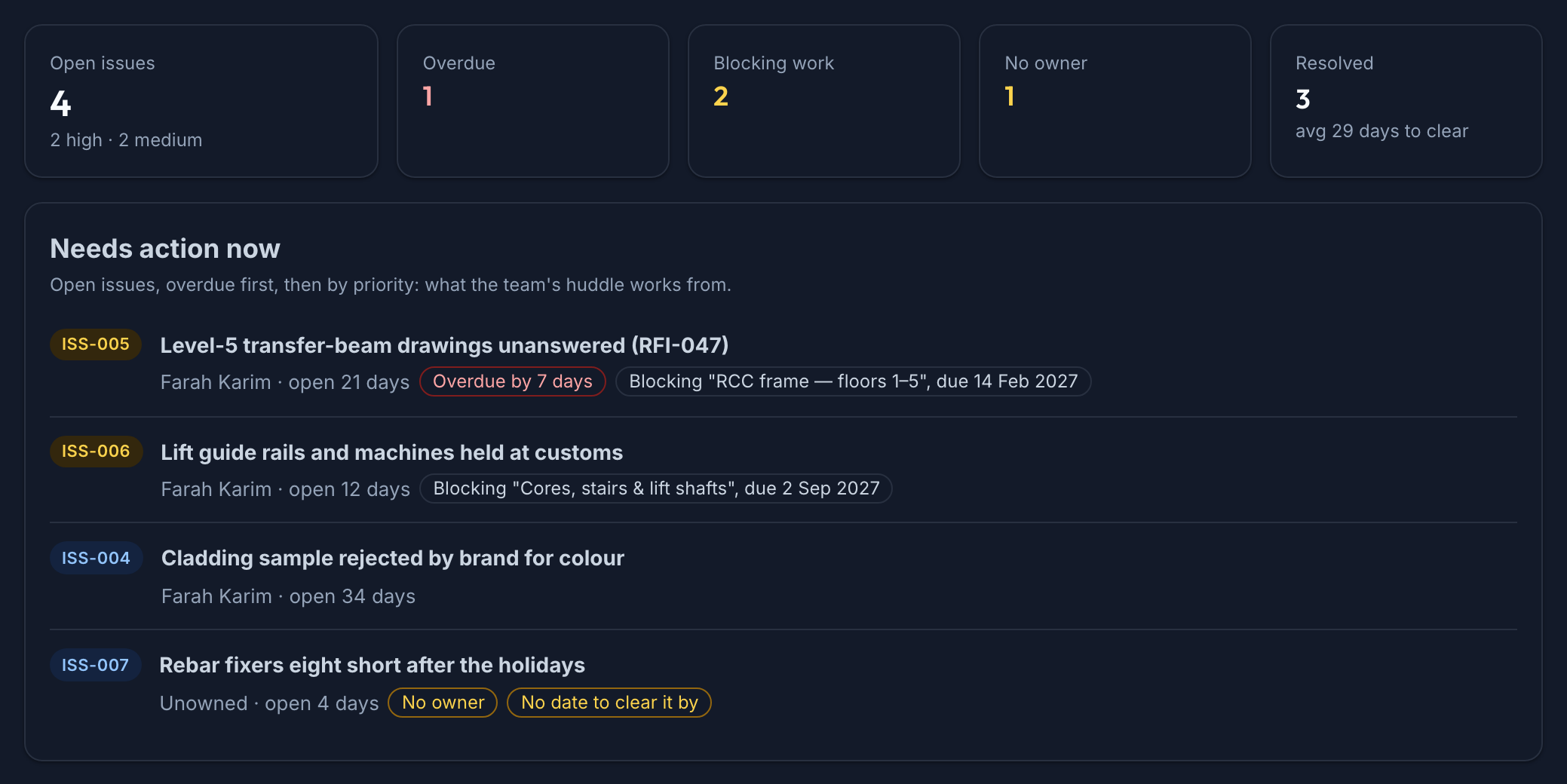
Reading the screenshot: 4 open (2 high, 2 medium); 1 overdue; 2 blocking work; 1 with no owner; 3 resolved, 29 days to clear on average. Needs action now: ISS-005 Level-5 transfer-beam drawings unanswered (RFI-047), Farah Karim, open 21 days, overdue by 7 days, blocking "RCC frame, floors 1–5". ISS-006 Lift guide rails and machines held at customs, blocking Cores, stairs & lift shafts. ISS-004 the cladding colour. ISS-007 Rebar fixers eight short after the holidays: no owner, no date to clear it by.
✅ Do work the list in order: what's late and blocking first.
❌ Avoid sorting by "date raised". The newest issue isn't the most important one.
2 · The issue log: owner, date, and what it's connected to
The theory: issue log. Each issue has a description, category, priority, one owner, a target date, and its status. Linking it to the risk it came from and the work it blocks shows its real cost.
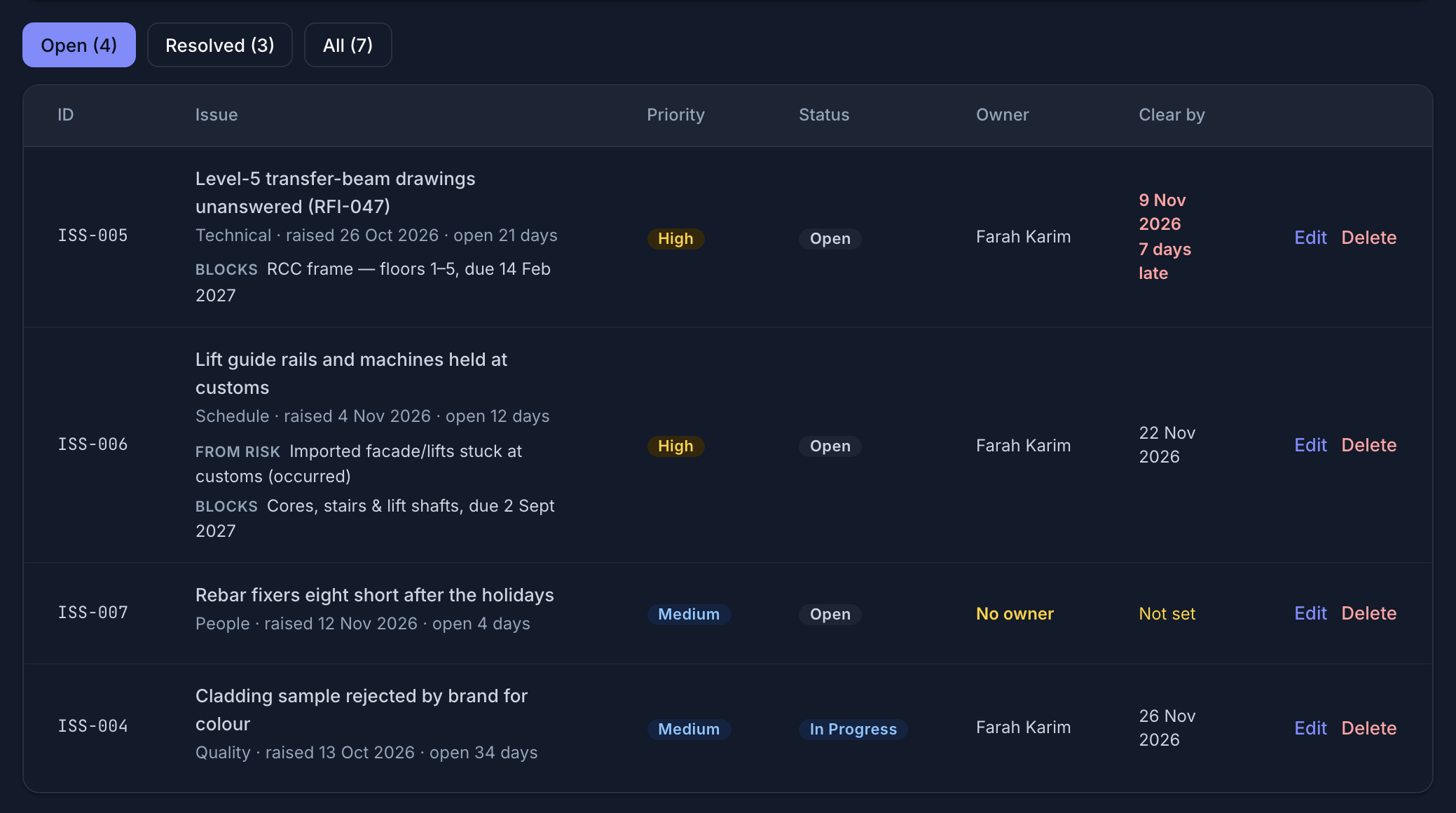
Reading the screenshot: the Open (4) view. ISS-005, technical, raised 26 Oct, Blocks: RCC frame, floors 1–5, High, due 9 Nov 2026, 7 days late in red. ISS-006, From risk: Imported facade/lifts stuck at customs (occurred), Blocks: Cores, stairs & lift shafts, High, Farah Karim, due 22 Nov. ISS-007, People, No owner, clear-by Not set. ISS-004 the cladding colour, In progress, due 26 Nov.
✅ Do mark the risk as occurred when you log the issue it became, so the register stays true.
❌ Avoid an issue owned by a team or a company. Name one person.
3 · Resolved: how each one was cleared
The theory: escalate through governance; record the resolution. The PM clears what's within their authority and escalates the rest, with the impact stated. The resolution goes in the log.
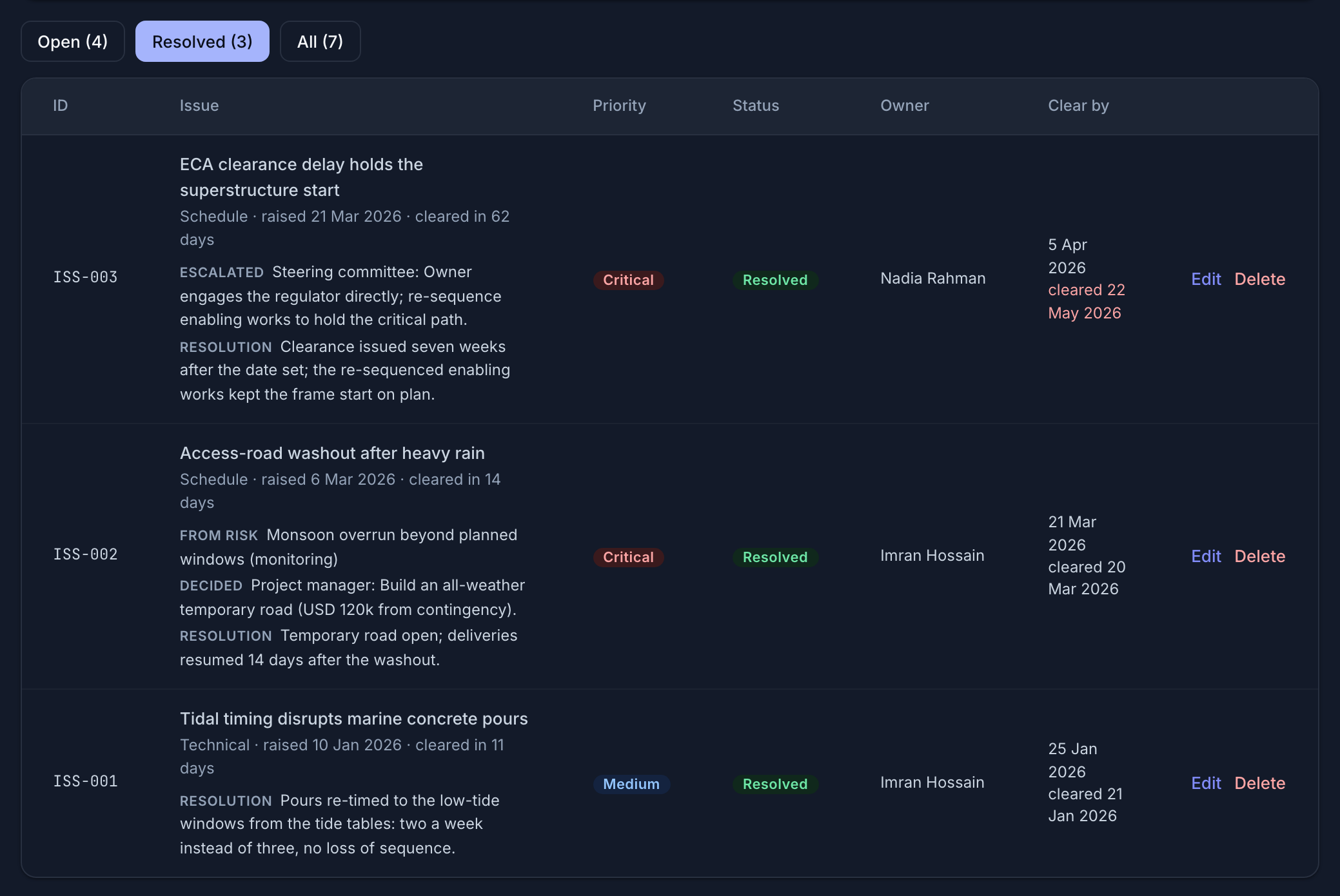
Reading the screenshot: the Resolved (3) view. ISS-003 ECA clearance delay holds the superstructure start, Critical: Escalated: Steering committee: owner engages the regulator directly, cleared 47 days after its date (shown in red). ISS-002 Access-road washout, Critical: From risk: Monsoon overrun beyond planned windows (monitoring), Decided: Project manager: build an all-weather temporary road (USD 120k from contingency), cleared in 14 days. ISS-001 Tidal timing: pours re-timed to low tide, cleared in 11 days.
✅ Do write what fixed it. That's what the lessons-learned review will need.
❌ Avoid closing an issue as "resolved" with nothing written. Nobody can learn from that later.
Best practices & pitfalls
- Do keep issue vs risk clear: a risk might happen, an issue has.
- Do give every issue one owner and a date, at the moment it's logged.
- Do clear impediments yourself when you can; it's the fastest way a PM adds value.
- Do escalate early, through the defined path, when it's beyond your authority.
- Pitfall: an issue log that nobody reviews. Work it in the team's cadence.
- Pitfall: escalating something you could have decided yourself. That's passing it up, not managing it.
On the PMP exam
Know issue vs risk (and that a risk that occurs becomes an issue), the issue log as the artefact, and the PM's servant-leader duty to remove impediments. In agile, impediments are raised in the daily stand-up and the scrum master or team lead clears them. In scenarios, the best answer usually acts on the blocker: talk to the person who can clear it, then escalate through governance if that fails. Logging it and waiting is wrong; going over someone's head on the first day is wrong too. "RAID" (Risks, Assumptions, Issues, Dependencies) may appear as a combined log.