
Align stakeholder expectations
In the app: Project → Stakeholders → Register
PMP ECO · People (33%) · Task P5. For each stakeholder, know where their engagement is and where you need it to be — and close the gap deliberately.
What it is
Once stakeholders are identified and prioritised, alignment is about attitude: is each one Unaware, Resistant, Neutral, Supportive, or Leading today — and where does the project need them? The current → target gap drives the engagement strategy. PMBOK® 8e captures this with the Stakeholder Engagement Assessment Matrix (C = current, D = desired).
Why it matters
- Not every stakeholder needs to love the project — some only need to move from Resistant to Neutral so they stop blocking it. Naming the target prevents over- or under-investing.
- The gap is the actionable part: it converts "manage stakeholders" into specific moves.
Where you do it in VanillaPM
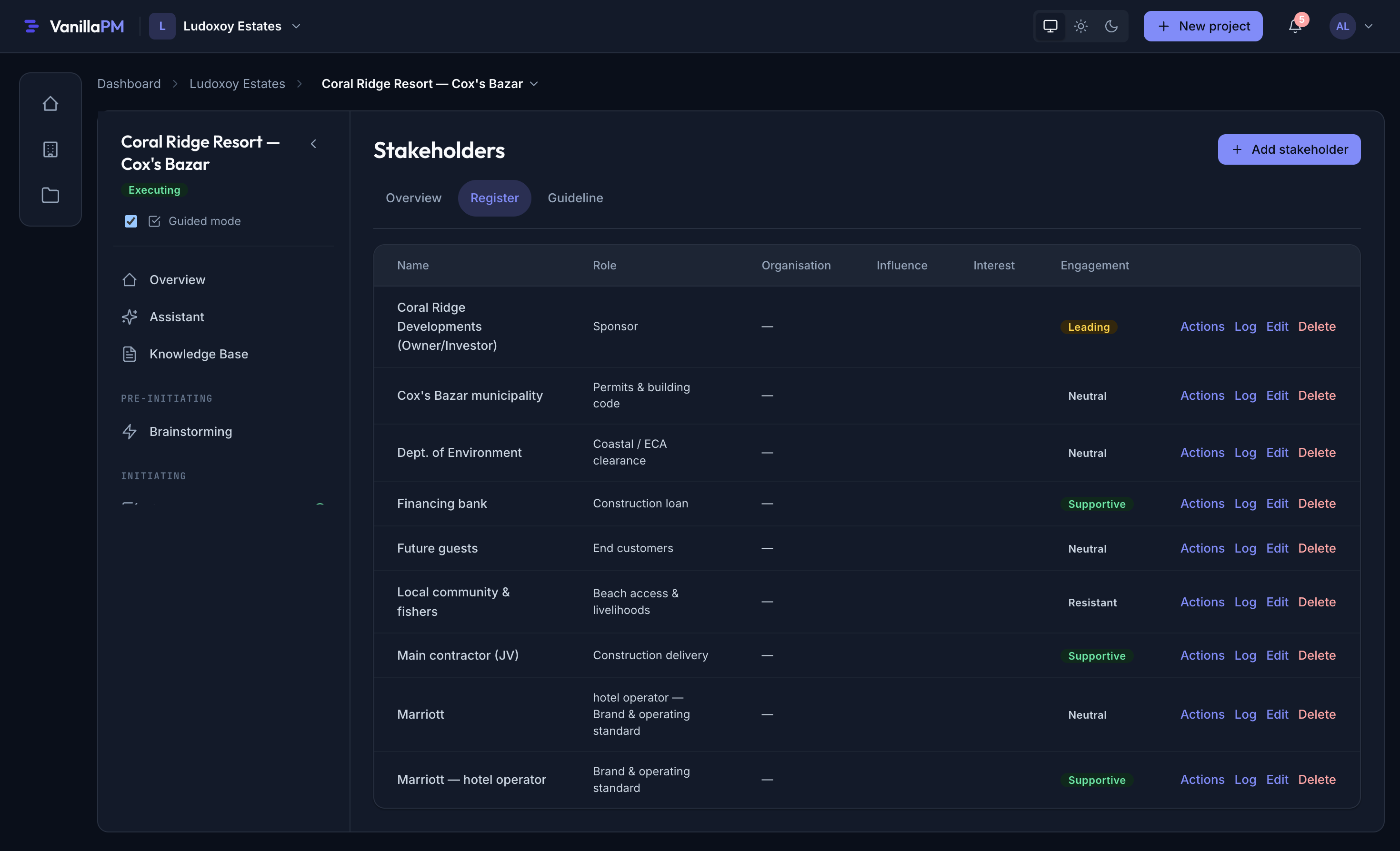
On the Stakeholders → Register, open a stakeholder and set their current engagement level and the target you need — the register's Engagement column shows the current level at a glance, and each gap gets an owner and an action (per-stakeholder Actions). The current→target thinking is the Stakeholder Engagement Assessment Matrix, explained on the Stakeholders Guideline.
Walked example — Coral Ridge Resort
Coral Ridge's targets are pragmatic, not uniform:
| Stakeholder | Current | Target | The move |
|---|---|---|---|
| Local community & fishers | Resistant | Neutral | Beach-access plan + local hiring commitment |
| Dept. of Environment | Neutral | Supportive | Early, transparent ECA monitoring data |
| Marriott (operator) | Supportive | Leading | Involve in fit-out standard sign-offs |
| Owner / investor | Leading | Leading | Maintain — monthly steering |
The community doesn't need to champion the resort — moving them off Resistant so the beach-access dispute doesn't stop work is the win.
The artefact
- Engagement assessment (current → target) — per-stakeholder attitude gap, with the strategy and actions to close it.
Best practices & pitfalls
- Do set realistic targets — "Neutral" is a legitimate goal for an opponent.
- Do re-assess after major events (a clearance win, a community meeting).
- Pitfall: aiming everyone at "Leading" — you'll spread engagement effort too thin and miss the one gap that actually threatens delivery.
On the PMP exam
Know the five engagement levels and the current-vs-desired matrix. Situational questions often hand you a resistant-but-powerful stakeholder; the strong answer targets a specific, modest shift and picks a tailored engagement action — not a blanket "communicate more".