
Evaluate the external environment
In the app: Project → Environment
PMP ECO · Business Environment (26%) · Task B8. Watch what's changing outside the project, measure it against what the plan assumed, and route each material change to a risk, a change or a plan update before it arrives as a surprise.
What it is
A long project outlives the assumptions it started with. Enterprise environmental factors (regulation, the economy, markets, technology, politics, climate) move while the work goes on. The task is to:
- Scan across the whole environment. PESTLE is a checklist for not missing a whole area: Political, Economic, Social, Technological, Legal, Environmental.
- Measure what you can. For each factor that matters, pick an indicator, write down the value the plan assumed, and set a threshold that means "act". A trend you can see beats a worry you can't size.
- Assess the impact on scope, schedule, cost and the business case.
- Route it: a risk (it might hit us), a change request (it has changed what we must deliver, B3), a plan update, or the business case (it changes the value, Pr3). Some factors are opportunities.
- Review on a cadence; the outside world doesn't wait for your reporting cycle.
Why it matters
- Plans are built on assumptions about the outside world. When the world moves, the plan is wrong whether or not anyone updates it.
- A threshold turns noise into a decision. "Steel is getting expensive" is a feeling; "rebar is 14.7% over the estimate and past the line we set" is a reason to act.
- Blind spots are the dangerous ones. The factor nobody is watching is the one that surprises you.
Where you do it in VanillaPM
- Environment opens on the scan:
- tiles: factors watched (how many with a measured indicator), past a threshold, high impact, not routed, reviews overdue, and PESTLE blind spots;
- the PESTLE strip: how many factors in each area, with empty areas highlighted;
- Needs action: thresholds crossed (with no response, or with one that needs checking), high-impact factors not routed anywhere, opportunities past their threshold, overdue reviews.
- Each factor shows what was observed, the impact on the project, where it was routed (and the linked risk, change request and assumption), and its indicator: the latest value, the change against the plan, a trend line with the plan value and the threshold, and when it crossed. Add a reading to update it.
Walked example — Coral Ridge Resort
Coral Ridge watches six factors; four have measured indicators.
- Rebar price: the estimate assumed BDT 95,000 a tonne; the team said act at 105,000. It crossed in October and is now 109,000, 14.7% over the plan. It has been assessed, but not routed: no risk, no change, no plan update. With floors 6–10 still to buy, that's the first thing to fix.
- Coastal-setback regulation: high impact (it could force a redesign of the beachfront deck), but not routed and not reviewed for 45 days. It belongs on the risk register now, while it's still a consultation.
- Heavier monsoons: rain days in the wettest month have risen every season since 2022, from 15 to 21, past the threshold of 18. It is routed: RISK-005 (accepted, with float), the 2026 season's re-baseline (CR-03), and assumption ASM-003 (about 10 weeks a year). The flag says check the response still holds: if the trend continues, ten weeks of float may not be enough.
- Tourism occupancy in Cox's Bazar: the business case assumed 58%; it's 70%, past 65. That's an opportunity, routed to the business case and the early-opening opportunity (RISK-009, B5).
- Interest rates are under watch, below the threshold, tracked as RISK-008.
And the strip shows two blind spots: nothing political and nothing social is being scanned.
The workspace — the theory behind each screen
Every screenshot is the actual sample project, not a mock-up.
1 · The scan: coverage, thresholds, what needs action
The theory: environmental scanning. Look across the whole environment, not only where you already expect trouble, and act on what's material.
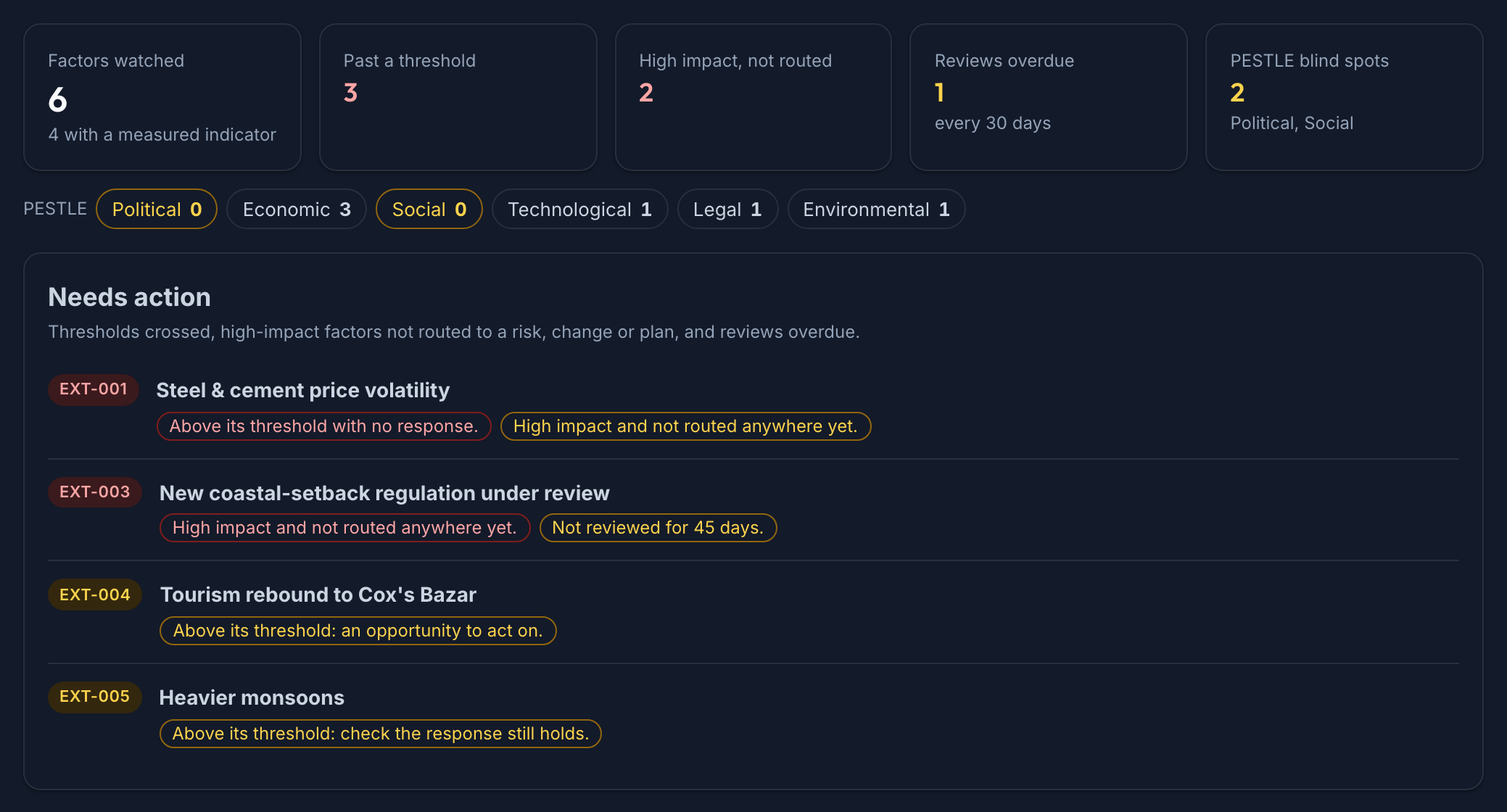
Reading the screenshot: 6 factors watched, 4 with a measured indicator. 3 past a threshold. 2 high impact, not routed. 1 review overdue (every 30 days). 2 PESTLE blind spots: Political, Social. The strip: Political 0, Economic 3, Social 0, Technological 1, Legal 1, Environmental 1. Needs action: EXT-001 steel (above its threshold with no response, high impact and not routed), EXT-003 coastal setback (high impact and not routed, not reviewed for 45 days), then EXT-004 tourism (an opportunity to act on) and EXT-005 monsoons (check the response still holds).
✅ Do check every PESTLE area, even if you decide nothing there matters.
❌ Avoid a watch-list built only from the risks you already know.
2 · Past the threshold, with nowhere to go
The theory: assess the impact and respond. A material change needs a response, not just a note.
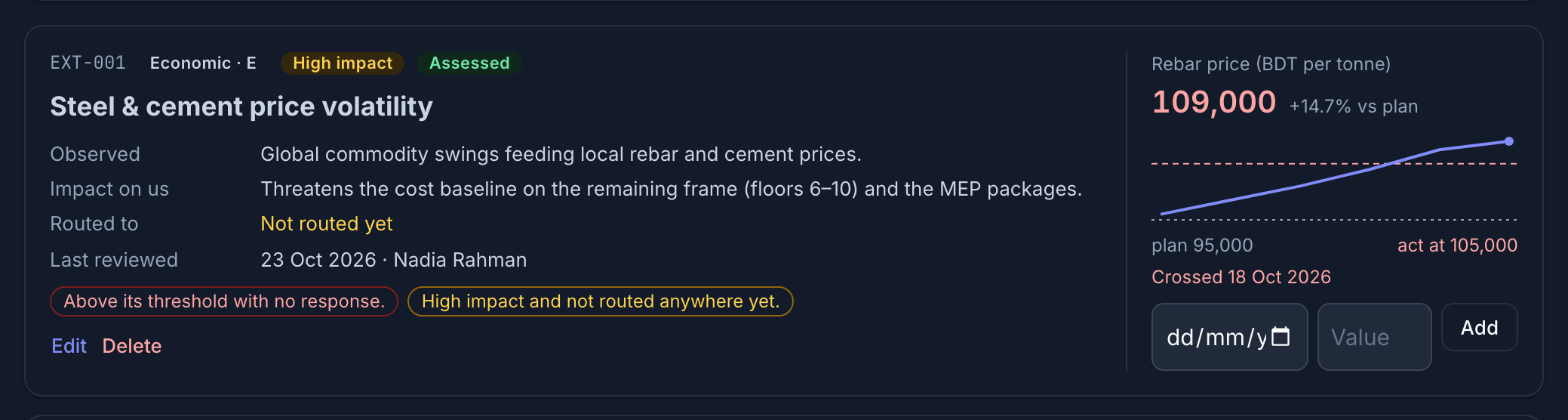
Reading the screenshot: EXT-001 Steel & cement price volatility, Economic · E, High impact, Assessed. Impact on us: the cost baseline on the remaining frame (floors 6–10) and the MEP packages. Routed to: Not routed yet. The indicator: rebar price 109,000 BDT per tonne, +14.7% vs plan, the line rising through the dashed threshold; plan 95,000, act at 105,000, crossed 18 Oct 2026.
✅ Do set the threshold when you add the factor, so "act" is decided before the pressure is on.
❌ Avoid marking a factor "assessed" without routing it anywhere.
3 · Routed, and still watched
The theory: feed the environment into risk, change and the plan. A factor connects to the risk it creates, the change it caused and the assumption it tests.
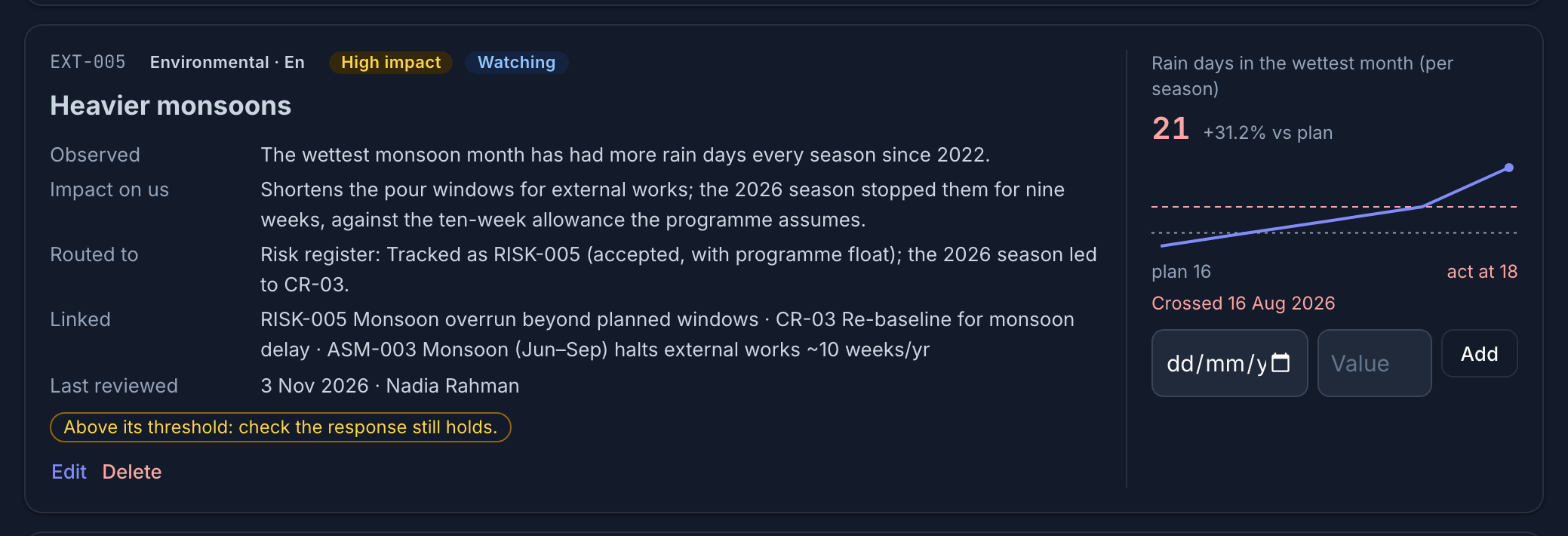
Reading the screenshot: EXT-005 Heavier monsoons, Environmental · En, High impact. Impact on us: the 2026 season stopped external works for nine weeks, against a ten-week allowance. Routed to: Risk register: tracked as RISK-005 (accepted, with programme float); the 2026 season led to CR-03. Linked: RISK-005, CR-03 Re-baseline for monsoon delay, ASM-003 Monsoon (Jun–Sep) halts external works ~10 weeks/yr. The indicator: rain days in the wettest month, 21, +31.2% vs plan, rising every season; crossed 16 Aug 2026. The flag: check the response still holds.
✅ Do link a factor to the assumption it tests, so the assumption gets revisited.
❌ Avoid treating "it's on the risk register" as the end of the matter. Trends keep moving.
4 · An opportunity
The theory: opportunities are environmental changes too. A favourable shift can be exploited or enhanced, through the business case.
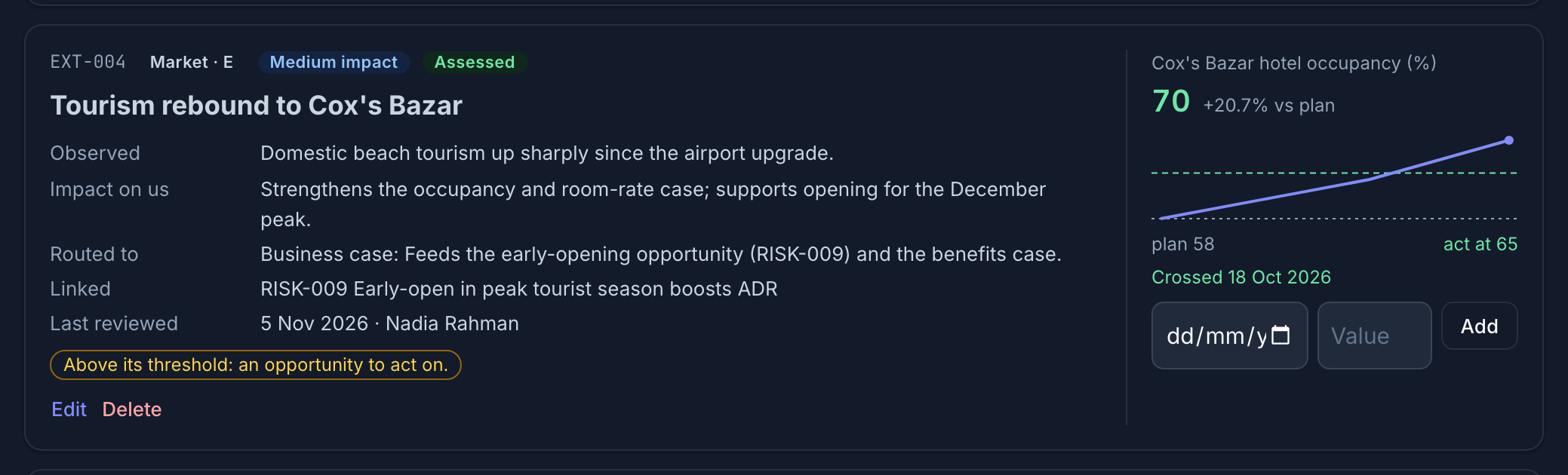
Reading the screenshot: EXT-004 Tourism rebound to Cox's Bazar, Market · E, Medium impact, Assessed. Routed to: business case: feeds the early-opening opportunity (RISK-009) and the benefits case. The indicator: hotel occupancy 70%, +20.7% vs plan (58%), past its threshold of 65, in green because a rise helps.
✅ Do scan for upside as well as downside.
❌ Avoid only ever reporting external change as bad news.
Best practices & pitfalls
- Do give each material factor an indicator, a plan value and a threshold.
- Do route every material change: risk, change request, plan update or business case.
- Do review the scan on a cadence, and after any big external event.
- Pitfall: treating the environment as fixed at kick-off.
- Pitfall: a scan that only covers the areas you're comfortable with. Blind spots are where the surprises come from.
On the PMP exam
Know enterprise environmental factors, PESTLE (and similar scans), and that the PM must monitor the external environment throughout and assess the impact of changes on scope, schedule, cost and the business case. The best answers evaluate the impact and take it through the right path: update the risk register, raise a change request, update the plan or the business case, and inform the sponsor. Staying rigid to the original plan after a material external change is the trap.