
Develop the integrated PM plan
In the app: Project → Documents / Knowledge Base
PMP ECO · Process (41%) · Task Pr1. Bring every subsidiary plan and baseline together into one coherent plan for how the project will be executed, monitored, and controlled.
What it is
The project management plan (PMP) is the master plan that integrates all the subsidiary plans — scope, schedule, cost, quality, resources, communications, risk, procurement, stakeholder — plus the three baselines (scope, schedule, cost) and the chosen development approach (predictive, agile, or hybrid). Integration is the PM's signature act: making the parts fit into a consistent whole. It becomes the single source of truth that changes are measured against.
Why it matters
- Sub-plans written in isolation contradict each other — a schedule that ignores the procurement lead time, a cost plan blind to the risk reserve. Integration catches those.
- The PMP defines how change is controlled; without it, "the plan" is whatever the last email said.
Where you do it in VanillaPM
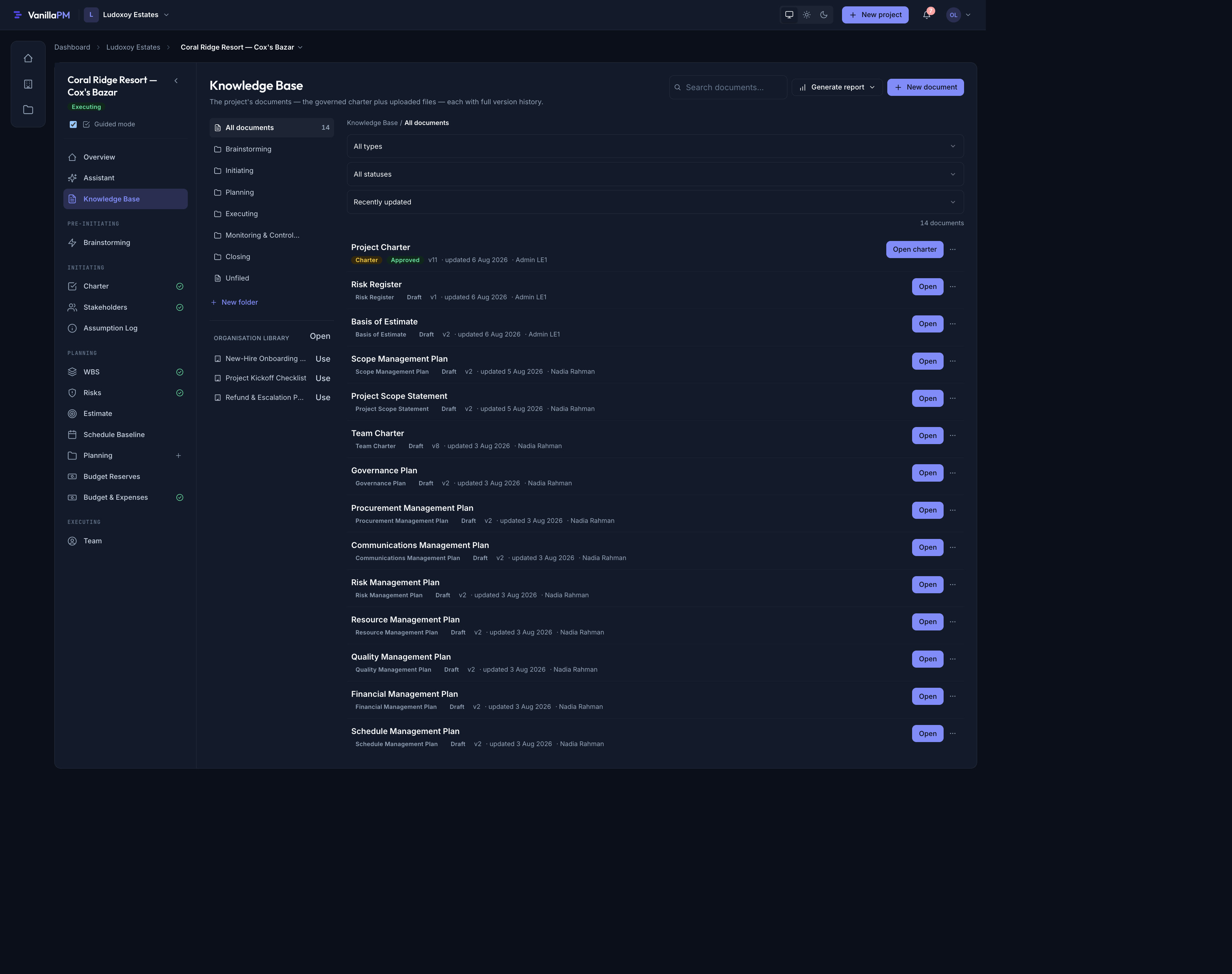
The charter authorises the project; the governed management plans (scope, schedule, cost, quality, risk, procurement, communications, stakeholder, governance) live as versioned documents in the Knowledge Base, and the development-approach settings (project type, parameters) tailor which plans a given project must produce. Together they are the integrated plan set.
Walked example — Coral Ridge Resort
Coral Ridge is predictive (a construction build), so its plan set is the full governed suite, each inheriting from the charter: the scope plan (WBS), the schedule plan (baselined Gantt), the cost plan ($48M with a $2.4M contingency and $1.2M management reserve), plus quality, risk, procurement, communications, and governance plans. The baselines are set together — you can't baseline the schedule without the scope and the cost — which is exactly the integration point.
The artefact
- Integrated project management plan — the charter + all subsidiary plans + the three baselines + the development approach, kept consistent and versioned.
Best practices & pitfalls
- Do tailor the plan to the project — a small internal project doesn't need every subsidiary plan; a $48M build does.
- Do baseline scope, schedule, and cost together, and only after they're consistent.
- Pitfall: a shelf-ware plan. If the PMP isn't what you measure change and progress against, it isn't integrated — it's decoration.
On the PMP exam
Integration is where the PM's authority lives. Expect questions on tailoring the development approach, the PMP as the baseline for integrated change control, and keeping subsidiary plans consistent. When a scenario adds work or shifts an approach, the answer routes through the plan, not a side deal.