
Lead the project team
In the app: Project → Team (Overview · RACI · Health · Recognition)
PMP ECO · People (33%) · Task P3. Build, develop and support a team that can deliver: clarify who does what, grow the team through its stages, and keep it healthy.
What it is
Leading a team spans forming it (roles and responsibilities), developing it (skills, cohesion, the Tuckman stages), and supporting it (removing blockers, recognising good work, watching morale). PMBOK® 8e frames the modern PM as a servant leader. Success belongs to the team, and the PM's job is to create the conditions for it.
Management tracks process and schedule. Leadership looks after people, trust and a shared vision. You need both, but on the exam and on a real site, the leadership half is the one that gets skipped.
Why it matters
- Role ambiguity is a top cause of dropped work and duplicated effort. A clear responsibility assignment prevents both.
- Teams move through predictable stages. Recognising storming as normal, not as failure, lets a PM coach through it instead of panicking.
- Recognition and health signals are leading indicators. They move before the schedule does.
Where you do it in VanillaPM
Everything lives in the project's Team workspace:
- Team → Overview shows the team's Tuckman stage, the roster, the latest health pulse and recent kudos on one screen.
- Team → RACI assigns Responsible / Accountable / Consulted / Informed for every task.
- Team → Health runs an anonymous pulse on clarity, safety, workload and morale.
- Team → Recognition is the kudos feed, each one optionally tagged with a team value.
- Team → Guideline carries the theory behind all of it: RACI rules, Tuckman's ladder, and the sources of power.
Walked example — Coral Ridge Resort
Coral Ridge fields a cross-discipline team: Nadia (PM), Farah (architect), Imran (site engineer), Tanvir (MEP lead) and Sadia (quantity surveyor). During piling and the first monsoon the team was storming: the piling method, the pour schedule and the glazing budget all turned into open disagreements (you can see them, resolved, in the conflict log). Now, in the superstructure phase, the team is performing. The RACI is clear, the pulse is mostly strong, and the kudos feed is active. One number stands out, though: workload scores 2.67 out of 5. That is the PM's next job.
The workspace — the theory behind each screen
Each screen below answers one leadership question. Every screenshot is the actual sample project, not a mock-up.
1 · Know which stage the team is in
The theory: Tuckman's ladder. Teams grow through five stages, and each one needs a different style of leadership:
| Stage | What it looks like | What the PM does |
|---|---|---|
| Forming | Polite, unsure, waiting for direction | Set direction; clarify roles and the team charter |
| Storming | Conflict surfaces as people push boundaries | Facilitate openly; keep it safe; resolve, don't suppress |
| Norming | Agreements settle; trust grows | Reinforce the norms; let the team self-organise |
| Performing | High trust, high output | Remove impediments, protect focus, get out of the way |
| Adjourning | The work winds down | Recognise contributions, capture lessons, close out well |

Reading the screenshot: the team is marked Performing, and the app shows the matching guidance underneath: remove impediments, protect focus, get out of the way. The stage is a judgement call the PM records with Set stage, so it should change when the team changes. A new member joining, or a big scope change, can send a performing team back to storming.
✅ Do expect storming, and treat it as a stage to coach through.
❌ Avoid marking a team performing because the schedule looks fine. Check the health pulse
first (section 3).
2 · Make ownership unambiguous
The theory: one Accountable per row. A RACI matrix has four roles:
- R — Responsible does the work. There can be several.
- A — Accountable owns the outcome and signs it off. Exactly one per task.
- C — Consulted gives input before or during the work (two-way).
- I — Informed is kept up to date on progress (one-way).
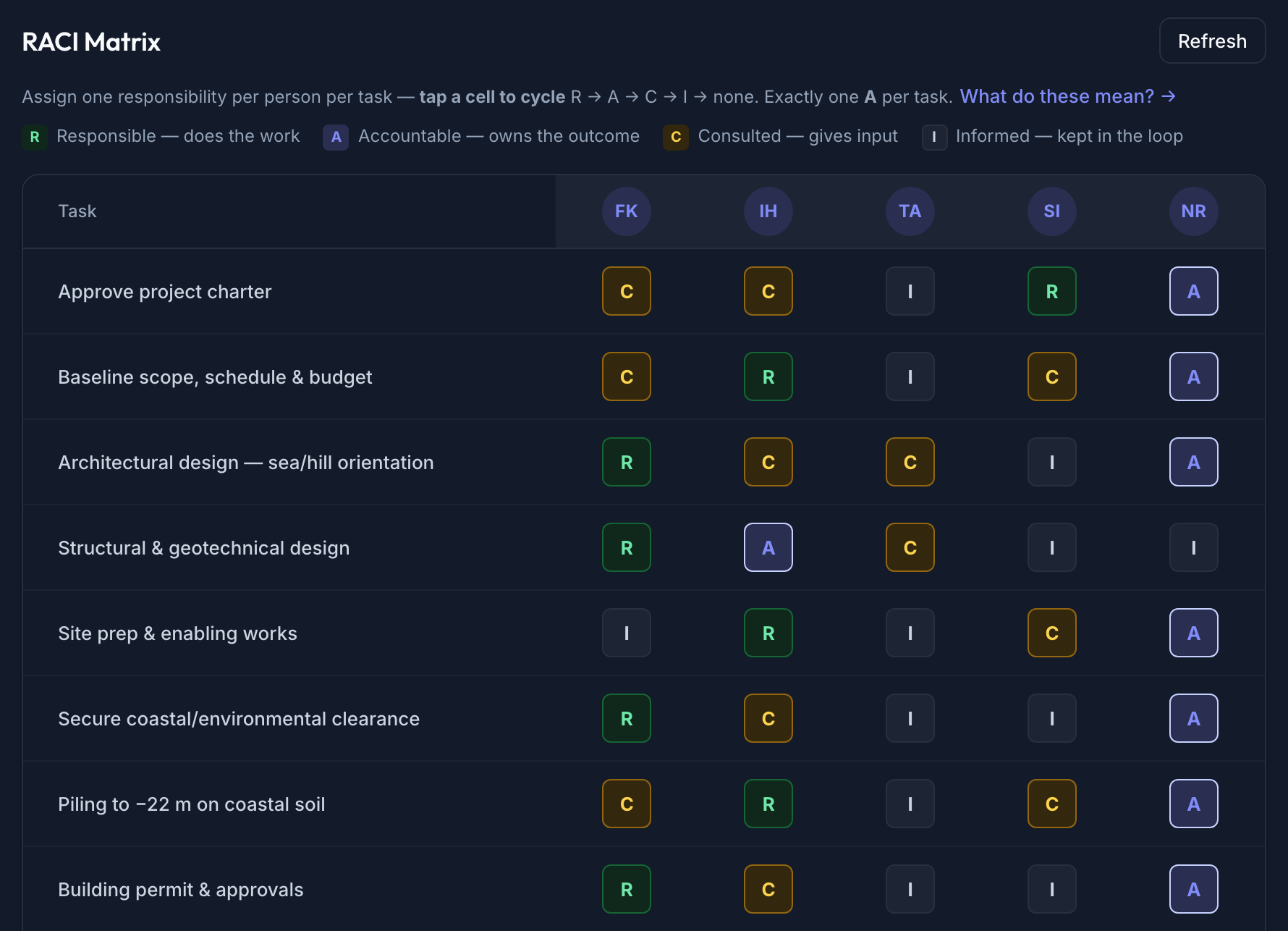
Reading the screenshot: the columns are the five team members, FK Farah (architect), IH Imran (site engineer), TA Tanvir (MEP lead), SI Sadia (QS) and NR Nadia (PM). Every row has exactly one A. Nadia owns most outcomes as PM, but not all of them: on Structural & geotechnical design, Imran is Accountable because the site engineer answers for buildability, while Farah does the work. Read the Piling row as a sentence: Imran does it, Nadia owns it, Farah and Sadia are consulted (design and cost), and Tanvir is kept informed.
✅ Do read each row as a sentence. If you can't say who signs it off, it has no real A.
❌ Avoid consulting everyone on everything. Too many C's turn every decision into a meeting.
3 · Read the team's health before the schedule does
The theory: leading indicators. Morale, clarity and workload move before the schedule slips. An anonymous pulse catches drift while it's still cheap to fix. People answer honestly only when they can't be identified, so the results stay hidden until at least three people have responded.
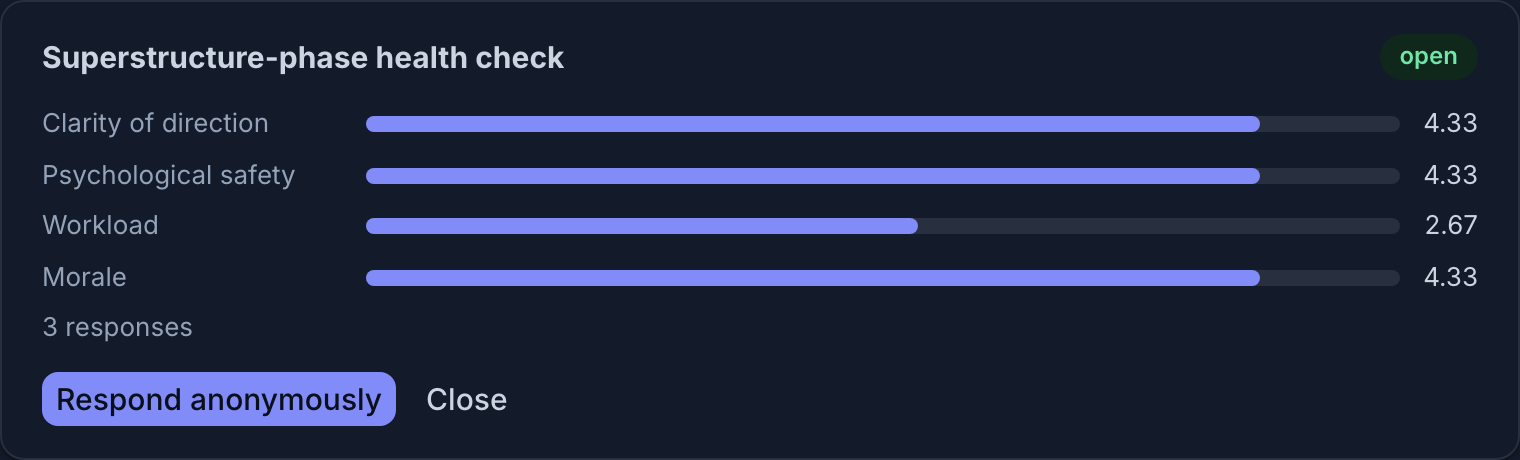
Reading the screenshot: clarity, psychological safety and morale all sit at 4.33 out of 5. That's a performing team. Workload is the outlier at 2.67. The team knows where it's going and feels safe saying so, but it's stretched. The servant-leader response is to look at the Workload tab, find who is over capacity, and remove work or add help. A speech about resilience is not the answer.
✅ Do discuss the results with the team, then close the pulse and open a new one next cycle.
❌ Avoid pulse fatigue. More than about one a month and the answers stop being honest.
4 · Recognise specific work, publicly
The theory: reward and referent power. French & Raven name five sources of power: legitimate (your position), reward, coercive, expert (knowledge) and referent (respect). Recognition builds the reward and referent kinds, which are the ones that last. Coercive power destroys psychological safety.
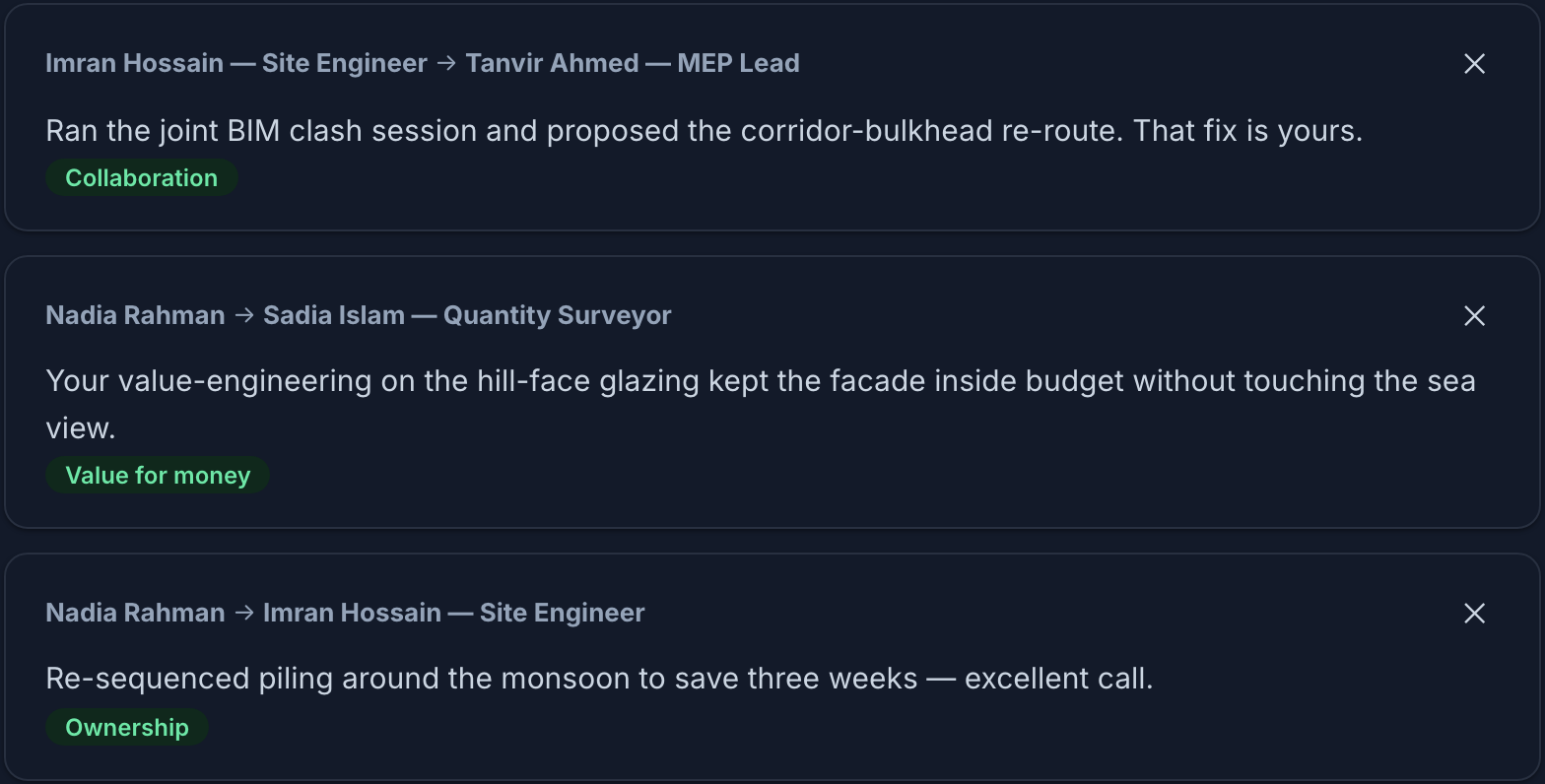
Reading the screenshot: each kudo names a specific contribution: three weeks saved on piling, the facade kept inside budget, the duct re-route that closed the MEP conflict. Each one is tagged with a team value (Ownership, Value for money, Collaboration), which reinforces the culture the team charter agreed. Note the top one: Imran thanks Tanvir. Recognition isn't only top-down, and a team where peers recognise each other is close to performing.
✅ Do be specific. "Great job, everyone" teaches nothing; "the bulkhead re-route" does.
❌ Avoid recognising only the loudest people. Check that the feed reaches every discipline.
Best practices & pitfalls
- Do ensure exactly one Accountable (A) per row. Two A's means no one is accountable.
- Do treat storming as a stage to coach through, not a problem to hide.
- Do read the health pulse alongside the schedule, and act on the lowest score.
- Do recognise contribution specifically and publicly; it compounds.
- Pitfall: a RACI where everyone is Consulted on everything. Decisions stall.
- Pitfall: leading with coercive power. It gets compliance and costs you trust.
On the PMP exam
Expect heavy servant-leadership framing. The best answers empower the team, remove impediments, and coach rather than command. Know the Tuckman stages and what the PM does in each, the RACI letters and the one-A rule, and the five sources of power (prefer expert and referent). When a question describes confusion over who owns something, clarifying responsibility (RACI) is often the right first move. When it describes a team that is struggling, look for the answer that finds the cause (talk to the team, check workload) before the one that escalates or reassigns people.