
Establish project governance
In the app: Project → Planning → Governance (Overview · Plan · Decisions)
PMP ECO · Business Environment (26%) · Task B1. Decide who decides what, write it down with numbers, and check that decisions are actually taken at the level the plan says.
What it is
Governance is the framework that keeps a project accountable to the organisation that pays for it:
- Decision rights: which decisions the project manager takes, which go to a steering committee or change control board, and which belong to the owner or sponsor. Good governance states them as thresholds, in money and in time, so nobody has to guess.
- Escalation paths: how a decision beyond someone's authority reaches the person who has it, and how fast.
- Phase gates (stage gates): go / no-go points between phases, each with criteria and a decision. A gate can pass, pass with conditions, or hold.
- Oversight: the steering committee, its cadence, the reports it reads (Pr9), and the change control board (B3).
- Records: a decision log, so who decided what, when and why is auditable later.
Governance should be tailored: heavy enough for the risk and value at stake, light enough that routine decisions don't wait a month for a committee.
Why it matters
- Unclear decision rights stall projects. Either nobody decides, or the wrong person decides and it gets reopened.
- Decisions taken at the wrong level don't hold. A committee that defers a decision it doesn't own hasn't decided anything; the owner can overrule it later.
- Gates that only ever pass are rubber stamps. A real gate can stop a phase that isn't ready.
Where you do it in VanillaPM
- Planning → Governance → Plan is the governed governance plan: structure, decision thresholds, phase gates, change-control workflow.
- Governance → Overview turns the plan into something checkable:
- Decision rights: the three levels, with the thresholds and how many decisions each has taken;
- an authority check that flags any decision linked to a change request whose impact needs a higher level than the one recorded;
- the phase gates with their criteria, status and dates;
- Recent decisions, with the level that took them.
- Governance → Decisions is the decision and escalation log: each entry records the level it was decided at, the date, and (where it decides a change) the change request.
Free download: Decision log template (Excel, CSV).
Walked example — Coral Ridge Resort
Coral Ridge's governance plan sets three levels:
- Project manager: delivery inside the approved plan, and contingency draws up to USD 250k per change.
- Steering committee (owner, PM, operator): any baseline change, larger contingency draws, brand or regulatory deviations, and the phase gates.
- Owner board: anything above 10% of the budget, and any change to the opening date.
The log shows it working. The monsoon washed out the access road; a USD 120k temporary road was inside the PM's limit, so Nadia decided it on site the same day. The hurricane-rated glazing (USD 350k) and the marine-grade rebar (USD 300k) were above it, so the steering committee decided them. Gates G1 (design freeze) and G2 (permits secured) have passed; G3 (structure complete) is next.
The finding is CR-05, the extra basement level. The steering committee deferred it. But it adds 45 days, which moves the opening date, and the plan reserves that for the owner board. The committee can't defer a decision it doesn't own: CR-05 has to go up.
The workspace — the theory behind each screen
Every screenshot is the actual sample project, not a mock-up.
1 · Decision rights, gates, and the authority check
The theory: governance framework. Decision rights tie each kind of decision to a level, using thresholds; phase gates control the move from one phase to the next. Both only work if they're checked against what actually happened.
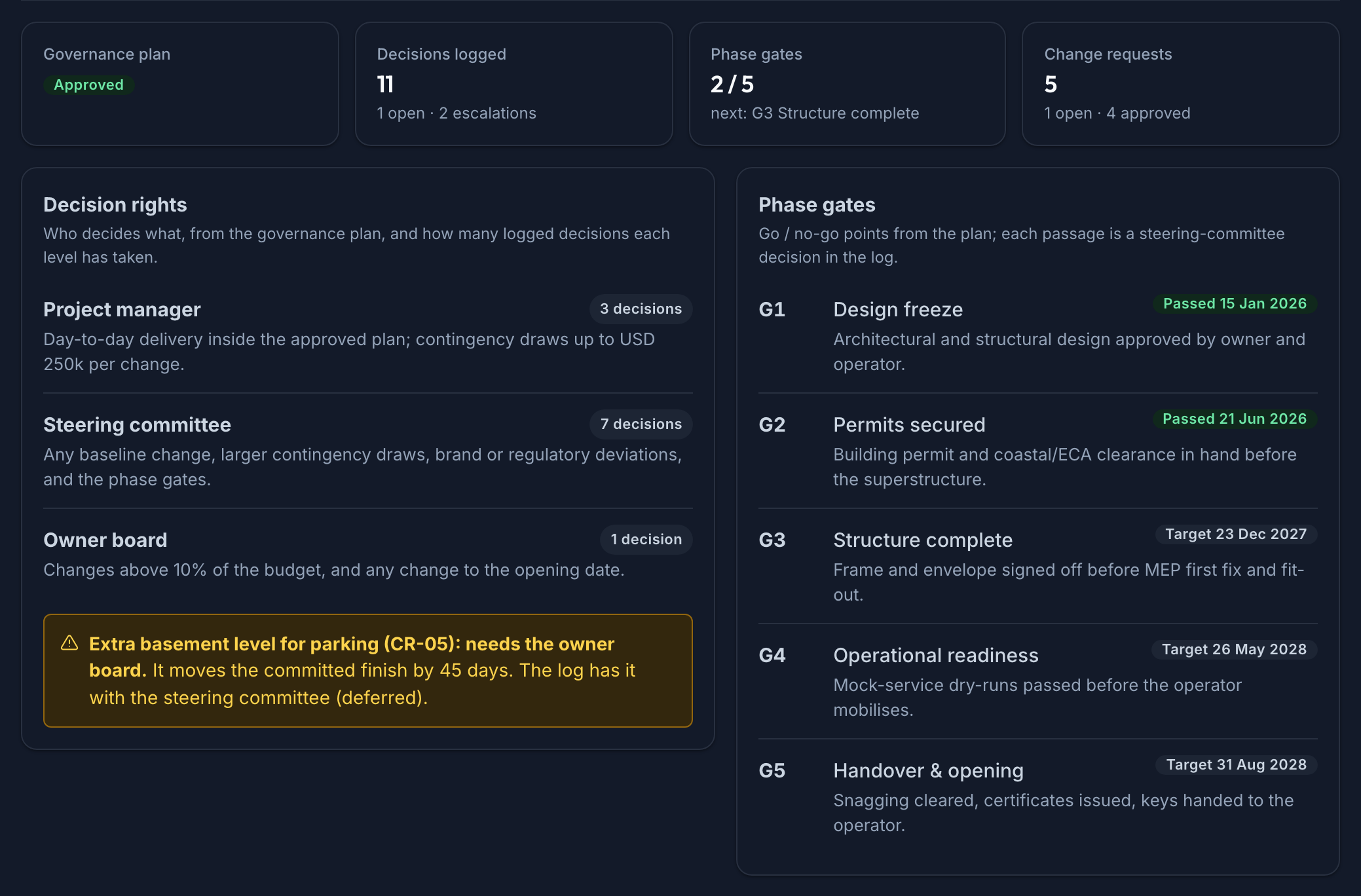
Reading the screenshot: the plan is Approved; 11 decisions logged (1 open, 2 escalations); gates 2 / 5, next G3 Structure complete; 5 change requests. Decision rights: the project manager has taken 3 decisions, the steering committee 7, the owner board 1 (the monsoon re-baseline, CR-03, which moved the opening date). The amber flag: Extra basement level for parking (CR-05): needs the owner board. It moves the committed finish by 45 days. The log has it with the steering committee (deferred). On the right, G1 passed 15 Jan 2026 and G2 passed 21 Jun 2026; G3 to G5 have target dates.
✅ Do write thresholds as numbers: an amount, a number of days, a named date.
❌ Avoid "significant changes go to the sponsor". Nobody agrees on what "significant" means.
2 · The decision and escalation log
The theory: decision log. Every significant decision and escalation is recorded: what, why, the options considered, who decided, at what level, and when. It makes authority auditable, and it stops decisions from being quietly reopened.
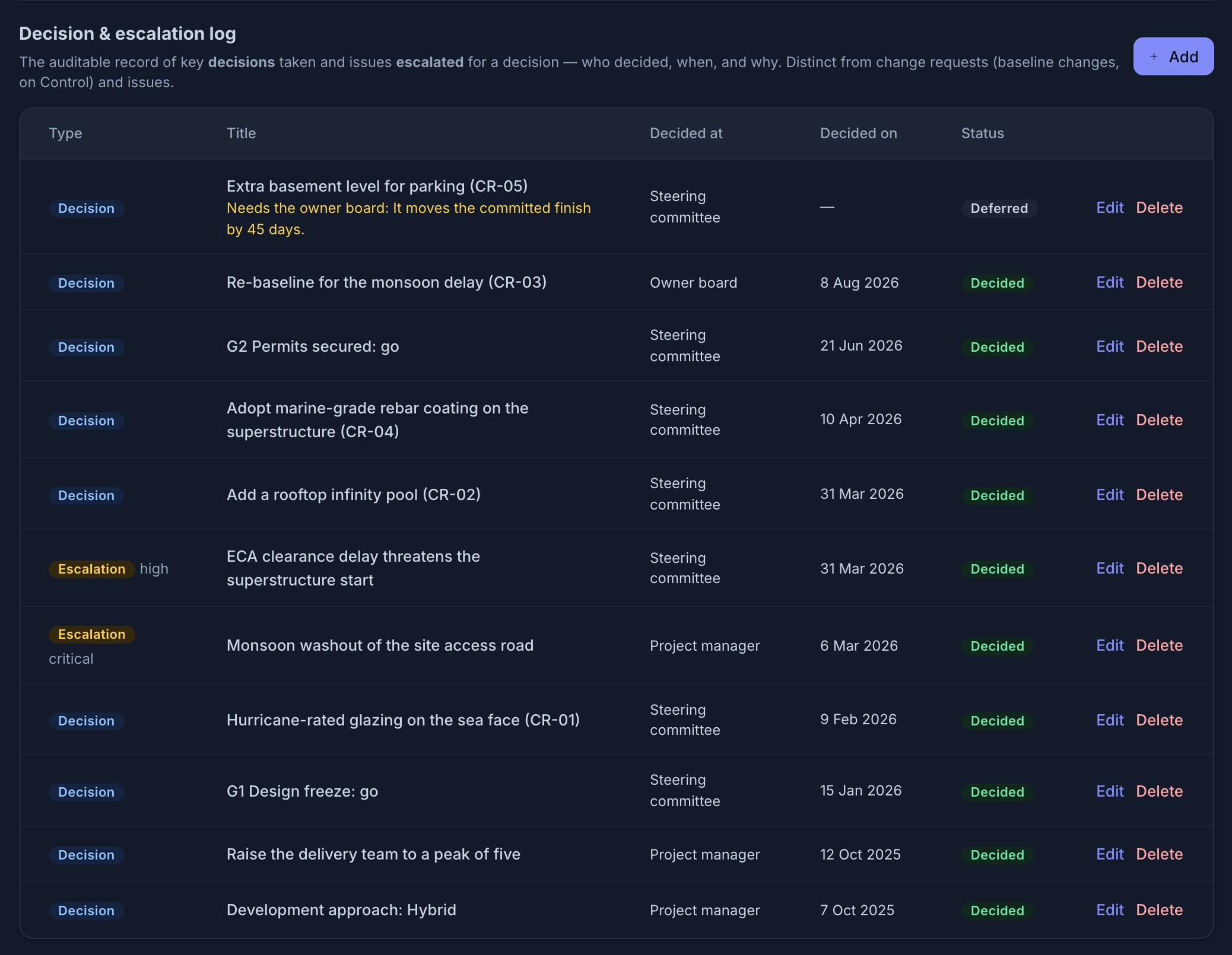
Reading the screenshot: open items first: Extra basement level for parking (CR-05), deferred at the steering committee, with the warning that it needs the owner board. Then the decisions, newest first, each with the level that took it: the monsoon re-baseline (CR-03) (owner board), G2 Permits secured: go (steering committee), marine-grade rebar (CR-04) (steering committee), the ECA clearance escalation (steering committee), the access road washout (project manager, within the limit), down to the development approach at the start.
✅ Do record decisions that were escalated, not only the ones the PM took.
❌ Avoid a log that only says what was decided. The rationale is what saves you in a dispute.
3 · The plan: thresholds and gates, in writing
The theory: the governance plan. It's part of the project management plan (Pr1), approved, and changed only through change control. The thresholds and gates in it are what the overview checks against.
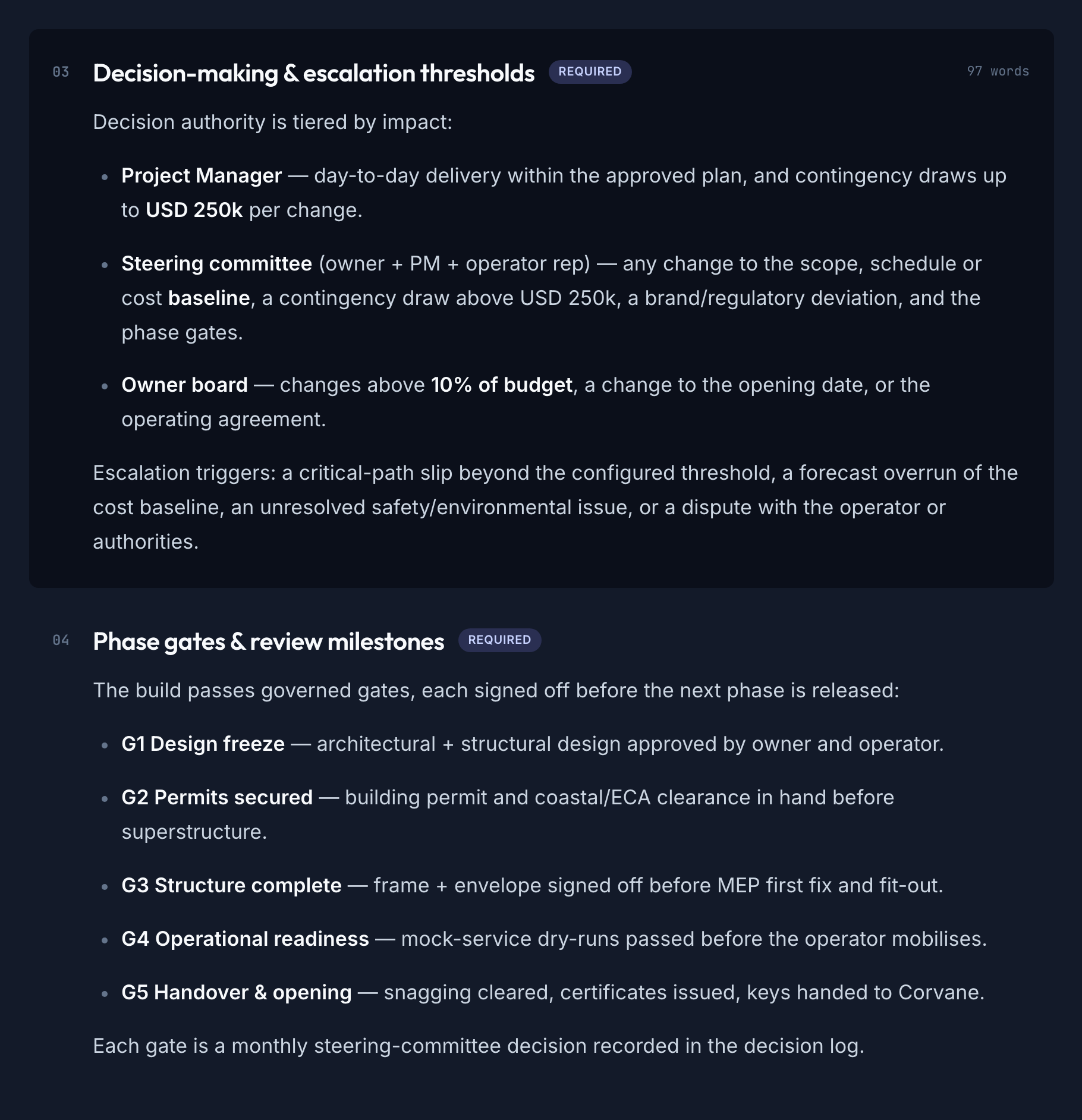
Reading the screenshot: Decision-making & escalation thresholds: the project manager up to USD 250k of contingency per change; the steering committee for baseline changes and larger draws; the owner board above 10% of budget or for any change to the opening date. Escalation triggers are named. Phase gates: G1 Design freeze to G5 Handover & opening, each a steering-committee decision recorded in the log.
✅ Do match governance to the project's size and risk, and say so in the plan.
❌ Avoid governance so heavy that every routine decision waits for the next committee.
Best practices & pitfalls
- Do give the PM real authority, with a number attached, so small decisions are fast.
- Do escalate through the defined path, with the impact stated.
- Do run gates as real go / no-go decisions; "hold" must be a possible answer.
- Pitfall: a committee deciding (or deferring) what belongs to a higher level.
- Pitfall: escalating everything. That's abdication, not governance.
On the PMP exam
Know governance (the framework of authority and oversight), the steering committee, the change control board, phase gates, escalation paths, and PMO types (supportive: templates and guidance; controlling: requires conformance; directive: manages the projects). The best answers escalate appropriately: decide what's within your authority, and send what isn't through the defined path with the impact analysed. Deciding beyond your authority is wrong; so is escalating every routine call.