
Manage and control changes
In the app: Project → Control → Change requests
PMP ECO · Business Environment (26%) · Task B3. Put every change through one door: analyse its impact across the whole project, get it decided by whoever has the authority, update the baselines and plans, and turn it into work.
What it is
Integrated change control is the single process every change goes through:
- Raise a change request. Anyone can.
- Analyse the impact, across the whole project: scope, schedule and cost (the baselines), and also quality, risk, compliance, resources, procurement and stakeholders. A change that looks cheap on cost can be expensive somewhere else.
- Decide, at the right level. The change control board (or whoever the governance plan names, B1) can approve, reject or defer it. A level without the authority can't decide it, and that includes deferring it.
- Update the baselines and plans if approved (Pr1), and communicate the decision.
- Implement and verify: turn it into work, then check it was done as approved.
Two distinctions matter:
- Change control vs change management. Change control governs changes to the project. Change management helps people adopt a change (B7).
- Corrective action vs change request. Bringing the work back in line with the plan is corrective action. Changing the plan itself, its scope, dates or budget, needs a change request.
Why it matters
- Uncontrolled change is how baselines become fiction. Each small addition seems harmless; together they're a different project.
- The cost of a change is rarely only its cost. An extra basement level adds money and days, and also water-table risk, fire-code requirements and pressure on a crew that's already full.
- A decision taken at the wrong level isn't a decision. It gets reopened by the person who actually owns it.
Where you do it in VanillaPM
- Control → Change requests: each request carries its impact on the baselines (days, cost and what pays for it, scope), its impact on other areas (quality, risk, compliance, resources, procurement, stakeholders), and its audit trail.
- Decision needed from shows which level must decide, worked out from the governance plan's thresholds and the change's impact.
- Approve / Defer / Reject record which level decided. VanillaPM refuses a decision from a level below the one the change needs, and writes every decision to the governance decision log.
- Approved changes can re-baseline the plan (Pr1) and be converted to tasks; a deferred change can be reopened for a decision.
Free download: Change request form template (Word, Markdown).
Walked example — Coral Ridge Resort
CR-05 asks for a second basement level for guest and event parking: +45 days and USD 1.8M. The impact analysis goes much further than that:
- Quality: excavating below the water table, where the basement joints already leaked once.
- Risk: dewatering, in ground that turned out softer than surveyed during piling.
- Compliance: car-park ventilation and fire-escape rules.
- Resources: the site crew is already over capacity in January.
- Procurement: a variation to the substructure works, or a new package.
- Stakeholders: more traffic past the community beach access; the operator wants event parking.
The steering committee deferred it pending a parking-demand study. But +45 days moves the opening date, and the governance plan gives that decision to the owner board. When the PM reopens CR-05 and tries to record a steering-committee approval, VanillaPM refuses: the steering committee can't decide it.
By contrast, CR-03 (the monsoon re-baseline, +62 days) went to the owner board, was approved, and produced baseline v3.
The workspace — the theory behind each screen
Every screenshot is the actual sample project, not a mock-up.
1 · Integrated impact analysis
The theory: perform integrated change control. Before anyone decides, assess the change's impact on every part of the plan, not only scope, schedule and cost.
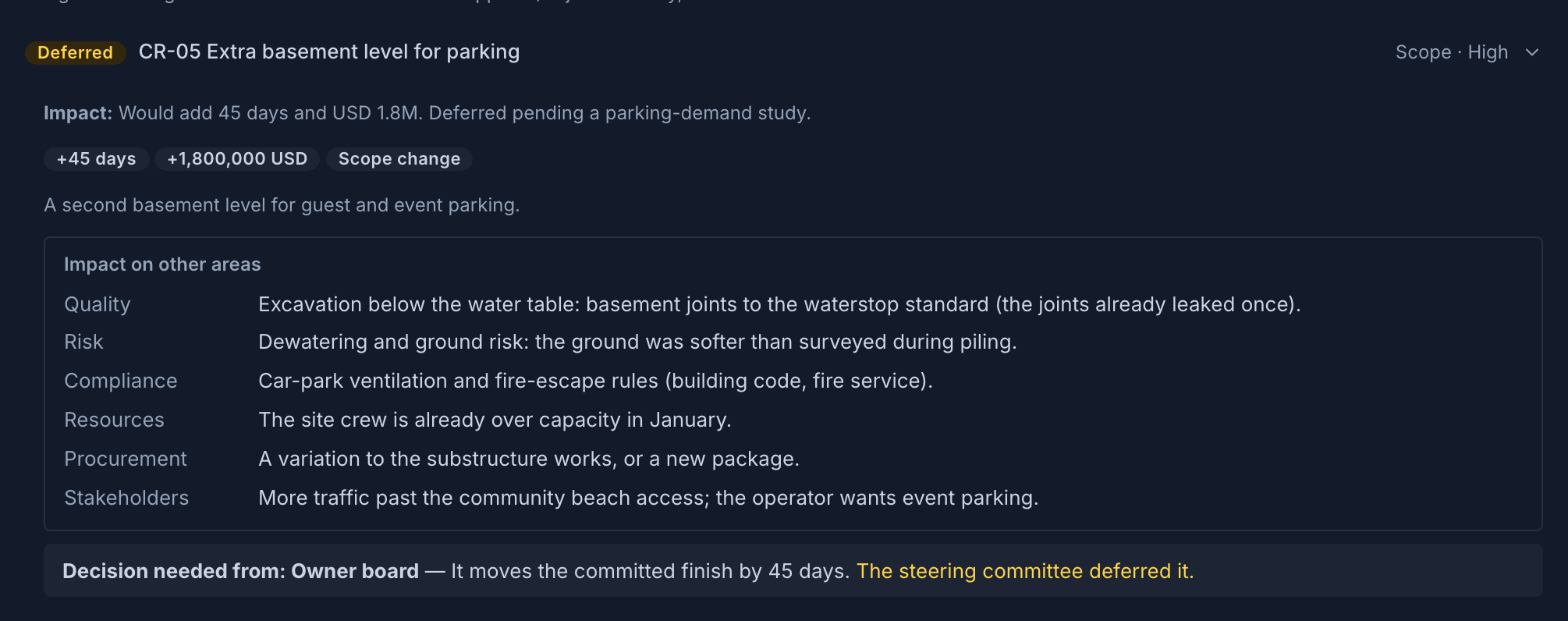
Reading the screenshot: CR-05 Extra basement level for parking, Deferred. +45 days, +USD 1,800,000, scope change. Impact on other areas: quality (water table, joints that already leaked), risk (dewatering, soft ground), compliance (ventilation and fire escape), resources (crew over capacity in January), procurement (a variation or a new package), stakeholders (beach access traffic, the operator's event parking). Decision needed from: Owner board. It moves the committed finish by 45 days. The steering committee deferred it.
✅ Do ask "what else does this touch?" for every area, before the decision.
❌ Avoid an impact analysis that only prices the change. Days and dollars are half the story.
2 · Decided at the right level, or not at all
The theory: change control board and decision authority. The change management plan (and the governance plan) say who can approve, reject or defer which changes. A board without the authority can't decide, not even to defer.
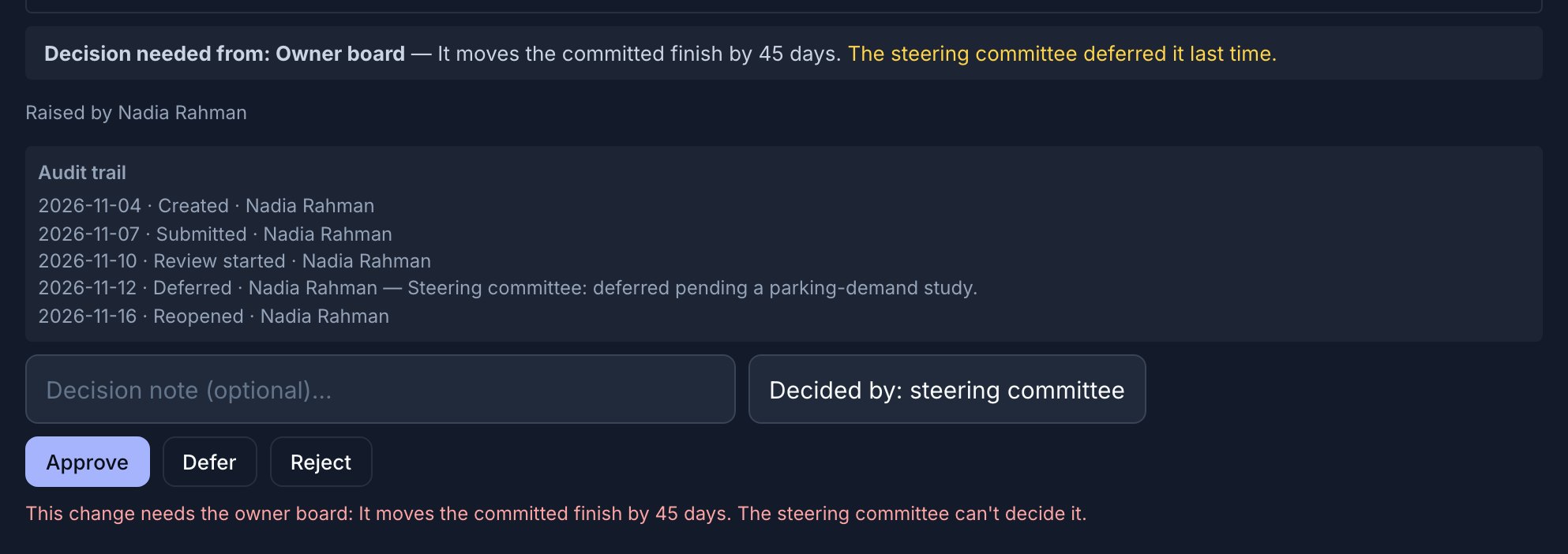
Reading the screenshot: CR-05 has been reopened: the audit trail shows the steering committee's deferral on 12 Nov 2026, then Reopened. The decision form is set to Decided by: steering committee and Approve was pressed. VanillaPM refuses: This change needs the owner board: it moves the committed finish by 45 days. The steering committee can't decide it. The next step is the owner board's meeting, not a workaround.
✅ Do send a change to the level its impact requires, with the analysis attached.
❌ Avoid a "provisional approval" at a lower level to keep things moving. It isn't one.
3 · From decision to baseline, with the trail
The theory: update the plan and communicate. An approved change updates the baselines and the affected plans, is communicated, and is implemented and verified. The trail shows each step.
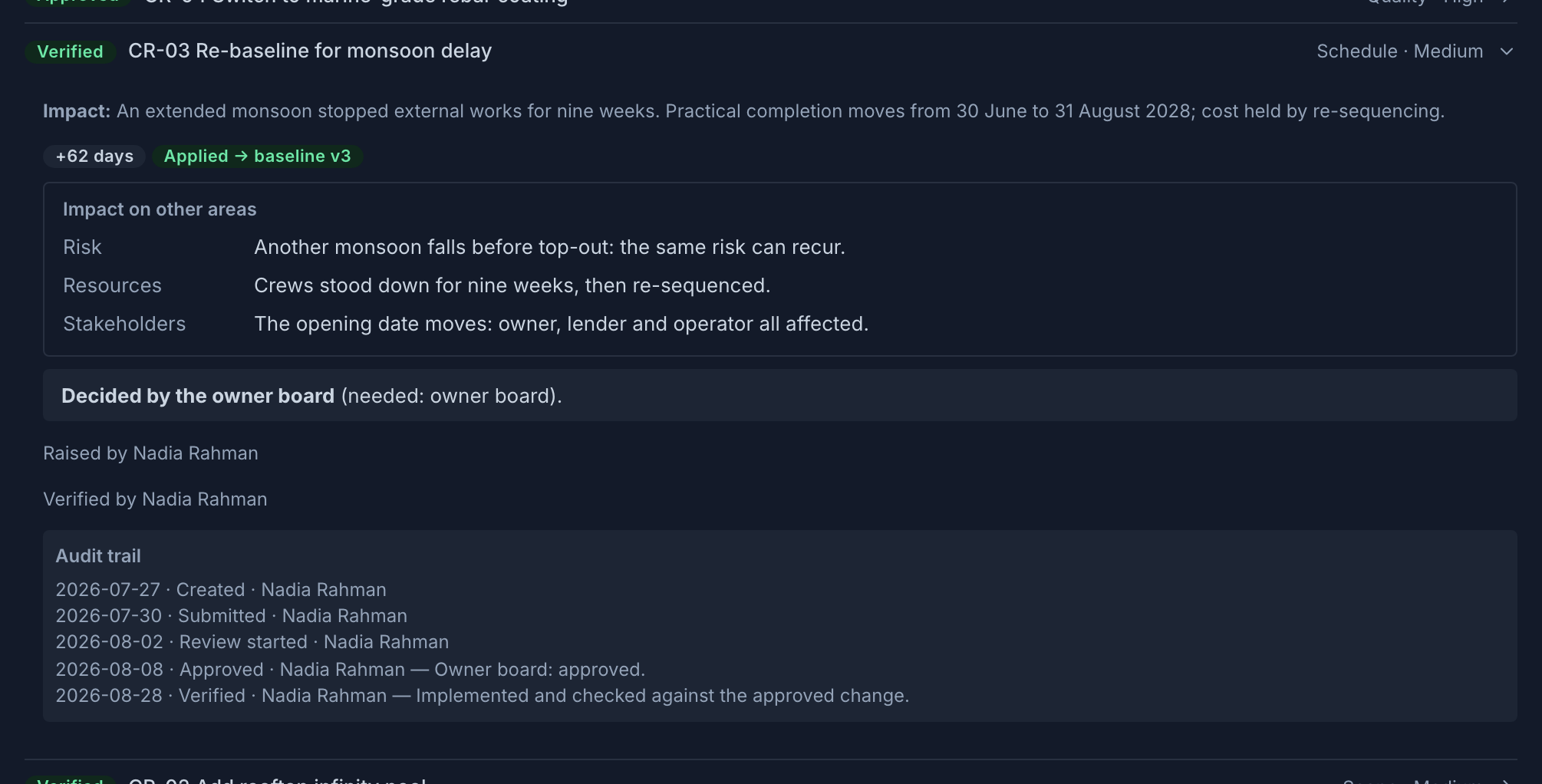
Reading the screenshot: CR-03 Re-baseline for monsoon delay, Verified. +62 days, Applied → baseline v3. Other areas: the monsoon risk can recur before top-out; crews were stood down and re-sequenced; owner, lender and operator are all affected by the new date. Decided by the owner board (needed: owner board). Audit trail: created, submitted, review started, approved by the owner board, verified twenty days later.
✅ Do link the approved change to the baseline version it produced.
❌ Avoid approving a change and leaving the plan as it was. The baseline then lies.
Best practices & pitfalls
- Do route every change, including the "small" ones, through the same process.
- Do analyse impact across all areas before the decision.
- Do record who decided, at which level, and why.
- Pitfall: starting the work before the decision. That's a scope change with no approval.
- Pitfall: a change process so slow that people go around it. Thresholds let small changes move fast and big ones get the right board.
On the PMP exam
Know the integrated change control steps: identify the change, analyse the impact, submit a change request, the CCB (or named authority) approves, rejects or defers, update the plans and baselines, communicate, then implement and verify. Know that only approved change requests change a baseline, and the difference between change control and change management. In scenarios where a stakeholder asks for a change directly, the right answer is to evaluate the impact and take it through change control: not to do it, and not to refuse it outright.