
Support organizational change
In the app: Project → Org-change
PMP ECO · Business Environment (26%) · Task B7. A project changes how people work. Find out who has to change, how ready they are, what's in the way, and act on it before the deliverable arrives.
What it is
A project delivers a capability. Organizational change management (OCM) is getting people to adopt it. Without adoption there's no benefit (Pr3).
- Assess the culture that receives the change: what it values, how it reacts to change.
- Find the affected groups: who has to work differently, how many people, and what changes for them.
- Gauge readiness, group by group. A common model is ADKAR: Awareness of why, Desire to take part, Knowledge of how, Ability to do it, Reinforcement so it sticks. The elements are in order. The first one that's weak is the barrier point: training people (knowledge) who don't want the change (desire) doesn't stick.
- Expect resistance and find the reason for it. Resistance is information, not insubordination.
- Act: communication, sponsorship, training, coaching, fixing the real cause. Each action has an owner and a date, timed against when the group has to be ready.
- Reinforce after go-live, until the new way is the normal way.
Change management is not change control (B3): change control governs changes to the project's plan; change management helps people adopt what the project delivers. Kotter's eight steps are another common model; the exam may name either.
Why it matters
- A building nobody can run is a cost, not an asset. The value arrives when people work the new way.
- The barrier decides the action. If housekeeping staff don't want the jobs, more training won't help; the pay will.
- People take longer than concrete. Recruiting and training 600 people has its own critical path, and it ends on opening day.
Where you do it in VanillaPM
- Org-change opens on the adoption picture:
- tiles: people affected (groups, changes), groups ready, groups with a barrier (and which element), high resistance, and changes not assessed yet;
- Readiness by group (ADKAR): each group's scores, coloured, with the barrier outlined, and the date it has to be ready;
- Needs action: barriers (red within six months of the ready-by date), high resistance, and actions that are overdue or have no owner.
- Below, each change (with its culture assessment) lists its affected groups: what changes for them, readiness and barrier, resistance and why, the next action (owner, date) and ready-by. Add affected group scores a new one.
Walked example — Coral Ridge Resort
Coral Ridge hands a finished building to an operating organisation that doesn't exist yet. Three changes are being managed; two have their groups assessed: 627 people in 6 groups. None is ready yet, which is normal 20 months before opening. What matters is where each one is stuck:
- Housekeeping (160 people): the barrier is desire (2/5), with high resistance: pay is below the competing Cox's Bazar hotels, so trained staff expect to leave. The action is a pay band and a career path, agreed with the operator before recruiting. Training them first would be wasted.
- Front office (85): awareness and desire are fine; the barrier is knowledge (2/5). That's what the brand training academy is for.
- Engineering (40) and local suppliers (30): the barrier is ability. The operator's engineers will shadow commissioning of the marine-grade plant; suppliers get food-safety certification.
- Fishers and beach users (300): barrier desire, high resistance: fear of losing the landing beach. The public-corridor plan in Bangla and the monthly town hall answer it (the same issue as RISK-007 in B5).
- Owner management team (12): no barrier, but the action (an asset-management briefing for the board) is 30 days overdue: the one item to act on now.
The third change, embedding the brand operating standard, has no groups scored yet.
The workspace — the theory behind each screen
Every screenshot is the actual sample project, not a mock-up.
1 · Readiness by group
The theory: assess readiness for change. Score each affected group on the adoption model, find the barrier point, and act on it first.
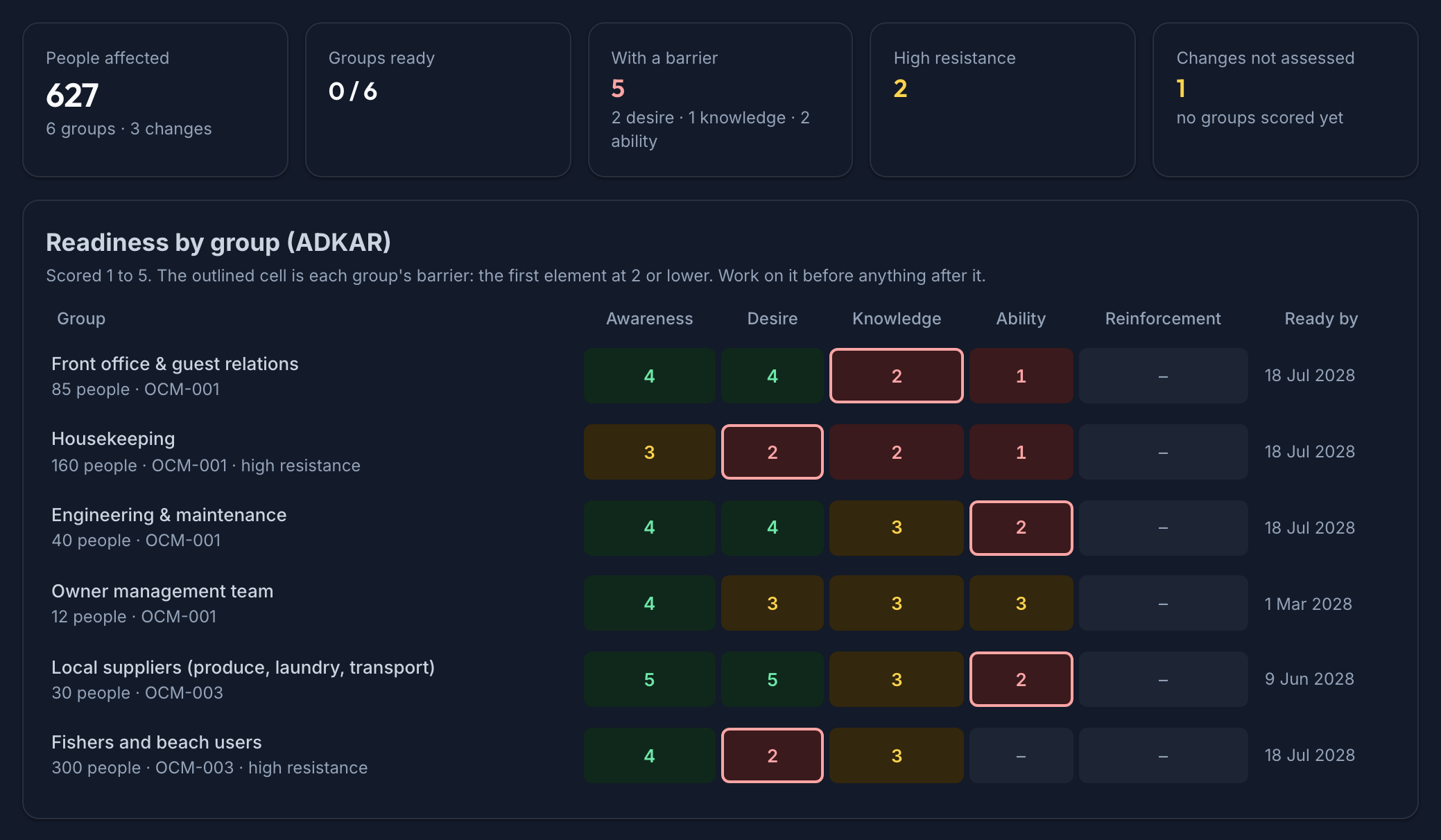
Reading the screenshot: 627 people affected, 6 groups · 3 changes. Groups ready 0 / 6. 5 with a barrier: 2 desire · 1 knowledge · 2 ability. 2 with high resistance. 1 change not assessed. In the grid, the outlined cells are the barriers: front office at knowledge (4, 4, 2, 1), housekeeping at desire (3, 2, 2, 1), engineering and local suppliers at ability, fishers at desire. The owner management team has no barrier (4, 3, 3, 3), so it's developing. Reinforcement isn't scored yet: it comes after opening.
✅ Do score each group separately. "The organisation is ready" hides the group that isn't.
❌ Avoid starting with training. Check awareness and desire first.
2 · Needs action
The theory: manage resistance and plan the actions. Each barrier and each source of resistance gets an action with an owner and a date, timed against when the group must be ready.
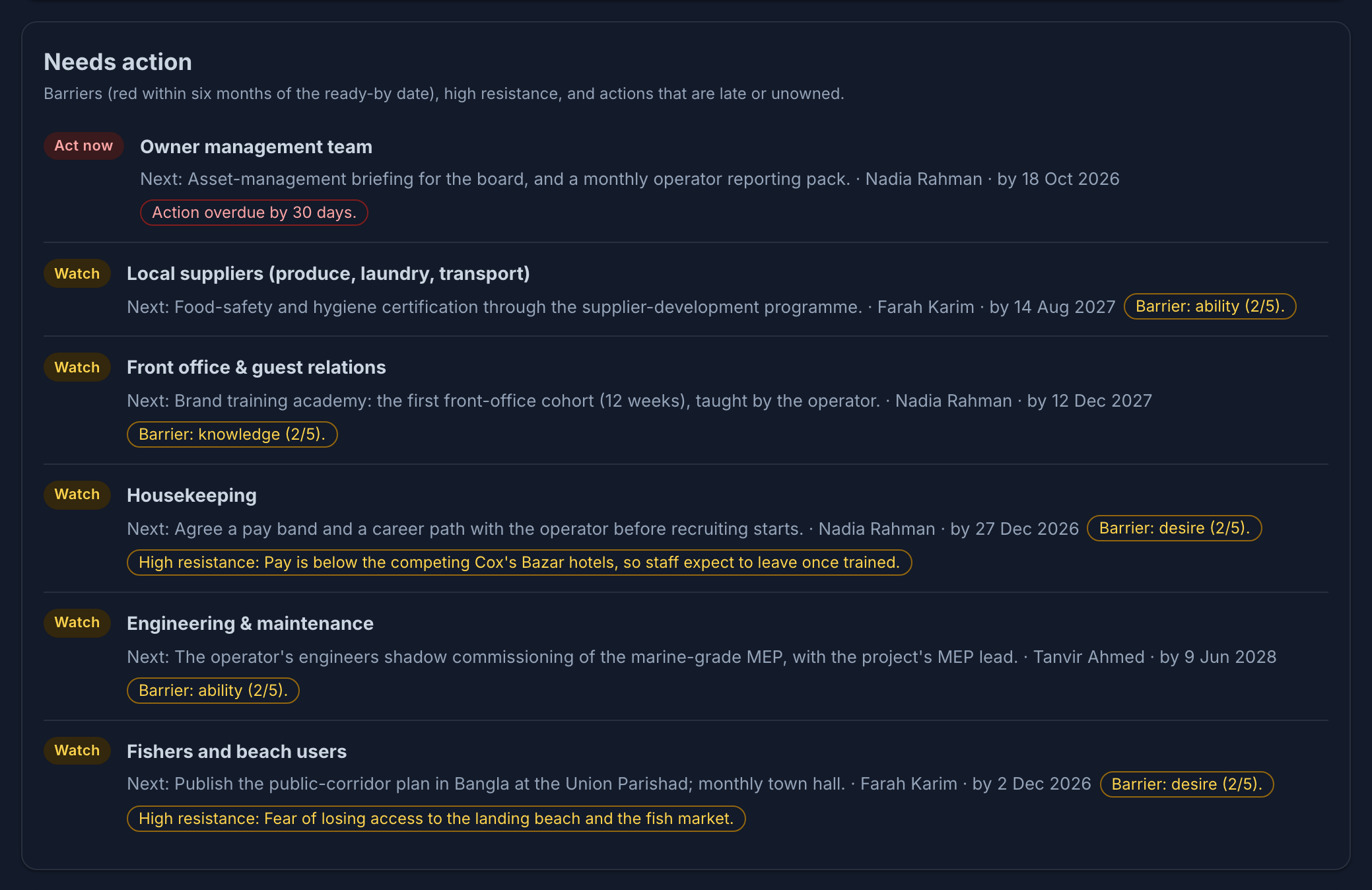
Reading the screenshot: Act now: Owner management team, asset-management briefing for the board, and a monthly operator reporting pack · Nadia Rahman · by 18 Oct 2026, action overdue by 30 days. Then Watch: local suppliers (barrier: ability), front office (knowledge), housekeeping (desire, and high resistance: pay is below the competing Cox's Bazar hotels…), engineering (ability), and the fishers (desire, high resistance: fear of losing access to the landing beach…). Each shows its next action, owner and date.
✅ Do find the reason behind resistance, then act on the reason.
❌ Avoid treating resistance as a communication problem only. Sometimes the answer is the pay.
3 · A change and its affected groups
The theory: culture and impact assessment. Each change records the receiving culture and, for each group, what changes for them.
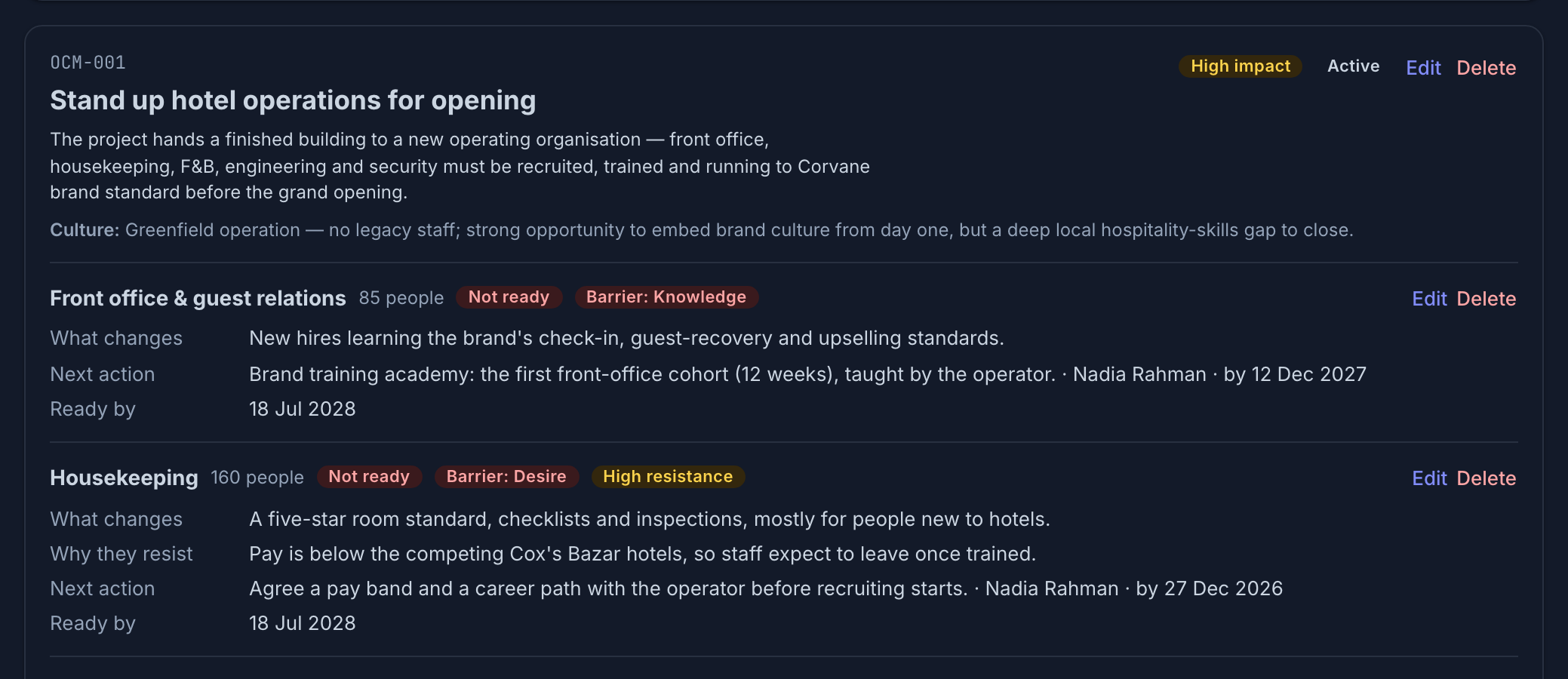
Reading the screenshot: OCM-001 Stand up hotel operations for opening, High impact, Active. Culture: greenfield operation, no legacy staff; a chance to embed brand culture from day one, but a deep local hospitality-skills gap. Front office & guest relations, 85 people, Not ready, Barrier: Knowledge; next action: the brand training academy's first front-office cohort. Housekeeping, 160 people, Not ready, Barrier: Desire, High resistance: why they resist: pay is below the competing Cox's Bazar hotels; next action: agree a pay band and a career path with the operator before recruiting starts. Both must be ready by the soft opening.
✅ Do write down what changes for each group, in their terms.
❌ Avoid one assessment for "the staff". Front office and housekeeping need different things.
4 · A change no one has assessed
The theory: assess before you plan. You can't plan adoption for groups you haven't identified.
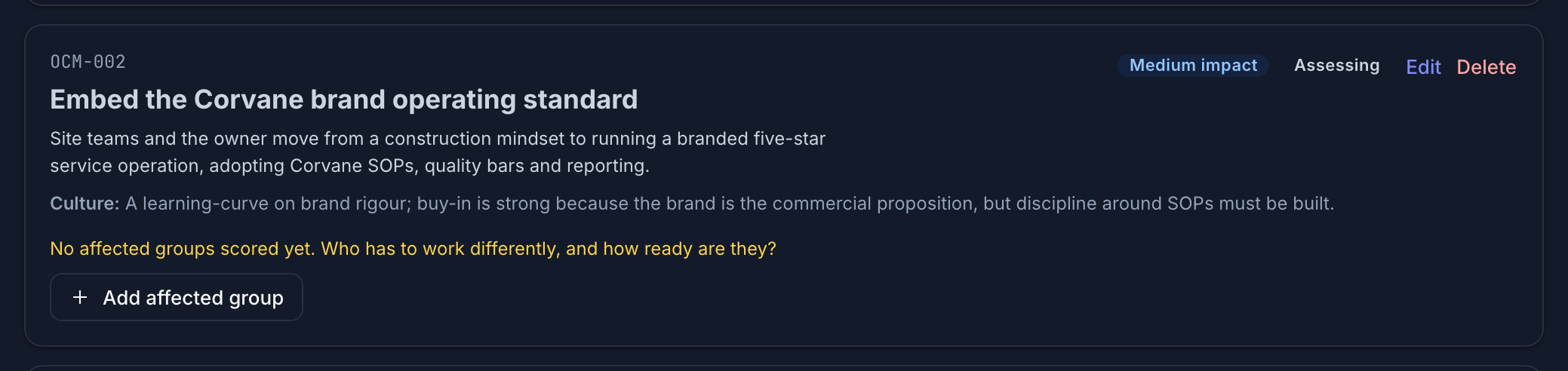
Reading the screenshot: OCM-002 Embed the Corvane brand operating standard, Medium impact, Assessing: the owner's teams move from a construction mindset to a branded service operation. The culture note is there, but No affected groups scored yet. Who has to work differently, and how ready are they? It's counted in the changes not assessed tile.
✅ Do list the groups as soon as the change is known.
❌ Avoid leaving adoption until handover. By then, it's too late to recruit or retrain.
Best practices & pitfalls
- Do keep change management (people adopting) separate from change control (the plan's baselines). The exam tests the difference.
- Do time adoption actions against the ready-by date, like any other critical path.
- Do use sponsors and respected peers (change agents), not only the project team.
- Pitfall: declaring success at go-live. Reinforcement continues after delivery.
- Pitfall: treating every group the same. The barrier point is different for each.
On the PMP exam
Know organizational change management vs change control, readiness assessment, culture, resistance (find and address its cause), and the models: ADKAR (awareness, desire, knowledge, ability, reinforcement) and Kotter's eight steps. Strong answers assess the impact on each group, build awareness and desire before training, involve sponsors and change agents, and plan reinforcement after go-live. Weak answers push the change through, or treat resistance as something to override.