
Help ensure knowledge transfer
In the app: Project → Knowledge · Project → Documents
PMP ECO · People (33%) · Task P7. Make sure the knowledge the project depends on doesn't live in one person's head — capture it, and transfer it before it walks out the door.
What it is
Knowledge transfer covers both explicit knowledge (documents, drawings, procedures — easy to write down) and tacit knowledge (the experience and judgement in people's heads — hard to codify). The task is to identify the critical knowledge, know who holds it, and move it to where it's needed before a hand-off, a rotation, or project close.
Why it matters
- On a long build, people rotate. If the only person who understands the piling-strata history leaves mid-project, that knowledge — and the risk mitigations built on it — leaves too.
- Captured knowledge becomes an organisational process asset the next project inherits.
Where you do it in VanillaPM
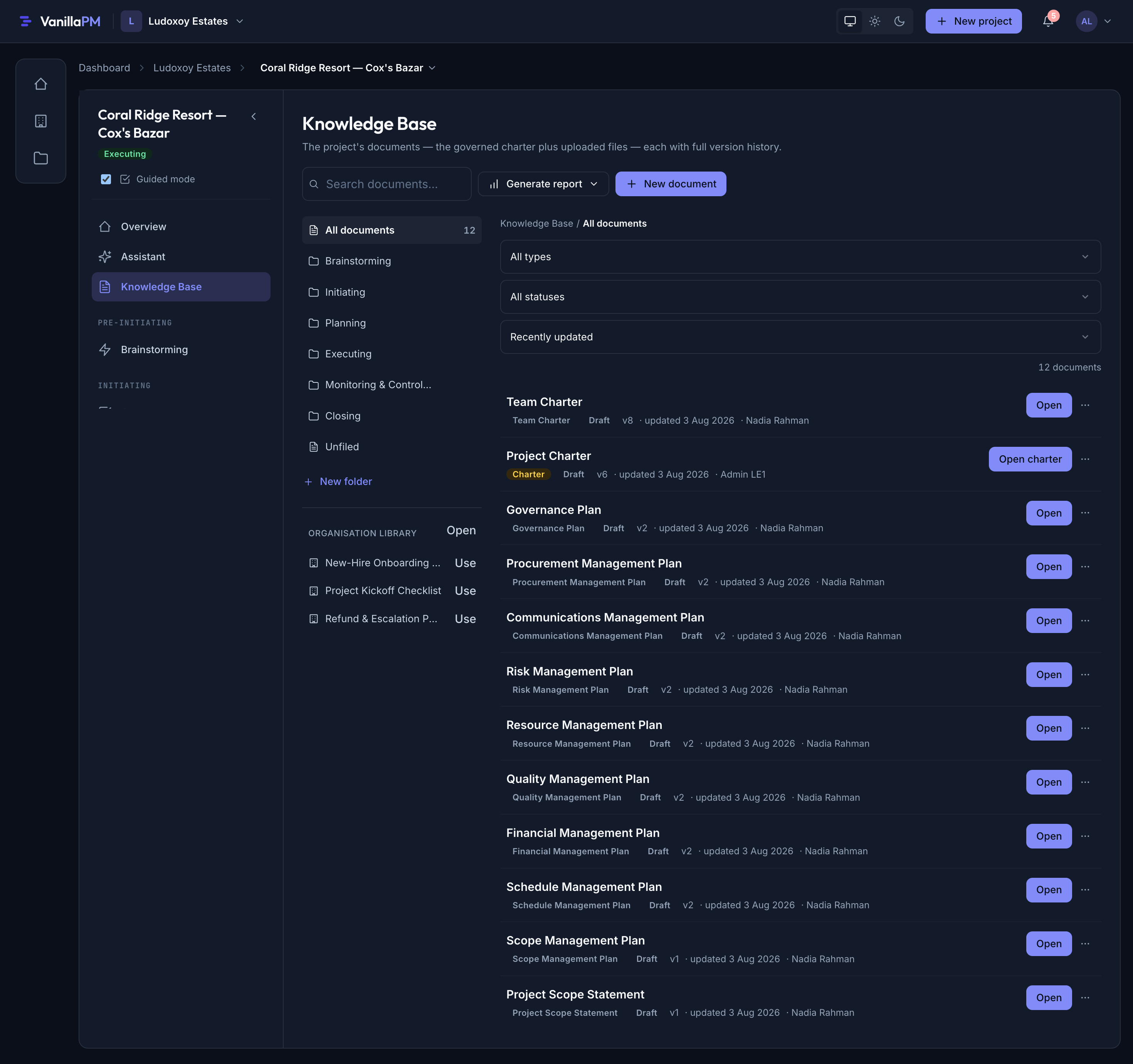
The Critical-Knowledge register records each critical topic, its holder, its criticality, and its transfer status/plan — so knowledge risk is tracked like any other. It sits alongside the Knowledge Base (explicit documents) and Lessons Learned (captured at close, P/B6).
Walked example — Coral Ridge Resort
Coral Ridge flags several critical-knowledge items: the geotechnical/piling history (holder: structural designer — high criticality, because the −22 m redesign rationale must survive a staffing change), the ECA clearance conditions (holder: environmental consultant), and the Marriott brand fit-out standard (holder: architect). Each has a transfer plan — e.g. the piling rationale is documented in the KB and walked through with the site engineer, so status moves from at-risk to transferred.
The artefact
- Critical-Knowledge register — topic · holder · criticality · transfer status/plan.
- Backed by the Knowledge Base (explicit docs) and Lessons Learned (at close).
Best practices & pitfalls
- Do target tacit knowledge deliberately — pairing, shadowing, recorded walk-throughs — not just "write a document".
- Do transfer during the project, not only at close, when the holder may already be gone.
- Pitfall: treating knowledge transfer as a closeout formality; the risk is highest at hand-offs mid-flight.
On the PMP exam
Know the explicit vs tacit distinction and that knowledge management is continuous, not a closing checkbox. Answers that build knowledge sharing into the way the team works (a collaborative environment, documented and demonstrated) beat one-off documentation dumps.