
Plan and manage finance & budget
In the app: Planning → Financial Mgmt (Overview) · Budget & Expenses (Funding & cash-flow) · Control → Overview (Earned value)
PMP ECO · Process (41%) · Task Pr6. Build the budget from the work, hold the right reserves, make sure the money arrives before the spending does, and read the cost performance early enough to act on it.
What it is
The budget is built in layers, and each layer has an owner:
| Layer | What it is | Who controls it |
|---|---|---|
| Work packages | The estimated cost of the work. Their total is the budget at completion (BAC) | The PM, through the control accounts |
| + Contingency reserve | Money for identified risks (known-unknowns) | The PM, within the plan's rules |
| = Cost baseline | The approved, time-phased budget: what performance is measured against | Changed only through change control |
| + Management reserve | Money for unidentified risks (unknown-unknowns) | The sponsor or management |
| = Total budget | The full amount the project is authorised to spend |
Then there's funding. The budget says how much the project may spend; funding is the money actually available, and it usually arrives in steps: equity, loan tranches, grant instalments. The project needs enough funding in total and in time. Funding limit reconciliation compares the planned spend, period by period, with the funding available. Where the spend gets ahead, something has to give: reschedule work to level the spending, or bring funding forward.
Finally, control. Earned value compares three numbers at the data date:
- PV (planned value): the budgeted cost of the work scheduled to date.
- EV (earned value): the budgeted cost of the work actually done.
- AC (actual cost): what that work really cost.
From them: CPI = EV ÷ AC (below 1, over budget), SPI = EV ÷ PV (below 1, behind schedule), and a forecast, the estimate at completion (EAC).
Why it matters
- Counting a reserve twice hides real money. Contingency belongs in the cost baseline once. A budget with it in a line and added on top looks bigger than it is.
- Reserves get used up quietly. Every change paid from contingency leaves less for the risks that are still open.
- Projects run out of cash before they run out of budget. A project can be fully funded on paper and still be unable to pay a supplier for a month, waiting for the next tranche.
- A CPI of 0.95 is not "nearly fine". At a third complete, it predicts a seven-figure overrun on a large project, and the earlier you read it, the more you can still change.
Where you do it in VanillaPM
- Planning → Financial Mgmt → Overview shows the cost status against the plan's thresholds, the budget architecture (work + contingency = cost baseline + management reserve = total budget), the reserves with every approved change that drew on them, the forecast at completion set against the reserves left, and the funding position.
- Budget & Expenses holds the budget lines (the work only) and Funding & cash-flow: the tranches, the headroom, and a chart of cumulative planned spend against the funding steps, with any period where spend gets ahead shaded.
- Control → Overview has the earned value numbers: BAC, PV, EV, AC, CPI, SPI, EAC, ETC, VAC and TCPI, with three forecasting methods.
- A change request records what its cost is paid from: contingency (the baseline doesn't move), management reserve or new funding (both re-baseline).
- The integrated plan (Pr1) checks Funding covers the planned spend, and measures contingency after the draws against the open risks.
Free tool: Earned value calculator (CPI, SPI, EAC, TCPI).
Walked example — Coral Ridge Resort
The work is budgeted at USD 43.4M. Add USD 2.4M contingency and the cost baseline is USD 45.8M (baseline v3). The sponsor holds USD 1.2M management reserve outside it, so the total budget is USD 47.0M. Funding is USD 48M: USD 18M owner equity, then two loan tranches of USD 15M each.
A third of the way through, three things need a decision:
- Contingency is being spent. Two approved changes, the hurricane-rated glazing (CR-01) and the marine-grade rebar (CR-04), drew USD 650,000. USD 1.75M is left.
- Cost performance has slipped. CPI is 0.947: the piling closed USD 0.2M over because the ground was softer than surveyed (Pr5), the basement took on water, and the monsoon cost the frame weeks. If that rate continues, the work finishes at USD 45.8M, USD 2.45M over: more than the contingency left.
- The cash arrives late. The lender releases tranche 2 when the frame tops out, expected early December 2027. The facade and MEP packages start paying out a month before that. For 32 days, planned spend runs up to USD 2.57M ahead of the money.
The workspace — the theory behind each screen
Every screenshot is the actual sample project, not a mock-up.
1 · The budget architecture and the reserves
The theory: the cost baseline and the project budget. The cost baseline is the time-phased budget including contingency reserves and excluding management reserves. Contingency is for the risks you've identified, so it's drawn as those risks (or approved changes) happen. Management reserve is released by management, and using it changes the cost baseline.
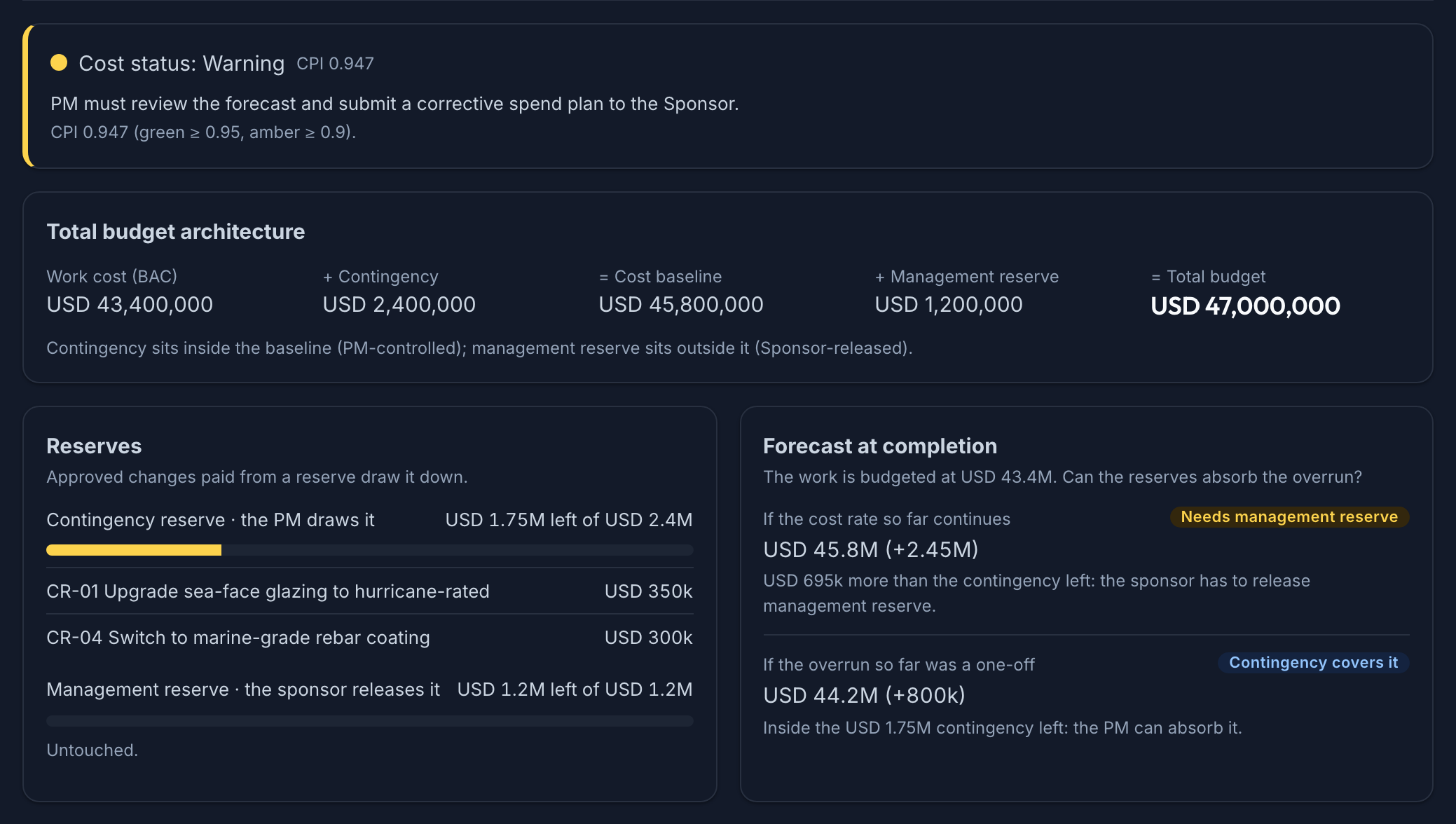
Reading the screenshot: Cost status: Warning, CPI 0.947 against a green line of 0.95: the PM owes the sponsor a corrective spend plan. Work USD 43.4M + contingency USD 2.4M = cost baseline USD 45.8M + management reserve USD 1.2M = USD 47.0M. Reserves: contingency USD 1.75M left of USD 2.4M, drawn by CR-01 (USD 350k) and CR-04 (USD 300k); management reserve untouched. Forecast at completion: if the cost rate so far continues, USD 45.8M, USD 695k more than the contingency left, so it needs management reserve. If the overrun so far was a one-off, USD 44.2M, and contingency covers it.
✅ Do record which reserve pays for each approved change, so what's left is always known.
❌ Avoid putting contingency in as a budget line. It ends up counted twice, and earning value.
2 · Funding: enough in total, but in time?
The theory: funding limit reconciliation. Funding requirements come from the cost baseline, and funding usually arrives in steps. Compare cumulative planned spend with cumulative funding, period by period. Where spend gets ahead, reschedule work to level the rate of spending, or arrange the money earlier.
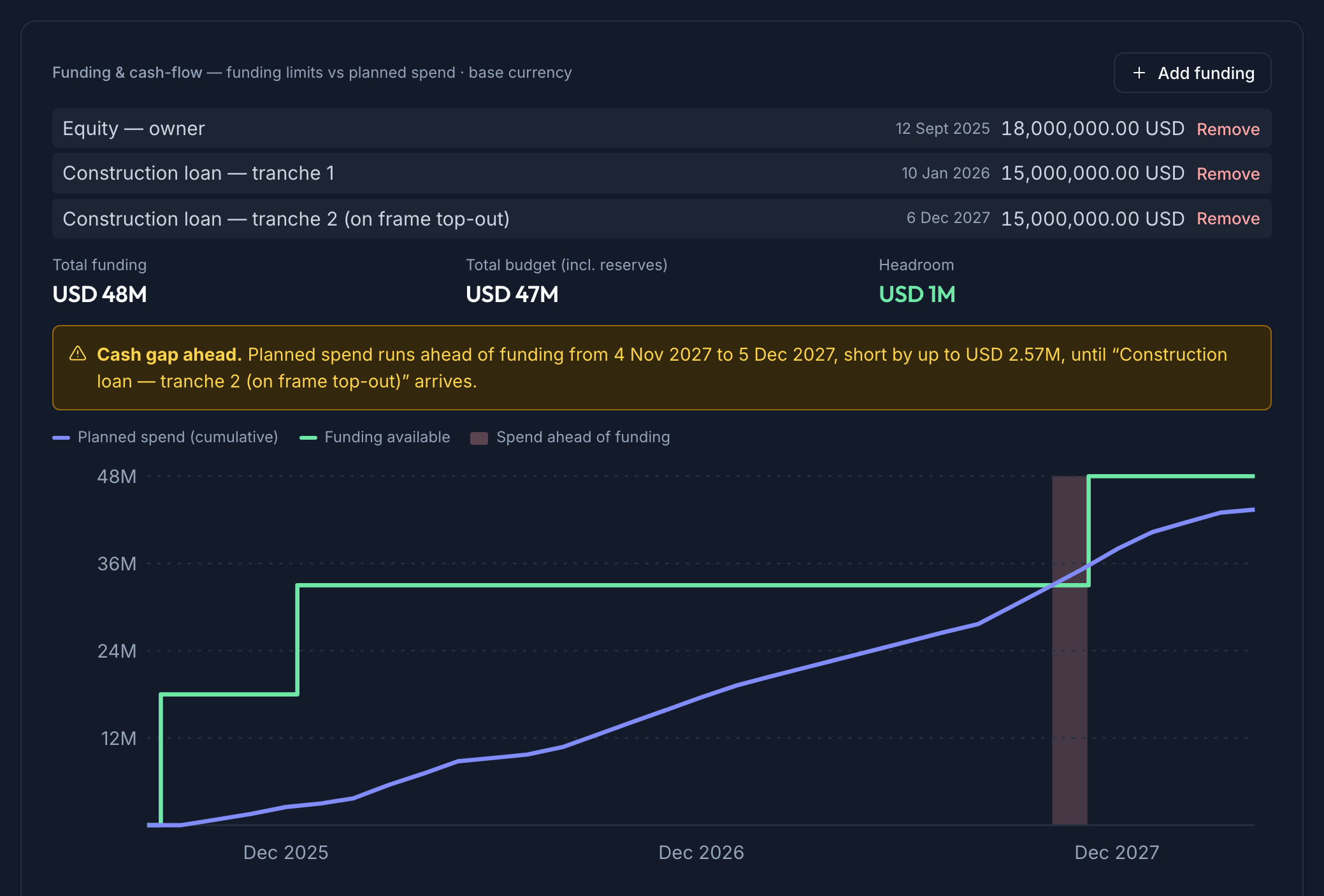
Reading the screenshot: three tranches, USD 48M against a total budget of USD 47M: USD 1M headroom, so the total is fine. The chart says otherwise about timing. The blue line (cumulative planned spend) crosses the green steps (funding available) in early November 2027, before tranche 2 lands on 6 December. Cash gap ahead: up to USD 2.57M short for 32 days. The options: move a payment milestone past the tranche, ask the owner to bring equity forward, or ask the lender to release on an earlier milestone.
✅ Do reconcile the spend curve against the funding steps as soon as the schedule is set.
❌ Avoid checking only the totals. "Funded" can still mean a supplier unpaid for a month.
3 · Earned value: read it early, forecast honestly
The theory: control costs. Measure PV, EV and AC at each data date; CPI and SPI show efficiency; EAC forecasts the out-turn. How you forecast depends on why the variance happened: BAC ÷ CPI if the current efficiency will continue, AC + (BAC − EV) if it was a one-off. TCPI shows the efficiency the remaining work needs to finish on budget.
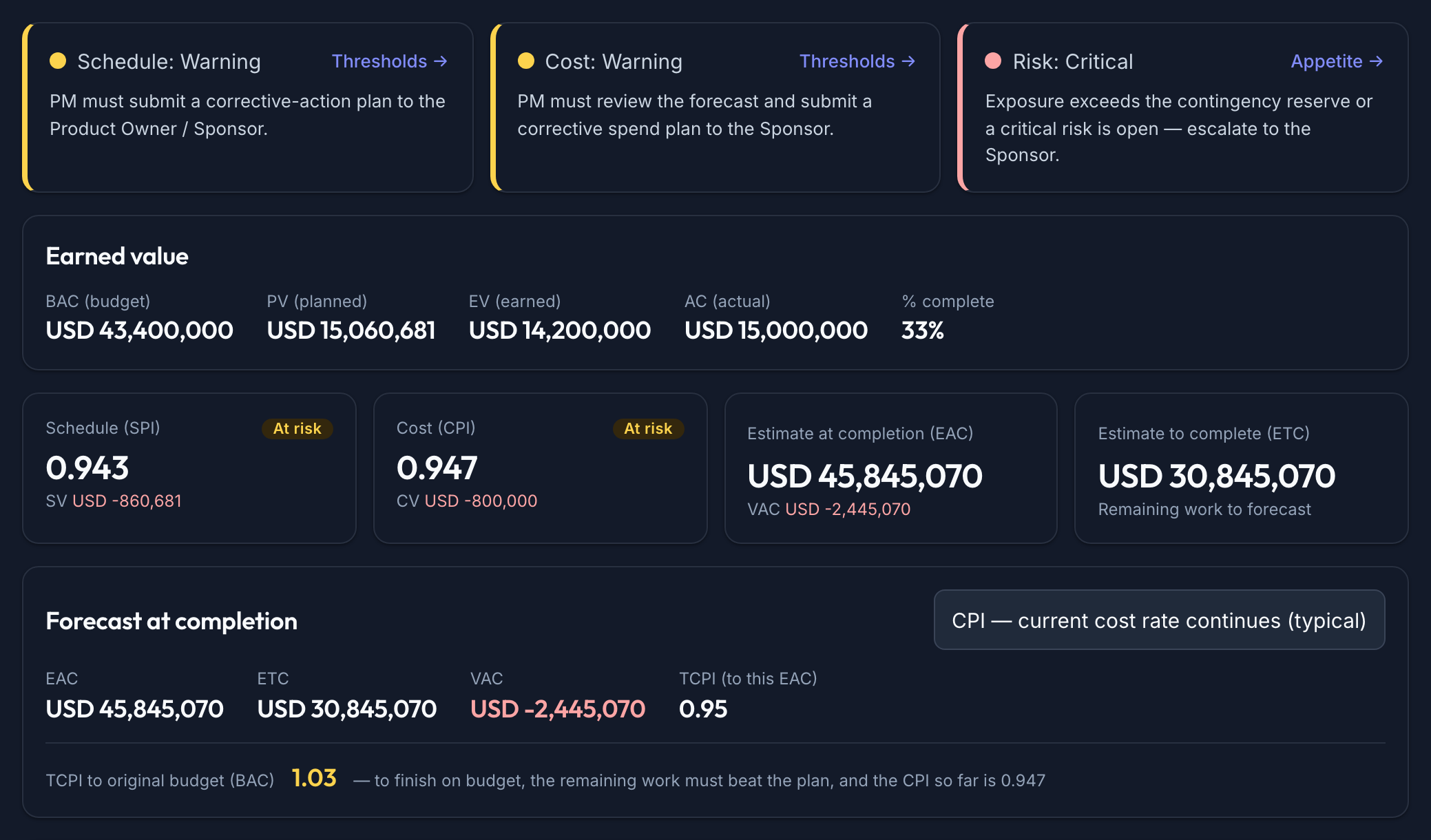
Reading the screenshot: BAC USD 43.4M, PV USD 15.06M, EV USD 14.2M, AC USD 15.0M, 33% complete. SPI 0.943 (behind), CPI 0.947 (over), CV −USD 800,000. EAC = BAC ÷ CPI = USD 45.8M, VAC −USD 2.45M. TCPI 1.03: to still finish on USD 43.4M, the remaining work must beat the plan, while the CPI so far is 0.947. The piling and basement overruns came from ground that's now behind the project (atypical); the frame overrun came from weather, and another monsoon falls before top-out (it could recur). So the PM reports both forecasts, sets out the corrective actions, and asks the sponsor to earmark management reserve for the gap.
✅ Do choose the EAC method from the cause of the variance, and say which one you used.
❌ Avoid reporting a TCPI above the current CPI as "achievable" without a plan that changes
how the work is done.
Best practices & pitfalls
- Do build the budget bottom-up from the work packages, then add the reserves on top, once.
- Do keep the two reserves apart: contingency inside the baseline, management reserve outside it and released by the sponsor.
- Do reconcile funding against the time-phased spend, not just the total.
- Pitfall: using management reserve without re-baselining. That money wasn't in the baseline, so the baseline has to change.
- Pitfall: waiting for CPI to cross a threshold before forecasting. Early in a project, small CPI changes are large sums.
On the PMP exam
Cost is formula-heavy. Know CV = EV − AC, SV = EV − PV, CPI = EV ÷ AC, SPI = EV ÷ PV, EAC = BAC ÷ CPI (typical), EAC = AC + (BAC − EV) (atypical), EAC = AC + (BAC − EV) ÷ (CPI × SPI) (both cost and schedule drag), ETC = EAC − AC, VAC = BAC − EAC, and TCPI = (BAC − EV) ÷ (BAC − AC). Know that the cost baseline includes contingency but not management reserve, that cost baseline + management reserve = project budget, and that funding limit reconciliation may mean rescheduling work to level spending. In scenarios, the PM uses contingency for identified risks within their authority; anything needing management reserve or new funding goes to the sponsor through change control.