
Engage stakeholders
In the app: Project → Stakeholders → Register
PMP ECO · People (33%) · Task P4. Identify everyone who can affect or be affected by the project, understand them, and engage them deliberately across the whole lifecycle.
What it is
A stakeholder is any individual, group, or organisation that may affect, be affected by, or perceive itself to be affected by the project — accurate perception or not. Engaging them is a continuous loop: identify → analyse → prioritise → engage → monitor, repeating as the landscape shifts. In PMBOK® 8e this is the Stakeholder Performance Domain, one of the eight outcome areas — not a one-off kickoff task.
Why it matters
- Effective stakeholder engagement is one of the strongest predictors of project success; poor engagement sinks projects whose schedule and budget were otherwise sound.
- It surfaces requirements and risks early, builds the political capital to clear obstacles, and reduces resistance — people support what they help shape.
Where you do it in VanillaPM
Build the stakeholder register (identify + analyse), then classify with the Power–Interest grid and, for political projects, the Salience model (power × legitimacy × urgency). The register is the backbone the later engagement, communications, and interaction tracking hang off.
Walked example — Coral Ridge Resort
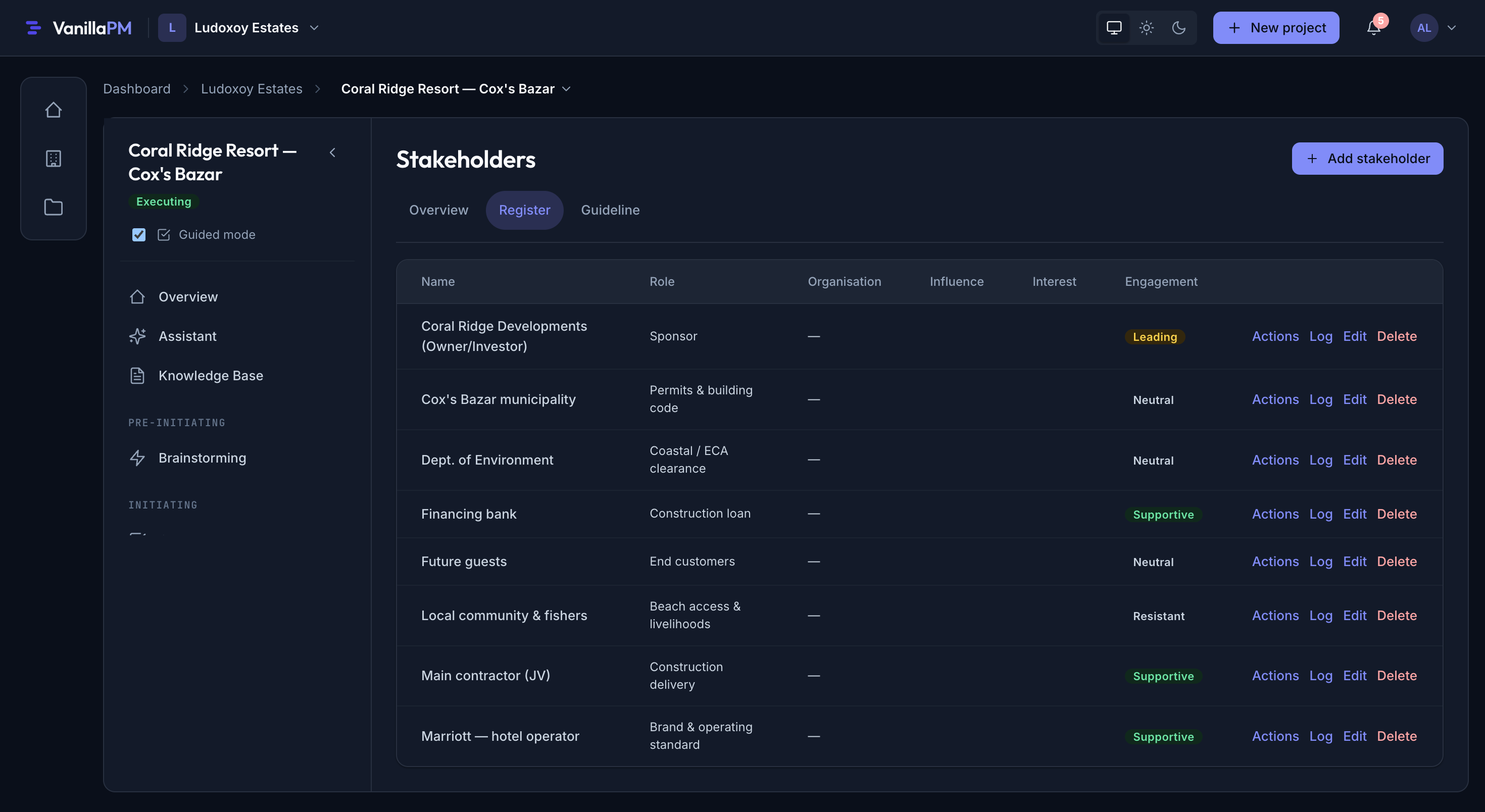
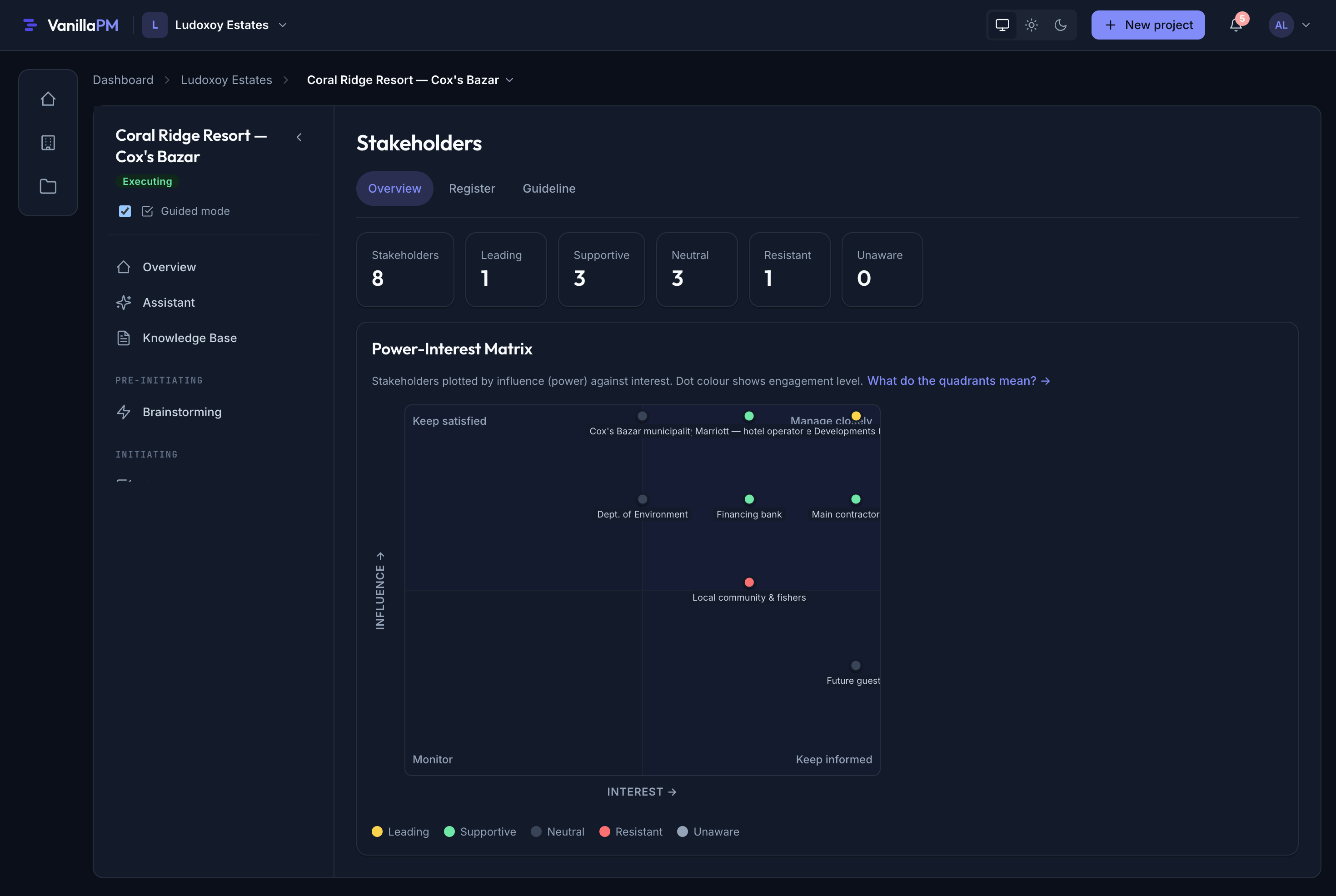
Coral Ridge's register spans far more than "the guest": Coral Ridge Developments (owner / investor — high power, high interest → manage closely), Marriott (operator, sets the brand standard → keep satisfied/closely), the Dept. of Environment (coastal/ECA clearance — regulator, high power → manage closely), the main-contractor JV, Cox's Bazar municipality, the local community & fishers (beach access — currently Resistant), and future guests. Opponents are stakeholders too: the community's beach-access concern is logged and owned, not wished away.
The artefact
- Stakeholder register — who they are, their interest, influence, current attitude, and owner.
- Power–Interest grid / Salience model — the prioritisation that decides how much attention each gets.
Best practices & pitfalls
- Do cast wide — include regulators, community, opponents, and the team itself.
- Do treat engagement as continuous; re-scan at each phase (new regulator, new community concern).
- Do manage perception as carefully as reality — a stakeholder who believes they're harmed still acts on it.
- Pitfall: equating stakeholders with "the customer" and missing the regulator or community who can stop the job.
On the PMP exam
The exam treats stakeholder engagement as continuous and proactive. Expect to place stakeholders on the Power–Interest grid and pick an engagement approach; know the register is built early but maintained throughout. Answers that ignore a powerful regulator or a resistant community — or that engage only at kickoff — are the distractors.