
Plan and manage resources
In the app: Project → Resources · Org → Allocation
PMP ECO · Process (41%) · Task Pr4. Get the right people and physical resources, in the right quantity, at the right time — without over- or under-loading them.
What it is
Resource management covers both human resources (the team) and physical resources (materials, equipment, facilities): estimate what's needed, acquire it, develop the team, and control utilisation. Two scheduling techniques matter here — resource levelling (shift work so no one exceeds capacity, which can move the finish date) and resource smoothing (even out demand within the existing float, which does not move the finish).
Why it matters
- Over-allocation is silent until it isn't: the same crane or the same crew booked on two work packages at once quietly guarantees a slip.
- Physical-resource lead times (imported lifts, façade units) drive the schedule as hard as labour.
Where you do it in VanillaPM
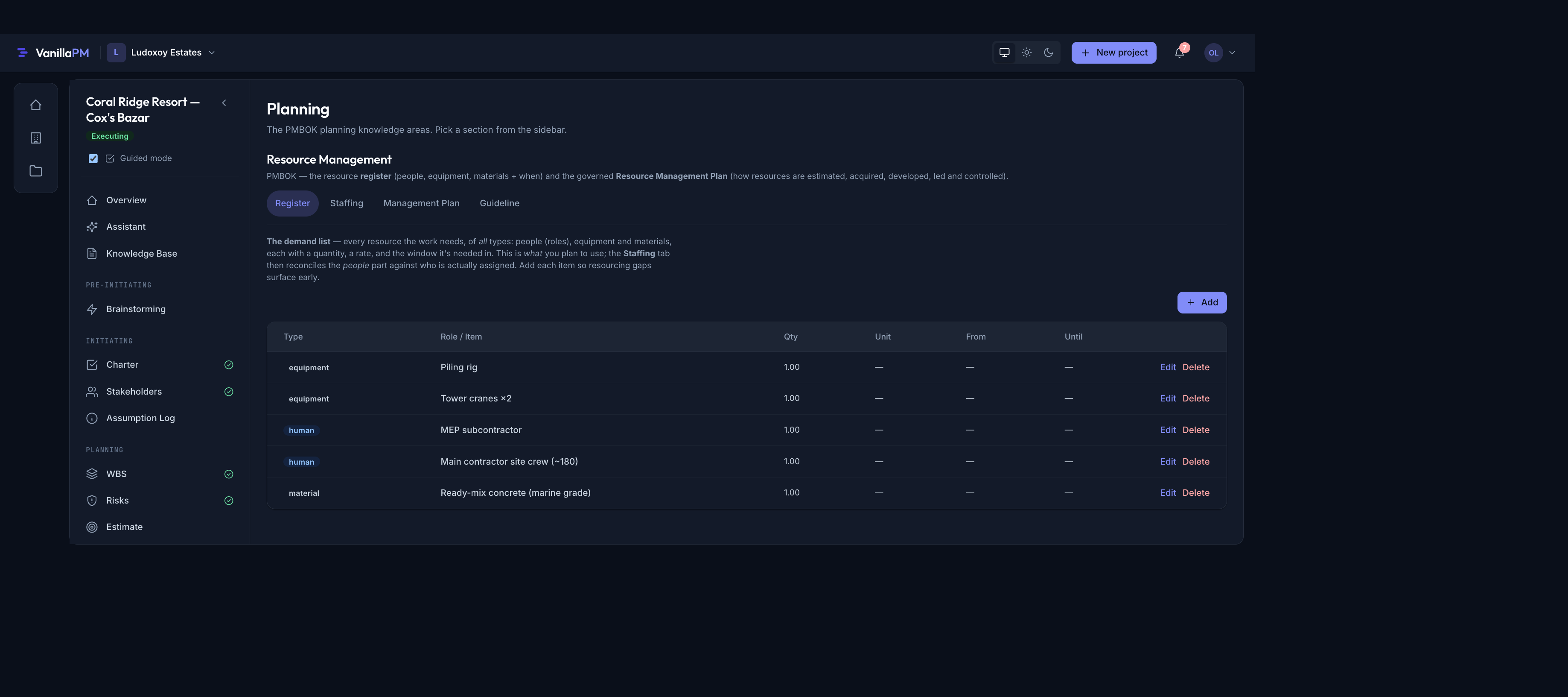
The resource plan / staff allocation shows capacity by role and where people are committed; org-level allocation tracks effort across projects and operations (staff can't be 150% allocated). Scheduling supports levelling so an over-committed crew is resolved before it bites.
Walked example — Coral Ridge Resort
Coral Ridge's constraints are classic construction: the piling rig and tower crane are single, shared resources; the formwork crew can pour one RCC floor cycle at a time. Planning the frame for floors 1–5 and 6–10 as sequential (not parallel) reflects that the crew is a levelled resource. On the human side, the QS and MEP lead are split across packages — the allocation view keeps either from being booked past 100%. Physical lead items (imported lifts, curtain-wall units) are planned early because customs delay is a live risk.
The artefact
- Resource plan — roles, quantities, and calendars for people and physical resources.
- Capacity / allocation view — who and what is committed where, guarding against over-allocation.
Best practices & pitfalls
- Do know the difference: levelling can extend the schedule; smoothing works within float and doesn't.
- Do plan long-lead physical resources as early as the team — they're often the real critical path.
- Pitfall: planning only labour and forgetting equipment and materials constraints.
On the PMP exam
Resource levelling vs smoothing is a favourite distinction. Know resource calendars, the acquire → develop → manage team flow, and that resources are both human and physical. Watch for scenarios where an over-allocation should be levelled — and the schedule impact that implies.