
Manage project closure
In the app: Project → Closeout (Phases · Project closure · Lessons learned · Final report)
PMP ECO · Process (41%) · Task Pr10. Close each phase, and finally the project, on evidence: deliverables accepted, contracts closed, costs final, lessons captured, and nothing left open without a name against it.
What it is
Closure applies to the project and to each phase. A phase is a natural break in the work: on Coral Ridge, each top-level branch of the WBS (design, substructure, superstructure …). Closing a phase as it finishes keeps closure from piling up at the end, when the team has already moved on.
Closing a phase or project means, in order:
- Confirm acceptance. Every deliverable formally accepted (Pr2). "Done" isn't "accepted".
- Close the contracts. Accept the seller's work, settle claims, release retentions, and record supplier performance (Pr5). Contract closure comes before administrative closure.
- Reconcile the money. Final cost against the budget, line by line.
- Capture the lessons, as the phase ends, while the people who learned them are still here.
- Close administratively. Archive the records, release the team and resources, and get the sign-off. For the project, also hand over to operations.
Sometimes a phase has to close with something still open. That's a conditional closure: the open items are written down, each with an owner and a date, and carried into the next phase. What's never acceptable is closing silently, as if nothing were open.
A project is closed even if it's cancelled: you still accept what exists, close the contracts, capture why, and release the team.
Why it matters
- Open contracts are open liabilities. Claims, retentions and warranties nobody tracks become disputes after the team has left.
- Unaccepted work gets argued about later. Formal acceptance is the end of "is it finished?".
- Lessons disappear with the team. Captured at the end of each phase, they're specific and honest; captured at the end of three years, they're vague.
Where you do it in VanillaPM
- Closeout → Phases lists each phase with its state (In progress, Awaiting acceptance, Ready to close, Closed) and, for the selected one, what the data says:
- Deliverables accepted from scope validation: accepted, done but awaiting acceptance, and still open, listed separately because they need different actions;
- Contracts closed from procurement, with each supplier's rating;
- Final cost for the finished work, and what's still running;
- Lessons captured for that phase.
- Close phase… is available only once the contracts are closed and lessons captured. If a deliverable isn't accepted yet, closing needs the carried-forward items in writing.
- Project closure is the final administrative checklist at handover; Lessons learned is the register, each lesson tagged to its phase; Final report generates the closing report and the project archive.
Walked example — Coral Ridge Resort
A third of the way through, the Site & Substructure phase is nearly done. Should it close?
- Contracts: 2 of 2 closed. Early enabling works (time & material) rated 4/5; piling (cost plus) rated 3/5, USD 0.2M over because the ground was softer than surveyed.
- Final cost: piling USD 5.2M planned, USD 5.4M final. The basement is still running.
- Lessons: 4 captured. Two went well (sequencing piling around the tides; starting the frame over the basement absorbed the piling delay), two didn't (too few boreholes; the basement joints let water in).
- Deliverables: 1 of 3 accepted. Site preparation is accepted. Piling is done but not yet formally accepted, and the raft and basement are still open: the water-tightness remedial works are due in January (Pr4).
So the PM has a choice: wait until January, or close the phase now with two exceptions written down (piling acceptance by the sponsor this month; the remedial works to the site engineer, moving to the superstructure punch list). Either is defensible. Closing without writing them down isn't.
The workspace — the theory behind each screen
Every screenshot is the actual sample project, not a mock-up.
1 · Phase readiness, read from the data
The theory: close project or phase. Before closing, confirm that the work is accepted, the procurements are closed, the costs are final and the knowledge is captured. Check the evidence, not someone's memory.
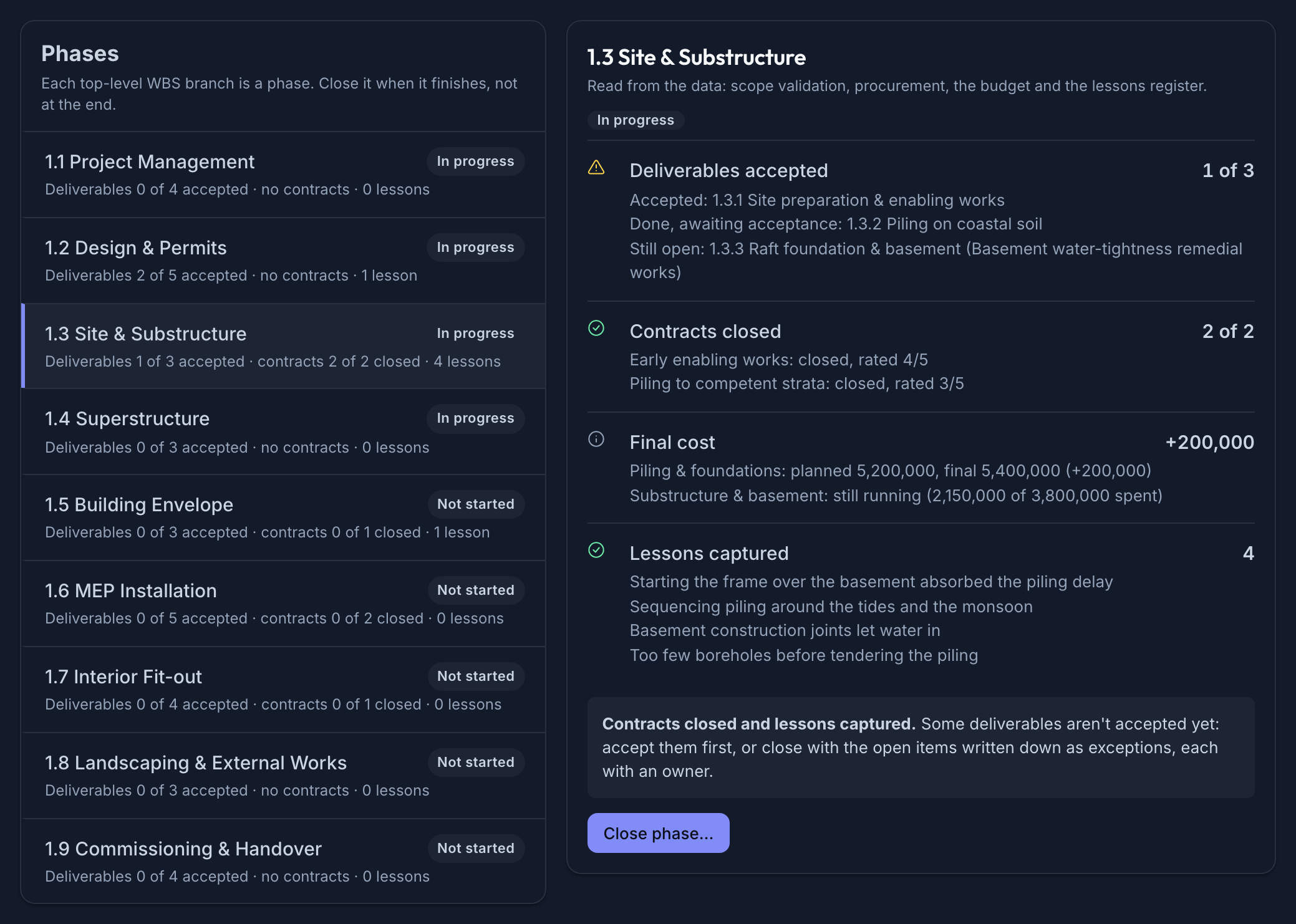
Reading the screenshot: nine phases, one per WBS branch, with their state. 1.3 Site & Substructure is selected: Deliverables accepted 1 of 3 (amber: site prep accepted; piling done and awaiting acceptance; raft still open with the remedial works); Contracts closed 2 of 2, rated 4/5 and 3/5; Final cost +200,000 on the piling, the basement still running; Lessons captured 4. The note says what's left: the contracts and lessons are done, so the phase can close, but only with the open items written down.
✅ Do close each phase as it finishes, not all of them at the end.
❌ Avoid treating "done" as "accepted". Acceptance is the customer's decision, recorded.
2 · Contracts first, then exceptions in writing
The theory: procurement closure precedes administrative closure; conditional acceptance. Contracts are closed before the phase. Where a deliverable is still open, the closure records it, with an owner and a date, and carries it forward.
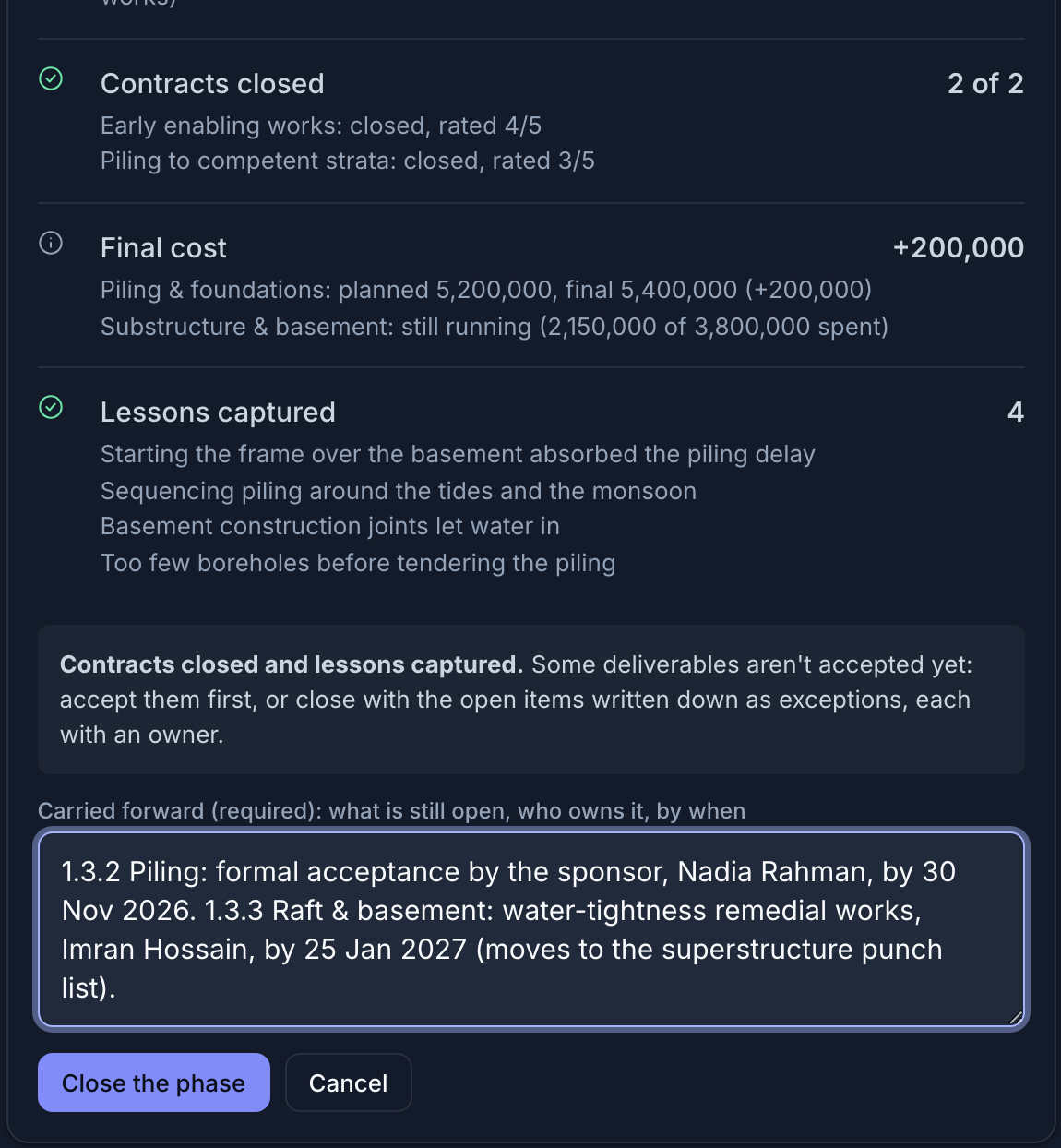
Reading the screenshot: Contracts closed 2 of 2 and Lessons captured 4, both green, so Close phase… is available. Because a deliverable isn't accepted, the form asks for what is carried forward: 1.3.2 Piling: formal acceptance by the sponsor, Nadia Rahman, by 30 Nov 2026. 1.3.3 Raft & basement: water-tightness remedial works, Imran Hossain, by 25 Jan 2027 (moves to the superstructure punch list). If the contracts were still open, the button wouldn't be there: they close first.
✅ Do give every carried-forward item an owner and a date.
❌ Avoid closing a phase with an open contract "to tidy up later". That's how retentions and
claims get lost.
3 · Lessons learned, by phase
The theory: the lessons learned register. Record what went well, what didn't and what to do next time, throughout the project, and transfer it to the organisation's knowledge at closure.
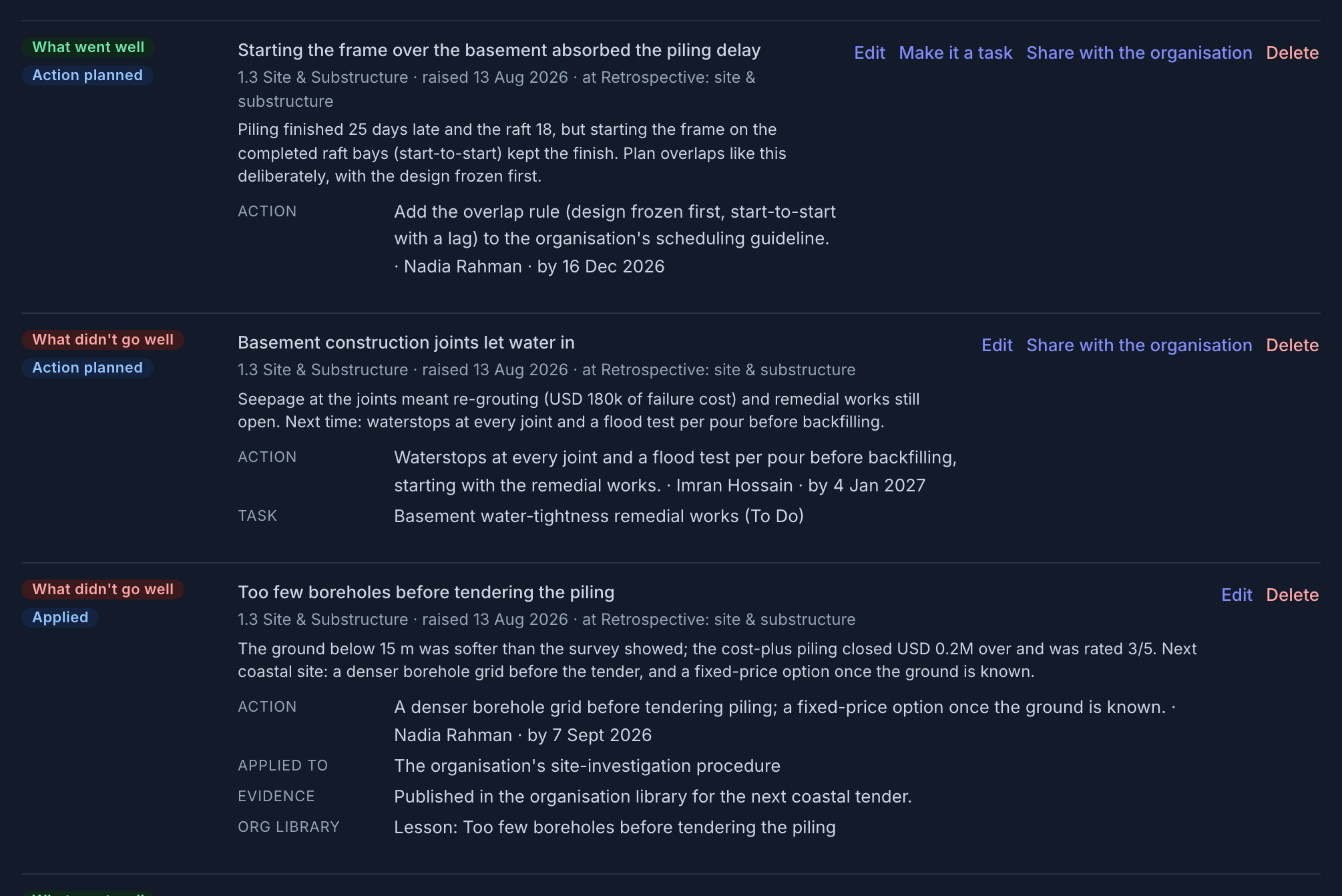
Reading the screenshot: three of the lessons from 1.3 Site & Substructure, each tagged to its phase and to the retrospective it came from: Starting the frame over the basement absorbed the piling delay (went well, with the reason); Basement construction joints let water in (didn't: waterstops and a flood test per pour, starting with the remedial works); Too few boreholes before tendering the piling (didn't: the cost-plus piling closed USD 0.2M over; next time, a denser borehole grid and a fixed-price option once the ground is known). Each one says what will change, who does it and by when. Whether it then happens is the improvement loop (B6).
✅ Do write each lesson so a stranger on the next project could act on it.
❌ Avoid lessons that only blame ("the supplier was slow"). Say what you'll do differently.
Best practices & pitfalls
- Do close contracts before administrative closure, every time.
- Do close phases as they finish; the end-of-project closure is then mostly done.
- Do close cancelled projects formally too, including the lessons.
- Pitfall: "done" counted as "accepted". Get the acceptance recorded.
- Pitfall: the team released before the lessons are captured. The knowledge leaves with them.
On the PMP exam
Know that Close Project or Phase applies to phases as well as the whole project, that procurement (contract) closure comes before administrative closure, and that the outputs include the final product transition, the final report and updates to organisational process assets (the lessons learned repository). Know that a project terminated early is still formally closed. In scenarios, the right answer gets formal acceptance, closes the contracts, captures the lessons and releases the resources; answers where the team simply moves on, or the PM closes the project with contracts still open, are the traps.