
Help ensure value-based delivery
In the app: Project → Benefits · Pre-Initiating → Investment appraisal
PMP ECO · Process (41%) · Task Pr3. Keep the project pointed at the value it exists to create, not just the outputs it ships, and keep checking that it is still worth doing.
What it is
A project produces outputs: a building, a system, a product. The organisation pays for the benefits those outputs make possible: revenue, savings, jobs, a rating, a capability. Value-based delivery means keeping the project tied to those benefits from start to finish.
Two business documents carry the value story. They are not project documents: they exist before the project starts and are still used after it ends.
- The business case says why the investment is worth making, in numbers: NPV, IRR, payback. The sponsor is accountable for it; the project manager keeps the project aligned with it.
- The benefits management plan says how each benefit will be realised. PMI names six parts: the target benefits, their strategic alignment, the time frame for realising them, the benefit owner, the metrics, and the risks to achieving them.
The catch is timing. Most benefits arrive after handover. A hotel earns its occupancy and room rates once it opens; a system saves money once people use it. So during the project you can't measure the benefit itself. You watch leading indicators, early signs that the benefit will (or won't) arrive, and you keep asking whether the business case still holds.
Why it matters
- On time and on budget is not the same as successful. A project can hit every date and still deliver nothing of value if the assumptions behind the benefits were wrong.
- The cheapest time to protect a benefit is during the project. Once the design is built, a missed benefit is expensive or impossible to recover.
- If the value has gone, the right answer may be to stop. The business case is ongoing justification, reviewed at phase gates, not a document filed at kickoff.
- Benefits need an owner after the project closes. The PM moves on; someone in the business has to measure whether the value arrived.
Where you do it in VanillaPM
- Benefits is the benefits register. The summary answers two questions first: is the business case still worth it? and where do the benefits stand? (realising now, after handover, at risk, realised). Each benefit has a metric, a baseline → target, when it realises, its leading indicator or current value, its owner in the business, and a status.
- Pre-Initiating → Investment appraisal holds the business-case numbers (NPV, IRR, BCR, payback), with an explanation of what each figure means for this project. Budget shows the same analysis.
- The governed Business Case and Benefits Management Plan documents live in the Knowledge Base, in the Pre-Initiating stage, before the charter.
Free tool: NPV, IRR and payback calculator.
Walked example — Coral Ridge Resort
The business case is healthy: NPV USD 9.4M, IRR 18.2% against a 12% hurdle, payback in about three and a half years. Of the six benefits, only one can be measured during the build: local jobs, because pre-opening recruitment has started (40 of 450). The other five realise after the hotel opens in September 2028, so the register tracks what can be seen now: group bookings for year one, the brand standard holding on the mock-up rooms, cost and schedule protecting the IRR.
One benefit is at risk: the LEED Gold rating. The design-stage scorecard shows 38 of the 60 points needed, and the LEED requirement from the scope lesson (Pr2) is still a draft with no budget. The rating can only be awarded after opening, but it can only be saved now, while the MEP design can still change.
The workspace — the theory behind each screen
Every screenshot is the actual sample project, not a mock-up.
1 · Benefits realise later, so track what you can see now
The theory: benefits realisation and leading indicators. Each benefit needs a measurable target and a time frame. Before it can be measured, track the indicators that predict it, and assign it to an owner in the business who will still be there after the project closes.
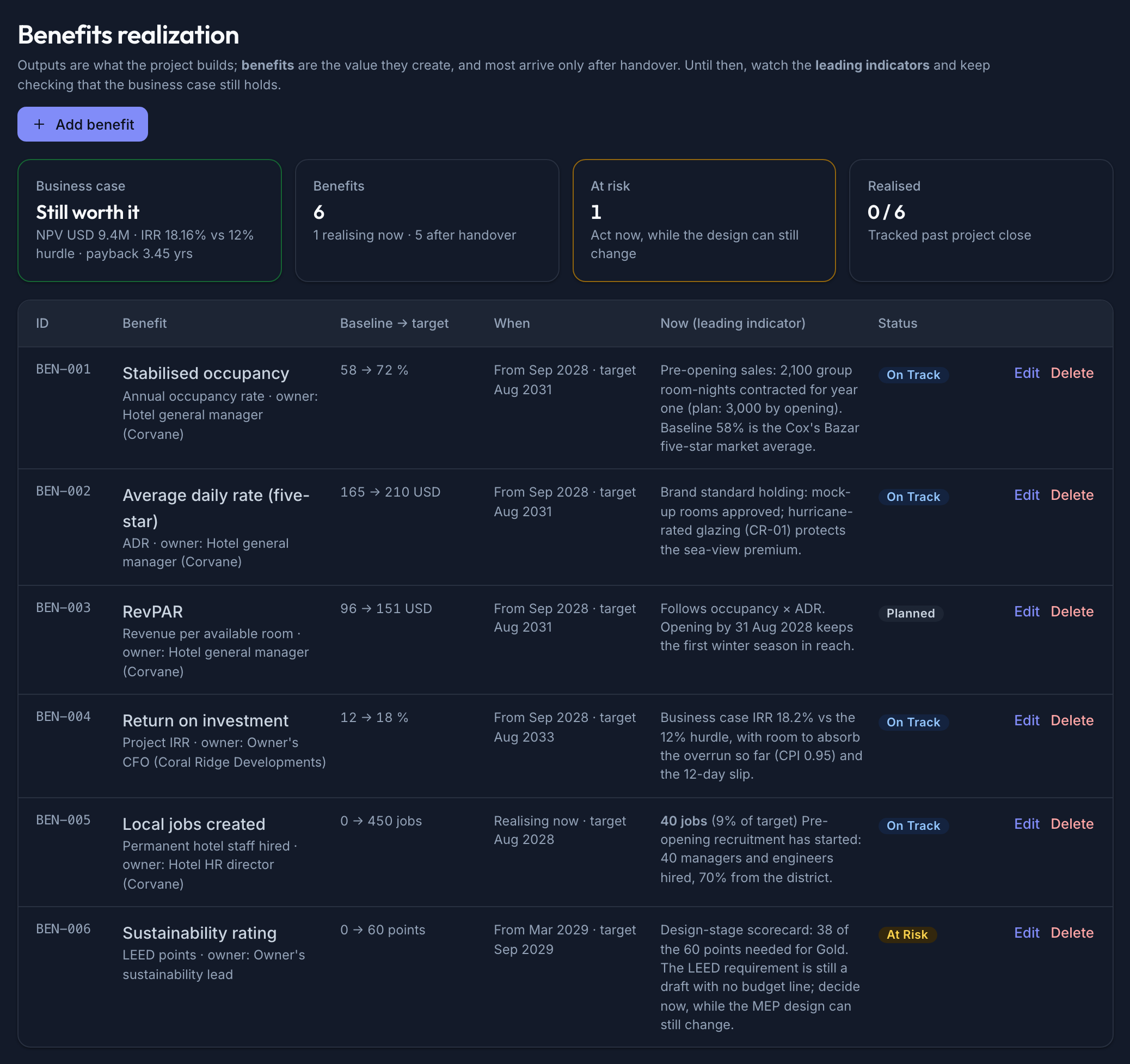
Reading the screenshot: the summary first. Business case: still worth it (NPV USD 9.4M, IRR 18.16% vs 12% hurdle, payback 3.45 years). 6 benefits: 1 realising now, 5 after handover. 1 at risk. 0 / 6 realised, tracked past project close. In the register, occupancy, ADR and RevPAR realise from Sep 2028, so the Now column shows their leading indicators instead of an invented current value. Local jobs is the only one realising now (40 jobs, 9% of target). Every owner is a business role: the hotel GM, the owner's CFO, the HR director. None of them is the PM.
✅ Do give every benefit a baseline, a target, a date, and an owner outside the project team.
❌ Avoid reporting a "current value" for a benefit that can't exist yet. It looks like progress
and isn't.
2 · The business case: is it still worth doing?
The theory: ongoing business justification. The business case is measured in money over time: NPV (the value in today's money, the decision figure), IRR compared with the hurdle rate, BCR (benefit per unit of cost) and payback. It is reviewed at each phase gate. If the numbers no longer justify the project, that is a reason to change course, or to stop.
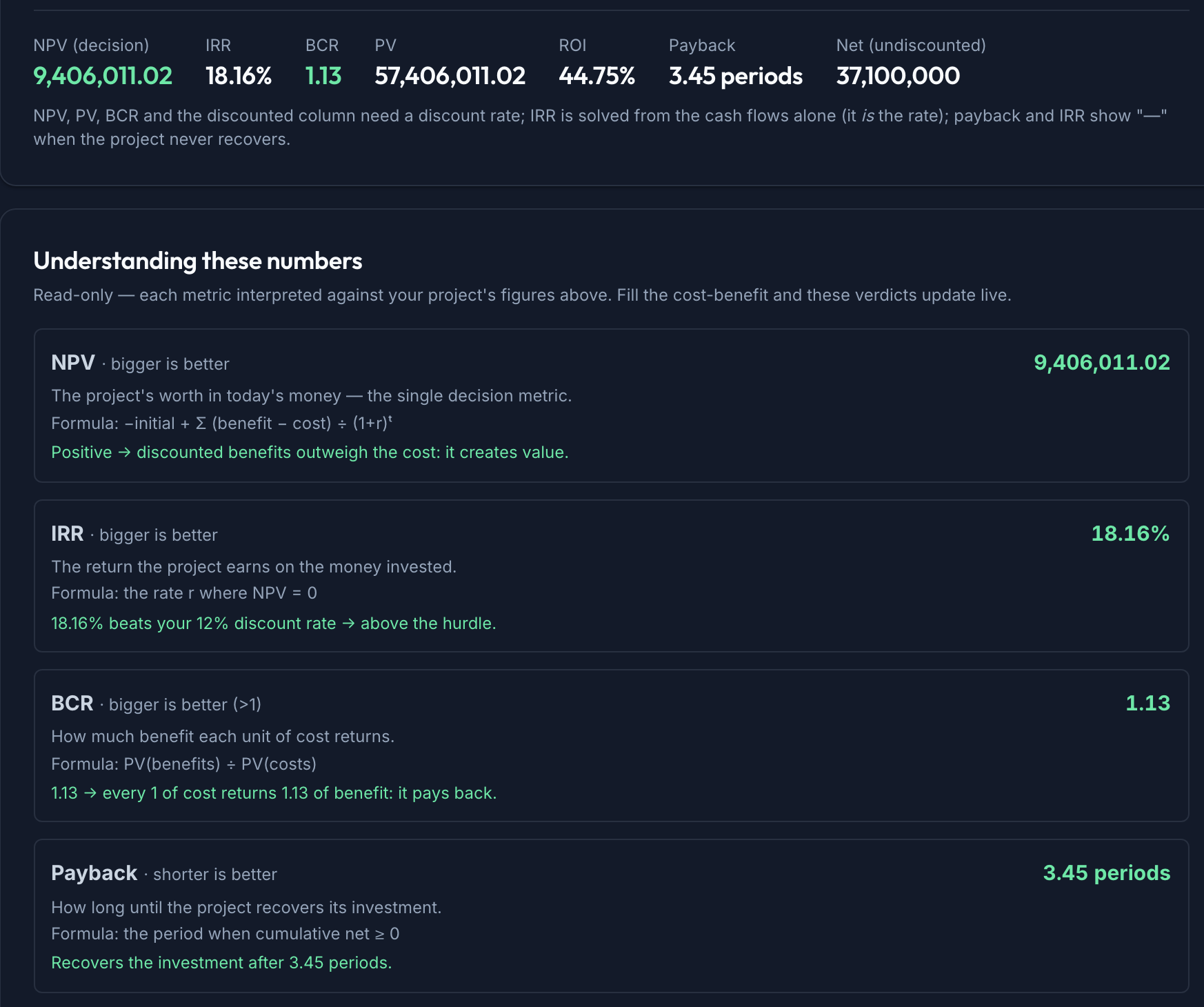
Reading the screenshot: NPV 9,406,011, positive, so the discounted benefits outweigh the cost. IRR 18.16%, above the 12% discount rate. BCR 1.13: every dollar returns 1.13. Payback 3.45 periods (years). Each verdict is calculated from the project's own cash flows, so if the costs or benefit forecasts change, the verdict changes with them. The benefits register's IRR target (18%) matches this figure, so the two documents tell the same story.
✅ Do re-run the numbers when a big change lands: a cost overrun, a delay, a new market forecast.
❌ Avoid sunk-cost thinking: "we've spent too much to stop" is not a business case.
3 · Protect the benefit while it can still be saved
The theory: risks to benefits. A benefit at risk is a project risk with a business owner. The response belongs in the project now (change the design, fund the requirement, or formally drop the target), not at handover when the building is finished.
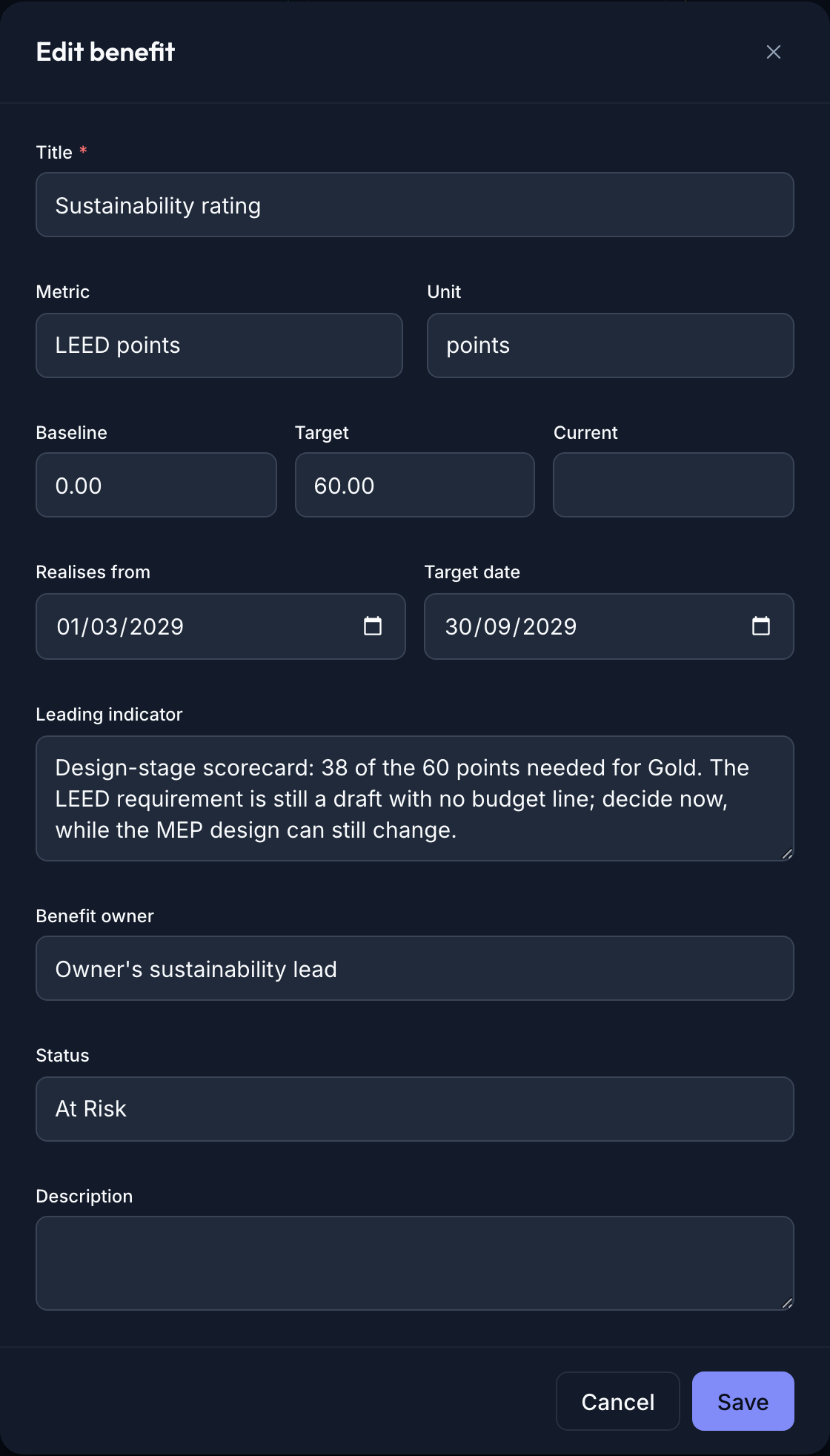
Reading the screenshot: Sustainability rating: 0 → 60 LEED points, realising from March 2029, owned by the owner's sustainability lead, status At Risk. The leading indicator says why: 38 of 60 points at design stage, and a requirement still in draft with no budget line. The decision is due now. Either fund the MEP changes that earn the missing points, or agree with the sponsor that Gold is no longer the target, and record that as a change to the benefits plan.
✅ Do turn an at-risk benefit into a decision with a deadline.
❌ Avoid quietly letting a benefit lapse. If a target changes, the business case and the
benefits plan change with it, openly.
Best practices & pitfalls
- Do make benefits measurable: "improve the guest experience" isn't trackable; "ADR USD 165 → 210 by August 2031" is.
- Do review the business case at every phase gate, and after any major change.
- Do hand each benefit to an owner who will measure it after the project closes.
- Pitfall: declaring success at handover. The project delivered the output; the value is still to come.
- Pitfall: benefits nobody can measure. If there's no baseline, there's no way to show the project made a difference.
On the PMP exam
Know the difference between outputs and benefits, and that the business case and benefits management plan are business documents owned by the sponsor. Expect scenarios where value erodes mid-project: the best answer revisits the business case with the sponsor and may change direction or stop the project, rather than pushing on because of money already spent. Benefits often realise after the project, so the right answer assigns a benefit owner to track them beyond closure. And when a deliverable is on track but its benefit isn't, raise it now, while the design can still change.