
Plan and manage procurement
In the app: Project → Planning → Procurement · Org → Vendors / Contracts
PMP ECO · Process (41%) · Task Pr5. Decide what to buy vs build, source it fairly, and administer the contracts so both sides deliver.
What it is
Procurement runs: plan (make-or-buy, contract strategy, the procurement SOW), conduct (solicit, evaluate, select a seller), and control (administer the contract, manage claims and changes, close it). The contract type allocates risk: fixed-price (FP) puts cost risk on the seller; cost-reimbursable (CR) on the buyer; time & materials (T&M) sits between and suits undefined scope.
Why it matters
- Most of a construction budget is bought, not built in-house — the contract strategy is a primary risk-management lever.
- The wrong contract type transfers risk to the party least able to control it, and it shows up as claims and disputes later.
Where you do it in VanillaPM
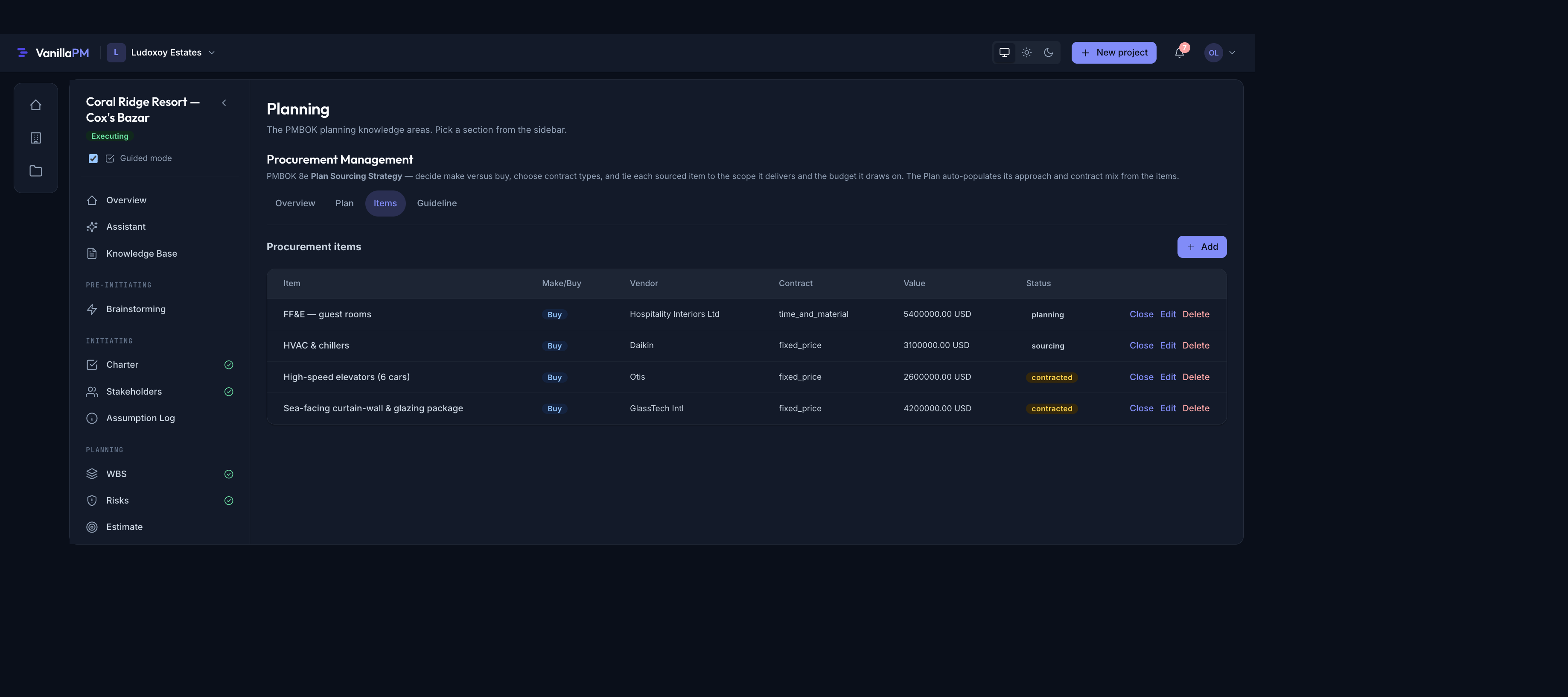
The procurement plan + items capture each package: its threshold, RFP/selection status, and the chosen approach, linked to the WBS scope it delivers. Vendors and Contracts hold the seller and agreement records, and a read-only roll-up ties procurement value back to the budget.
Walked example — Coral Ridge Resort
Coral Ridge's make-or-buy is mostly buy: the main-contractor JV delivers the build under a large contract; the imported façade and lifts and the MEP packages are separate procurements. The team leans fixed-price for well-defined packages (the JV frame contract) to transfer cost risk, and keeps a T&M posture where scope is still fluid (early enabling works). The imported-façade package is flagged because customs delay is a live risk — so its lead time and contract terms get extra attention.
The artefact
- Procurement management plan + items — package · threshold · contract type · RFP status.
- Vendor and contract records — the sellers and agreements, rolled up to budget.
Best practices & pitfalls
- Do match contract type to scope certainty: well-defined → FP; fuzzy → CR/T&M.
- Do write a clear procurement SOW — ambiguity there becomes a change order.
- Pitfall: picking the lowest bid on price alone; source selection should weight capability and risk, especially for safety-critical coastal work.
On the PMP exam
Contract types and who carries the risk is heavily tested — FP = seller risk, CR = buyer risk. Know make-or-buy, the procurement SOW, source-selection criteria, and that contract changes flow through integrated change control. Point-of-total-assumption and incentive-fee maths can appear for FPIF contracts.