
Foster continuous improvement
In the app: Project → Closeout → Lessons learned · Project → Meetings
PMP ECO · Business Environment (26%) · Task B6. Improve as you go — hold retrospectives, capture lessons throughout (not just at close), and feed them back into how the work is done.
What it is
Continuous improvement treats every phase as a chance to get better: run retrospectives, capture lessons learned throughout the lifecycle, turn them into process changes, and store them as organisational process assets (OPAs) the whole organisation can reuse. It's the kaizen mindset — small, steady, compounding improvement — applied to project delivery.
Why it matters
- Lessons captured at the end help only the next project; lessons captured during help this one — the next floor cycle benefits from the last one's mistakes.
- Improvement that isn't fed back into process is just venting; the value is in changing what you do.
Where you do it in VanillaPM
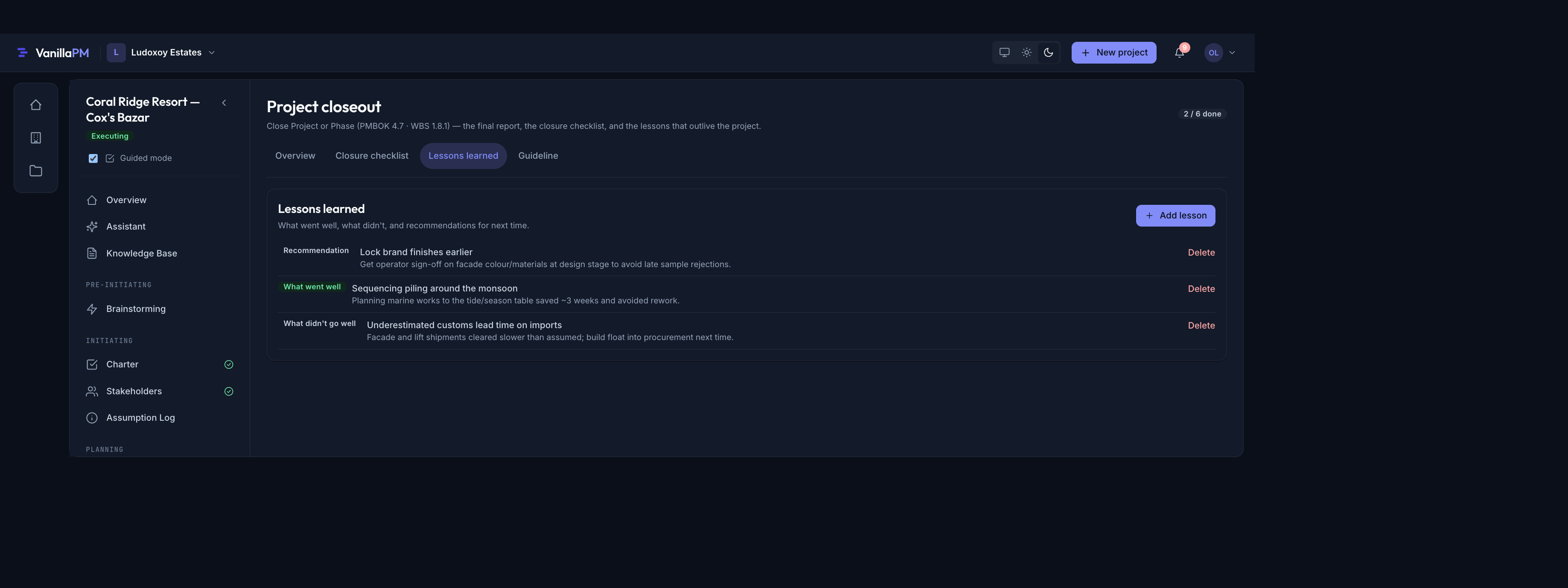
Lessons Learned (Closeout → Lessons learned) is captured continuously, retrospective meetings run per phase, and SOP / Knowledge-Base articles hold the resulting improvements as reusable OPAs.
Walked example — Coral Ridge Resort
Coral Ridge doesn't wait for handover to learn. After the floors 1–5 RCC cycle, a retrospective finds the pour-and-cure sequence lost days to the monsoon; the lesson — a revised wet-season pour window and a curing-cover standard — is captured and applied to floors 6–10, which run cleaner. The customs delay on lifts becomes a logged lesson (order long-lead imports earlier) that reshapes procurement on the remaining packages. Each improvement lands as a KB/SOP article for the next coastal build.
The artefact
- Lessons-learned register + retrospectives, with improvements stored as SOP/KB OPAs.
Best practices & pitfalls
- Do capture lessons continuously and apply them within the project — not just archive them at close.
- Do make retrospectives blameless so people surface the real lessons.
- Pitfall: a lessons log that's write-only — if nothing changes because of it, the loop is broken.
On the PMP exam
Continuous improvement, retrospectives, and lessons learned throughout the lifecycle are the themes — reinforced by agile's inspect-and-adapt cadence. Know that lessons become OPAs, and that the best answers act on improvement during the project, not only document it at the end.