
Manage stakeholder expectations
In the app: Project → Stakeholders → Register → Log · Actions (and the Backlog)
PMP ECO · People (33%) · Task P6. Keep engagement on track through the project: track the interactions, keep the commitments, and act on drift.
What it is
Alignment (P5) sets the target. Managing expectations is the ongoing work of getting stakeholders there and keeping them there: logging interactions, honouring commitments, and responding when someone's attitude slips. It is the monitor step of the identify → analyse → prioritise → engage → monitor loop.
Why it matters
- Engagement decays. A supportive regulator who stops receiving data drifts to neutral. A neutral community that hears a rumour drifts to resistant. Tracking catches the drift while it's cheap to fix.
- A written interaction history turns "I think we told them" into evidence, which matters on a multi-year, multi-agency build.
- Broken commitments cost trust faster than anything else. You can only keep the promises you wrote down.
Where you do it in VanillaPM
On Stakeholders → Register, each row has two buttons:
- Log opens the interaction log: date, type (meeting, call, email, presentation, document shared), summary, outcome, and the next action it led to.
- Actions opens the engagement actions: what you'll do, who does it, when, and its status.
Each engagement action also becomes a task at the top of the backlog, assigned to its owner, and the two stay in sync: finish the task and the action is marked done.
Walked example — Coral Ridge Resort
For the local community, the log tells the whole arc. A protest at the site gate when the beach path was fenced off for piling. A town hall where the project committed to a permanent public beach corridor and local hiring. The revised site plan sent in writing. Then, three days ago, a rumour that the corridor closes once the hotel opens, answered the same day. Each entry links to the action that follows it, so nothing promised is left hanging.
The workspace — the theory behind each screen
Every screenshot is the actual sample project, not a mock-up.
1 · Keep a record of every contact, and what came of it
The theory: the interaction log. Log each contact with its outcome, and especially the commitments made. Review the log before any major touchpoint, so you walk in knowing what was promised and where the relationship stands.
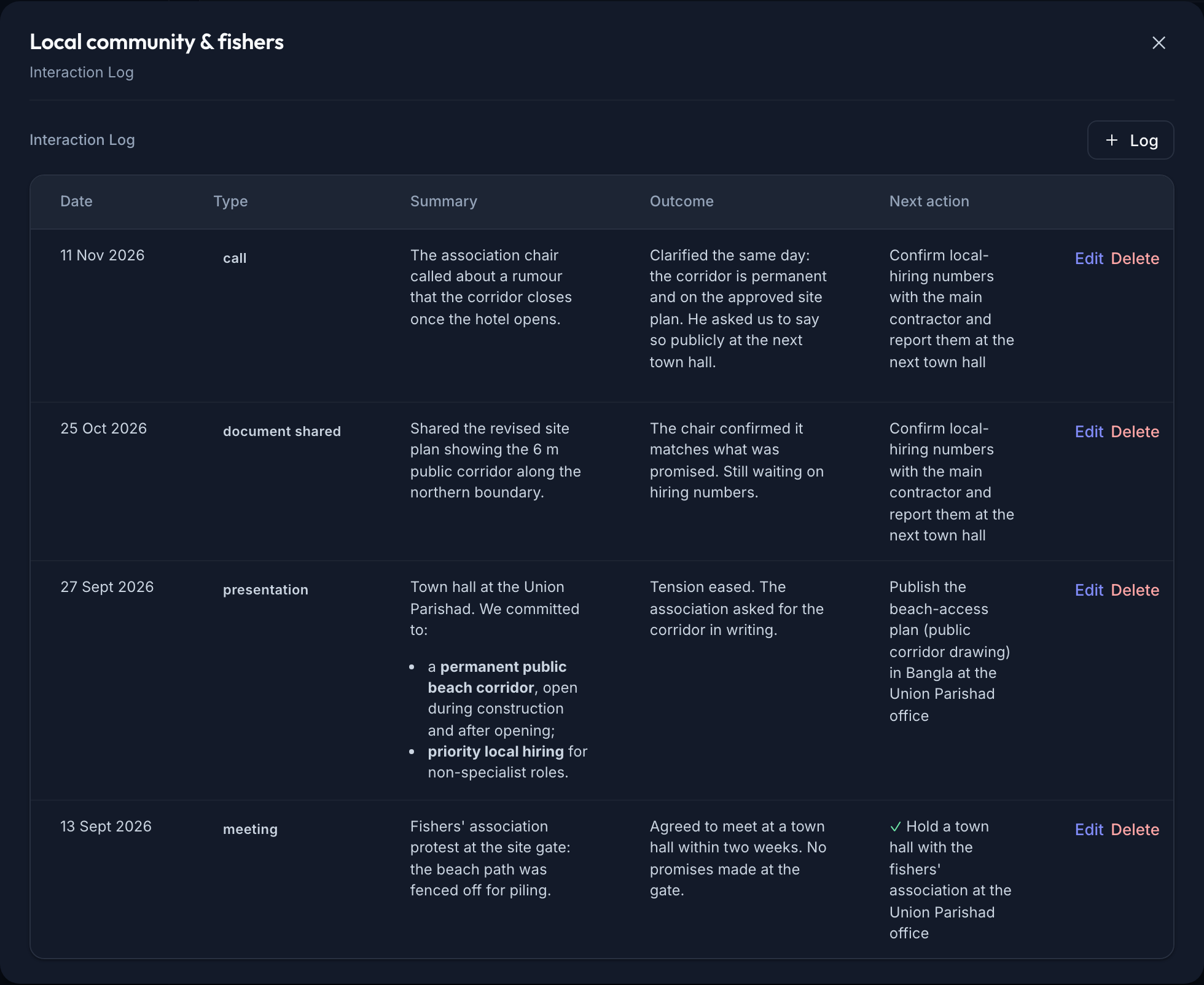
Reading the screenshot: read it bottom-up, oldest first. 13 Sept: a protest; note the outcome, "no promises made at the gate". Commitments belong in a proper forum, not under pressure. 27 Sept: the town hall, with the two commitments in bold. 25 Oct: the site plan shared in writing. 11 Nov: the rumour. This is engagement decay in action, caught early because there was already a relationship to call. The Next action column links each entry to a tracked action; the ✓ shows the town hall was done.
✅ Do log commitments in the words you used. "We committed to" is the line people remember.
❌ Avoid logging only meetings. A call that killed a rumour matters as much as a town hall.
2 · Make every commitment someone's job, with a date
The theory: engagement actions. Each commitment becomes an action with an owner, a due date and a status. That is the difference between a promise and a plan.
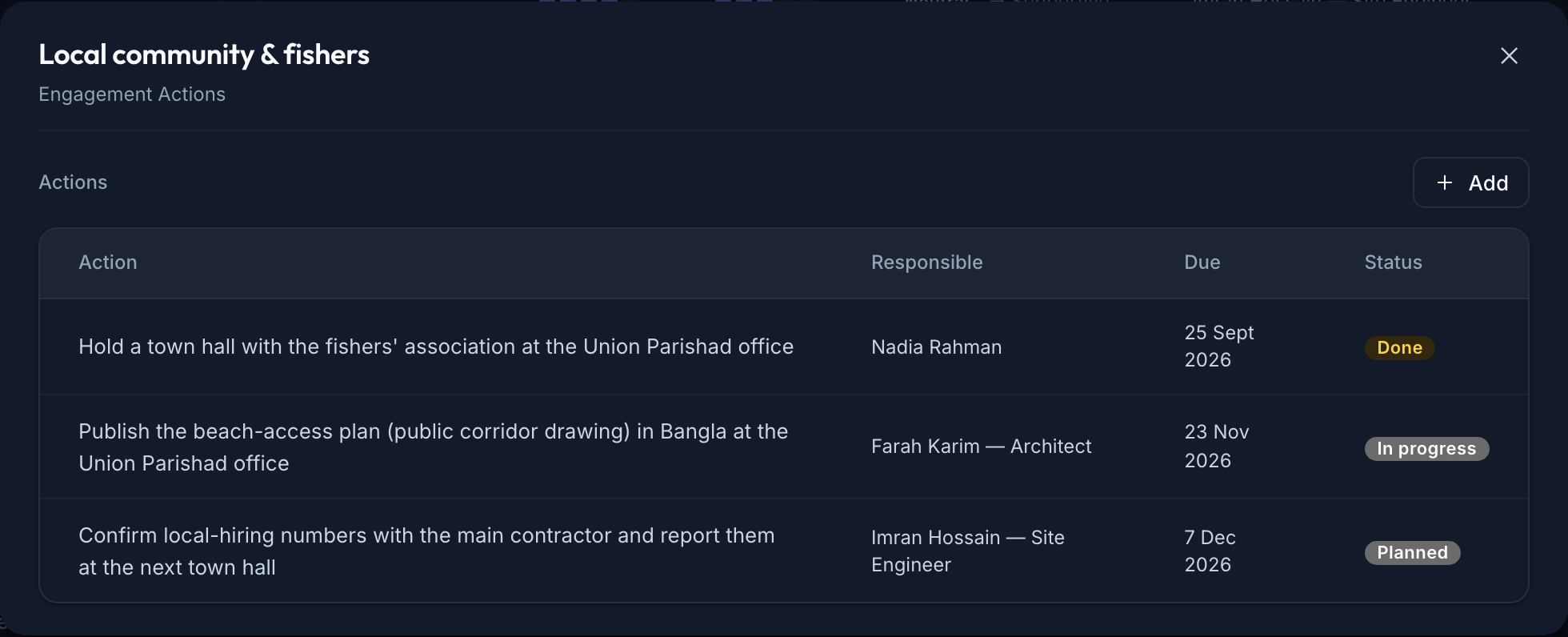
Reading the screenshot: three actions, three owners. The town hall (Nadia) is done. The beach-access plan in Bangla (Farah) is in progress, due in nine days. The local-hiring numbers (Imran) are planned. These two open actions are exactly what the town hall promised, so the community's attitude now depends on them landing on time.
✅ Do give each action one owner and a real date.
❌ Avoid promising in a meeting what nobody has been asked to deliver.
3 · Put stakeholder work where the team already looks
The theory: integration. Engagement work that lives only in a stakeholder tool gets forgotten. It competes for the same hours as the build, so it belongs on the same backlog.
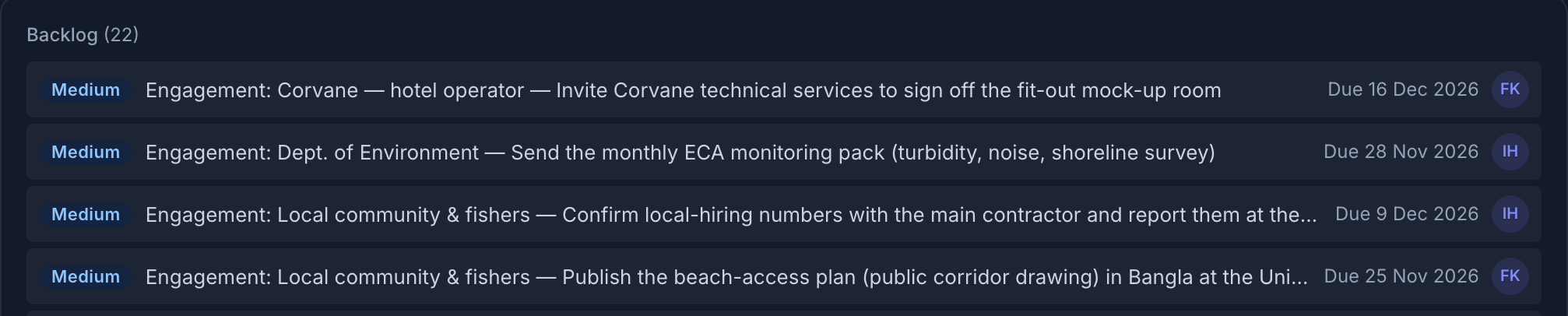
Reading the screenshot: the open engagement actions sit at the top of the project backlog, each assigned (FK Farah, IH Imran) with its due date, next to the construction work. Sprint planning now has to make room for the beach-access plan instead of discovering it a week late. When Farah closes the task, the action on the stakeholder flips to done.
✅ Do review open engagement tasks at every sprint planning or weekly meeting.
❌ Avoid a separate "stakeholder list" the delivery team never sees.
Best practices & pitfalls
- Do log commitments, not just meetings. Broken commitments cost trust fastest.
- Do review the log before any major stakeholder touchpoint.
- Do answer a rumour the same day, and repeat the answer publicly.
- Do revisit the engagement plan if the same stakeholder keeps slipping. Patching each slip treats the symptom.
- Pitfall: managing expectations only when there's a problem. Steady, small contact prevents the crises.
On the PMP exam
This is the monitor and maintain half of stakeholder work. Expect questions where engagement has slipped or a stakeholder feels blindsided. The best answers restore proactive, documented communication, check what was committed (the log), and revisit the engagement plan. A one-off apology, or escalating before you've talked to the stakeholder, is the distractor.