
Plan and manage schedule
In the app: Project → Gantt (Timeline · List · Variance)
PMP ECO · Process (41%) · Task Pr8. Turn the scope into a sequenced, estimated, baselined timeline — find the critical path, protect it, and control against the baseline as reality lands.
What it is
Schedule development runs: define activities → sequence them (dependencies, leads/lags) → estimate durations → develop the schedule → control it. The Critical Path Method (CPM) finds the longest path of dependent activities — the critical path — and each activity's float/slack (how much it can slip before it delays the project). To compress a schedule you can crash (add resources — costs money) or fast-track (run activities in parallel — adds risk). Uncertain durations can be estimated with PERT (three-point: (O + 4M + P) / 6).
Why it matters
- The critical path is where schedule risk lives — a day lost on it is a day lost on the project; a day lost off it may cost nothing.
- A baseline is what makes "are we behind?" a measurable question instead of a feeling.
Where you do it in VanillaPM
The Gantt workspace (Timeline · List · Variance) gives CPM/float, a baseline to freeze the plan, PERT three-point estimation, and variance (baseline vs actual). The schedule sequences the WBS work packages and drives the Earned-Value schedule indices.
Walked example — Coral Ridge Resort
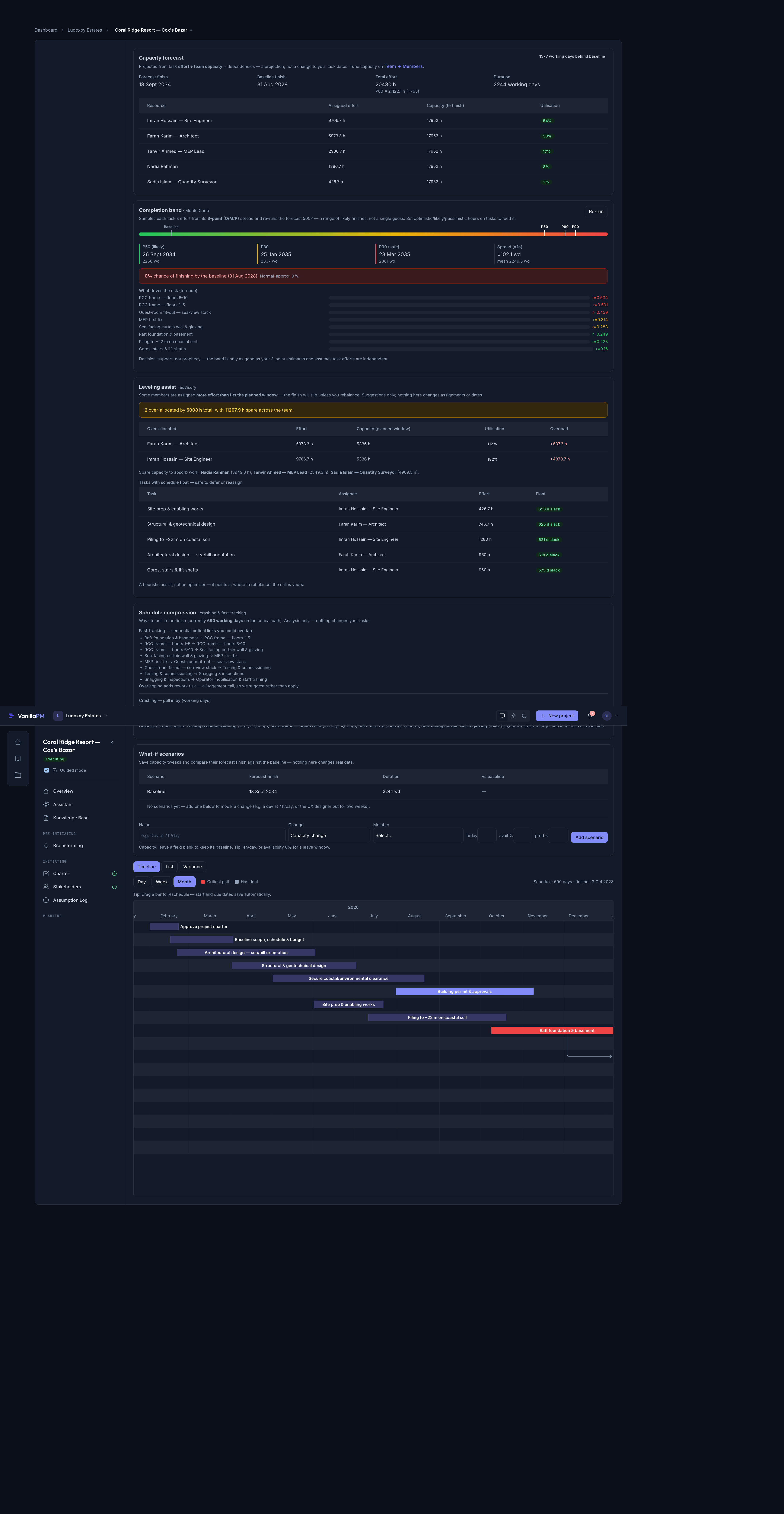
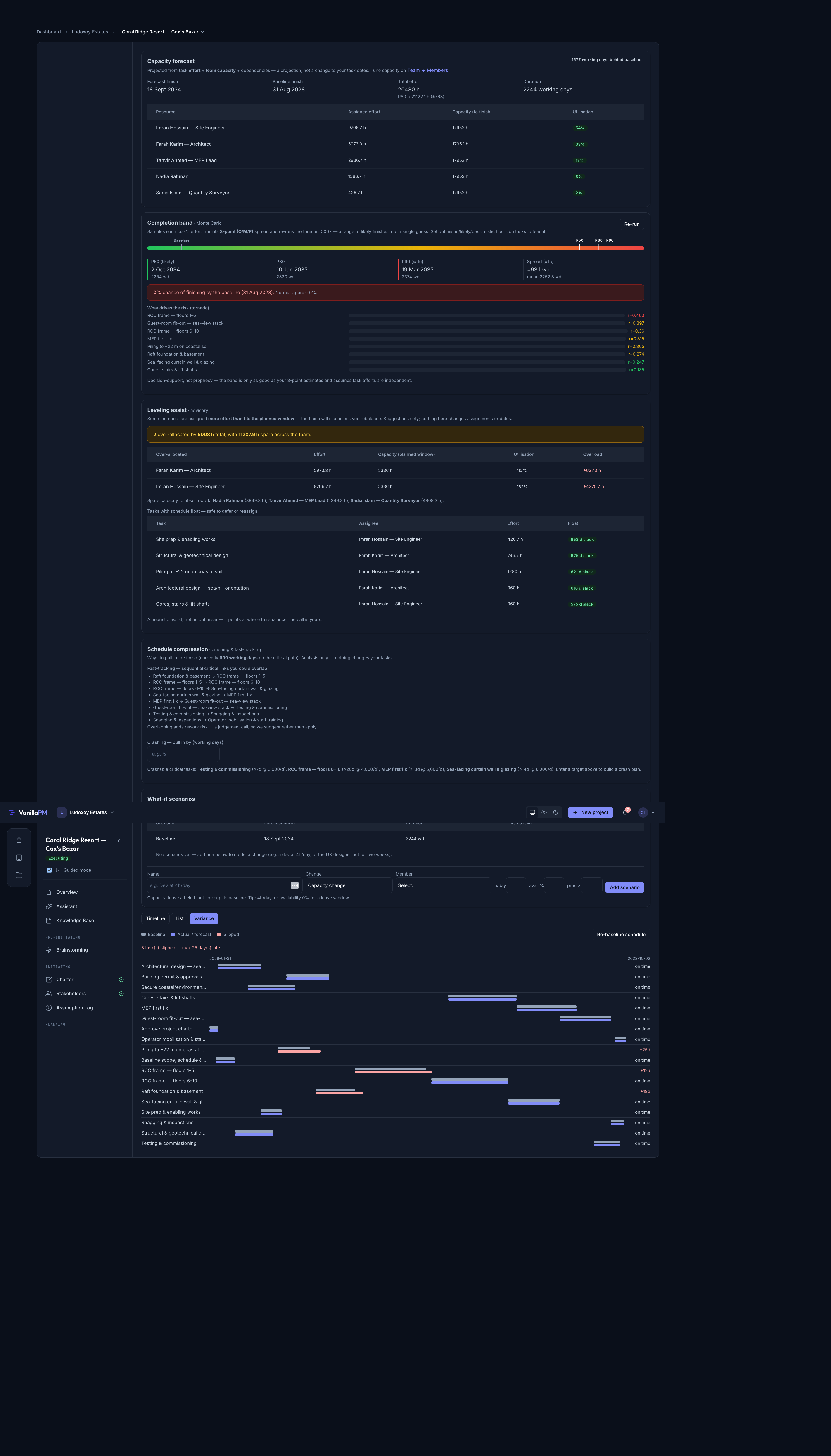
Coral Ridge's critical path runs design → coastal/ECA clearance → piling (−22 m) → raft & basement → RCC frame 1–5 → frame 6–10 → sea-facing curtain wall → MEP → fit-out → commissioning — each step gates the next, so the clearance and the frame cycles carry no slack. Because piling on unknown coastal strata is uncertain, its duration is PERT-estimated. To chase the peak-season open, the team fast-tracks the sea-view fit-out stack (starting fit-out on lower floors while upper floors are still framing) — buying schedule at the cost of added coordination risk. The baseline vs actual view shows where the monsoon pushed the frame and how the recovery is tracking.
The artefact
- Schedule baseline + Gantt (critical path, float), with PERT estimates and variance tracking.
Best practices & pitfalls
- Do know your critical path and guard it — that's where to focus attention and reserve.
- Do choose compression with eyes open: crashing costs money, fast-tracking adds risk; neither is free.
- Pitfall: managing to the baseline dates while ignoring the critical path — a slip off the path may not matter; a slip on it always does.
On the PMP exam
Schedule is technique-heavy: critical path, total vs free float, forward/backward pass, crashing vs fast-tracking, leads and lags, and PERT three-point estimating. Expect to identify the critical path from a network diagram and to pick the right compression method for a given constraint (cost-sensitive → fast-track; risk-sensitive → crash).