
Run a confidential whistleblowing channel
Learn HR · Humanitarian / INGO HR · Task B3. After safeguarding & PSEA taught the standard and showed the reporting route, this task goes inside the channel — how a concern is received, protected, worked and closed. It's the one Domain-B task with real product depth: the Speak-Up channel is a genuinely built feature, and getting it right is a safeguarding control in its own right.
What it is
A confidential whistleblowing channel (here, Speak-Up, apps/speakup) is the mechanism that
turns "you can report a concern" into something a reporter can actually trust. It is the concrete
form of CHS Commitment 5 — people have access to safe, accessible mechanisms to raise a
complaint — and it has to hold several promises at once:
- Off until it's trustworthy. The channel is disabled by default and may only go live once it is configured (a reporter-facing policy, a handler panel) and signed off. The sign-off attests to an exact version of the config; change anything afterwards and the channel auto-reverts to off until it's re-signed. Fail-closed, by design.
- Routed away from the line manager. Reports go to a designated panel of handlers — a panel, not a person — never automatically to the person being reported about.
- Anonymous, with a way back. A reporter can stay anonymous; a one-time tracking code is the only handle on an anonymous report, and it lets a two-way follow-up thread happen without ever revealing identity.
- Confidential at rest. The narrative, the context, any reporter details and the messages are encrypted; only a designated, in-scope, non-recused handler can ever read them.
- Recorded and recusable. Every read and action lands on an append-only case trail ("who opened what, when"); a handler who is named or implicated can recuse and immediately loses access.
- Escalated carefully. A substantiated concern can be escalated to a disciplinary case — but manually, and only by a written summary; the raw report never crosses over.
Grounded in CHS Commitment 5 and Humentum (cited for orientation, never reproduced).
Why it matters
- A channel people don't trust is worse than none. If a reporter fears the report goes to the person they're reporting, or that "anonymous" isn't really anonymous, they won't use it — and the harm stays hidden. Every property above exists to earn that trust.
- The sign-off gate is the safety interlock. Turning a confidential channel on carelessly — no policy, no panel, no accountability — is how confidentiality gets broken on day one. Fail-closed means the channel can't be live unless someone with authority has attested it's set up right.
- Routing + recusal are the anti-cover-up controls. The whole point is that a report about a manager doesn't land on that manager's desk. Designation and recusal are how the system structurally routes away from the implicated.
- The append-only trail is the accountability. "Who opened this confidential report, and when" is itself sensitive; a tamper-evident trail is what lets an organisation prove the channel was handled properly — and detect it if it wasn't.
Where you do it in VanillaPM
Two surfaces: an admin one to stand the channel up (gated on speakup.configure), and the
handler console to work reports (visible only to designated handlers).
-
Configure & sign off (the gate). Speak-Up settings carries the reporter-facing policy and an honest anonymity-limits statement, retention periods (unsubstantiated vs substantiated), the sign-off mode (owner-only or committee), and the designated handler panel — each handler a platform user or an external member, with a role and an optional category scope, and recuse-if-named on by default. The channel shows Active only once the required signer(s) have signed this version; the page even surfaces the jurisdiction's expectations for the panel (a template, not legal advice).
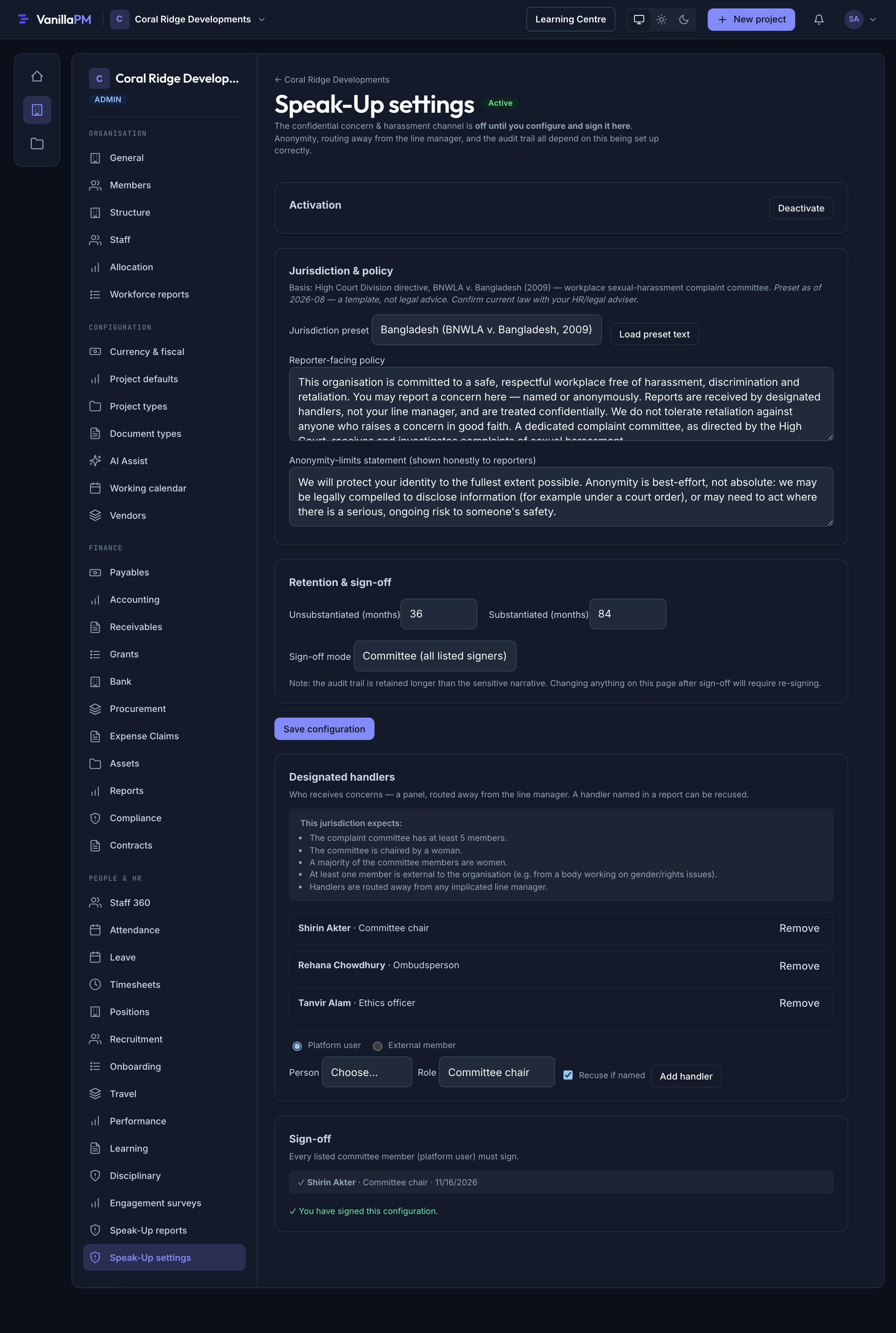
The Speak-Up settings page marked Active — jurisdiction & reporter-facing policy, an honest anonymity-limits statement, retention (36/84 months) and committee sign-off mode, a designated-handler panel (chair · ombudsperson · ethics officer) with the jurisdiction's committee expectations, and a sign-off confirming the current configuration is signed -
The handler console. A designated handler sees the concerns routed to them — by category, status (submitted → acknowledged → under review → resolved → closed), whether the report is anonymous or named, with its tracking code. Nothing here is visible to anyone who isn't a designated, in-scope handler.
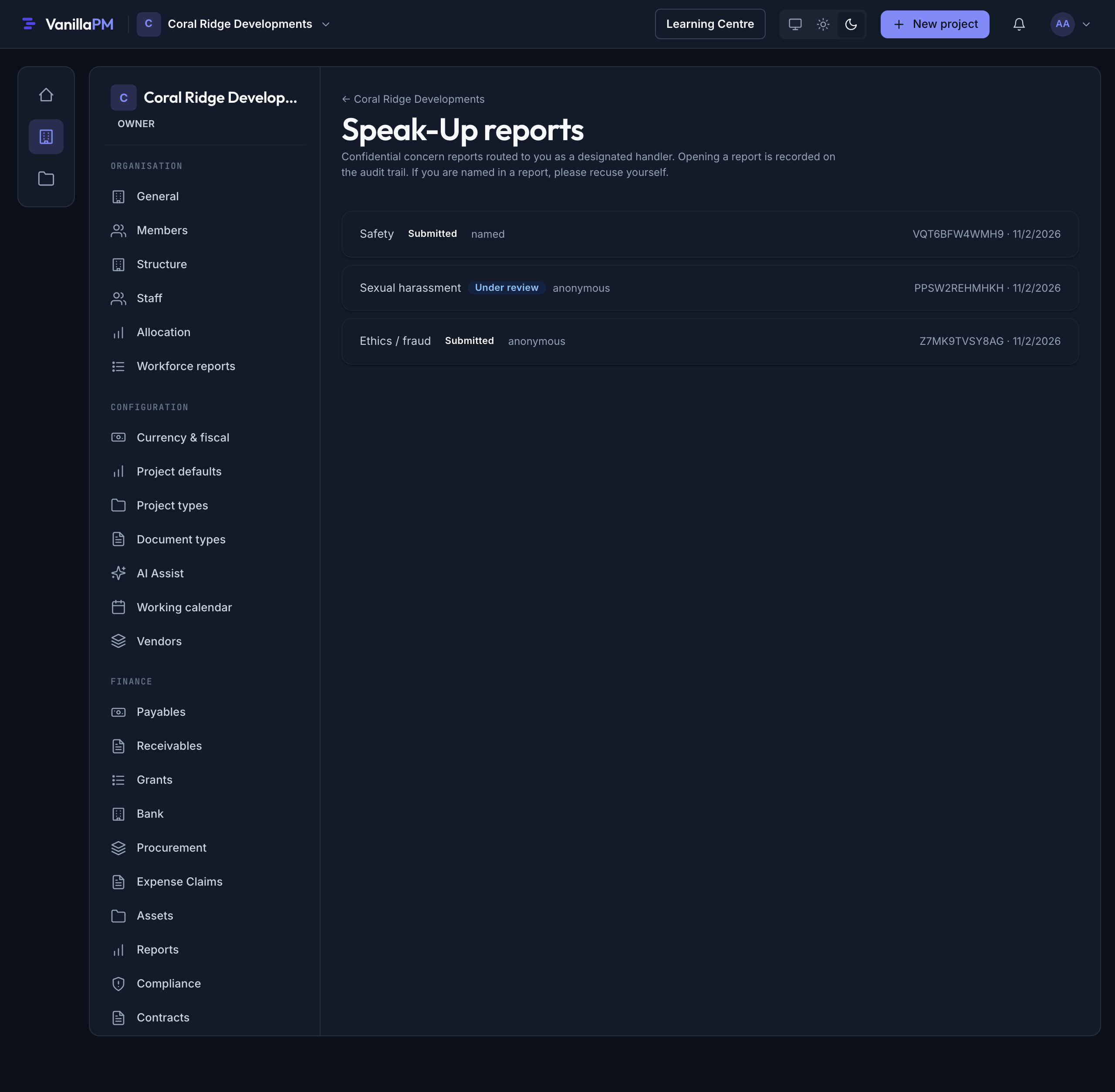
The Speak-Up reports console — three routed concerns (a named safety report, an anonymous sexual-harassment report under review, an anonymous ethics/fraud report), each with category, status, anonymous/named and a tracking code; a note that opening a report is recorded on the audit trail and that a named handler should recuse -
Work a report. Opening a concern (which the trail records) shows the encrypted narrative decrypted for the handler, the status actions (acknowledge · start review · take the case · resolve · close) and Recuse myself; a two-way reporter thread that works even when the reporter is anonymous; a disciplinary-escalation panel where only a written summary crosses to a case; and the append-only case trail of everything done so far.
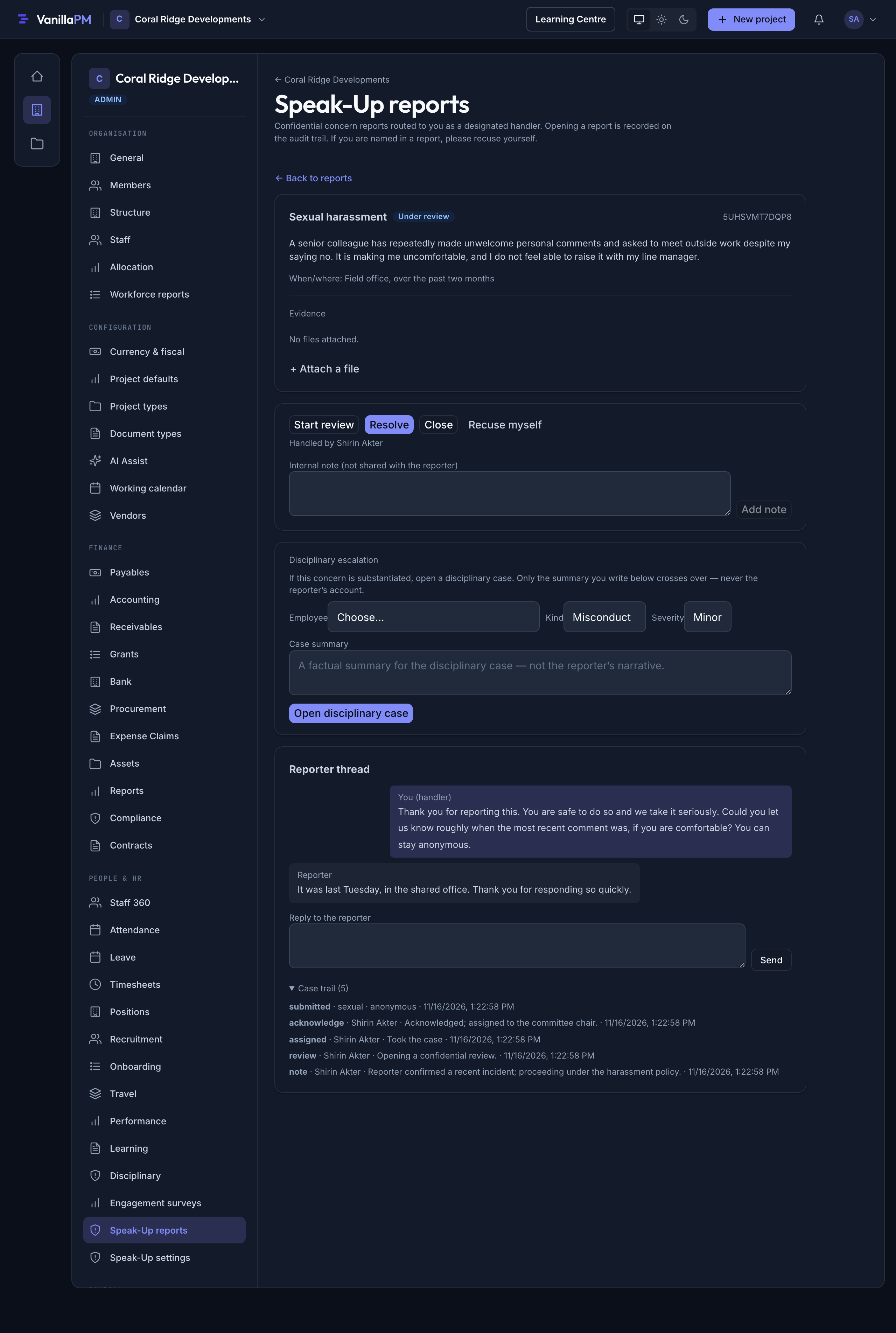
A concern opened in the console — an anonymous harassment report 'Under review', status actions and 'Recuse myself', a disciplinary-escalation panel noting only the summary crosses over (never the reporter's account), a two-way reporter thread, and an expanded append-only case trail (submitted · acknowledge · assigned · review · note), each entry stamped with handler and time
⚠️ Honesty box — built, but production-gated (and still staff-facing)
Unlike duty of care and safeguarding, this is a real, built module (CR-095) — the gate, the encryption, the panel, recusal, the trail and escalation all exist. Two honest caveats remain. First, it's production-gated. The channel is off by default and must be configured and signed off before it goes live — and going live for real is a decision for HR and legal, not a toggle an engineer flips: the jurisdiction preset is a template, not legal advice, and anonymity is best-effort, not absolute (the organisation may be legally compelled to disclose, or must act on serious ongoing risk) — which the reporter is told plainly. Second — carried over from B2 — this is a staff whistleblowing channel, not a beneficiary-facing community feedback mechanism. The deepest part of PSEA under CHS Commitment 5 — a safe route for affected communities to report an aid worker — is still policy the organisation runs in the field, a demand-driven future build. So the honest claim is: a real, well-built confidential channel for staff concerns — gated on sign-off, honest about anonymity, and not yet the community mechanism.
Walked example — a concern worked at Hilsa
The Hilsa Health Initiative stands up Speak-Up for its field programme. It configures the reporter-facing policy, sets committee sign-off, and names a panel: a chair, an external ombudsperson (no login — an external seat matters for independence), and an ethics officer. The chair signs off the configuration, and only then does the channel show Active and its public link start accepting reports.
A field staff member submits an anonymous concern — category: sexual harassment — about a senior colleague, choosing not to name themselves because they don't feel safe raising it with their line manager. In the console it lands as submitted, anonymous, with a tracking code. A handler acknowledges it, takes the case, moves it to under review, and — crucially — replies through the thread: "Thank you for reporting this. You're safe to do so… can you tell us roughly when the most recent comment was? You can stay anonymous." The reporter answers — "last Tuesday, in the shared office" — without their identity ever being revealed, because the tracking code, not a name, carries the thread. Every step is on the append-only trail: submitted · acknowledged · assigned · review · note, each stamped with the handler and the time.
Now the two protective turns. Recusal: if the report had named a handler — say the ethics officer — that handler would recuse, and the report would vanish from their view, routed to the rest of the panel. Escalation: if the review substantiates the concern, the handler opens a disciplinary case — but writes a factual summary for it; the reporter's raw account stays in Speak-Up, more restricted than the HR case. The channel protected the reporter at every step, and the record proves it did.
The records — what the channel captures
| What it holds | Who can read it | |
|---|---|---|
| Config + sign-off | policy · anonymity limits · retention · panel · a sign-off bound to the exact config version | admins with speakup.configure; the sign-off is the activation attestation |
| Concern | category · encrypted narrative/context · anonymous? · (named) reporter details · tracking code · status | only designated, in-scope, non-recused handlers |
| Reporter thread | two-way messages keyed on the tracking code (encrypted) | the reporter (by code) ↔ handlers |
| Case trail | append-only actions + every read ("who opened what, when") | handlers; the accountability record |
| Recusal | a handler removed from one concern | enforced — a recused handler can't see it |
| Escalation link | the disciplinary case spawned from a written summary | the concern stays more restricted than the case |
What makes it safe is what each record can't do: the narrative can't be read by a non-handler or a recused handler; the thread can't reveal an anonymous reporter; the trail can't be edited; the escalation can't carry the raw account across.
Controls & assurance
- Fail-closed activation.
enabledcan only be true while the config is complete and signed for its current version; any edit changes the version hash, drops the sign-offs, and auto-reverts the channel to off. You can't have a live channel nobody attested to. - Routing by construction. A concern is only ever visible to a designated handler whose
category scope covers it and who isn't recused — enforced in code (
can_view_concern), not by convention. The line manager sees nothing unless they were designated. - Recusal is real removal. Recusing isn't a note — it removes the handler's access to that concern, honouring "route away from the implicated."
- Encryption at rest + audited reads. Sensitive fields are encrypted; every open and every evidence download is written to the append-only trail. Evidence is served only through an audited, designation-gated stream — never a shareable link.
- Escalation is manual and summarised. Nothing auto-escalates; a handler chooses to, and only the summary they write crosses to the disciplinary case. The concern record stays more restricted.
- Retention is deliberate. Unsubstantiated reports are kept for a shorter window than substantiated ones (e.g. 36 vs 84 months), and the audit trail outlives the sensitive narrative — accountability without hoarding the account.
Best practices & pitfalls
- Do build a real panel with at least one external seat, and leave recuse-if-named on — independence is what makes the channel trustworthy.
- Do have HR/legal confirm the policy and anonymity limits before you sign off; the preset is a starting template, not legal advice.
- Do use the thread to support an anonymous reporter — the tracking code lets you follow up without ever asking who they are.
- Pitfall: promising absolute anonymity. The tool is honest that it's best-effort; a handler who promises more breaks trust the first time disclosure is compelled.
- Pitfall: editing the config after sign-off and wondering why the channel went dark. That's the auto-revert working — re-sign the new version.
- Pitfall: pasting the reporter's raw narrative into the disciplinary case. Only your summary crosses; the account stays in the more-restricted Speak-Up record.
- Pitfall: treating this staff channel as your PSEA community mechanism. It isn't — the beneficiary-facing route is still policy you run in the field.
Practise question
Q1. You're a designated Speak-Up handler. An anonymous report comes in naming a colleague for harassment; the reporter wants to stay anonymous but is willing to answer questions. Partway through, you realise the report also implicates you. Walk through how you handle it — confidentiality, follow-up, your own position, and escalation — and what the system does at each step.
Answer: First, follow up through the thread, not by hunting for identity. The tracking code lets you ask the reporter for detail — when, where — and them to answer, without ever revealing who they are; the narrative and the thread are encrypted and visible only to designated handlers. Second, the moment you realise you're implicated, recuse yourself. Recusal isn't a courtesy note — it removes your access to that concern, which then routes to the rest of the panel (this is exactly why it's a panel, not a person, with an external seat). You should not be the one to acknowledge, review, or especially escalate a report that names you. Third, if a non-recused handler reviews it and substantiates it, escalation to a disciplinary case is manual and carries only a written summary — the reporter's raw account stays in the more-restricted Speak-Up record. Throughout, the append-only trail records who did what and when — including that you recused — so the handling is accountable and tamper-evident. And the honest caveat you'd never hide from the reporter: anonymity is best-effort, not absolute — if there were a serious ongoing risk or a legal compulsion, the organisation might have to act or disclose, which the policy states up front. The system's job is to make the trustworthy path the structural one; recusing when named is you upholding that.
Your hands-on assignment
Stand the channel up in a sandbox and walk a concern through it. In a demo organisation — never live staff data (your names and figures will differ from Hilsa's):
- In Speak-Up settings, read the policy, the anonymity-limits statement and the retention periods.
- Add a handler panel (with recuse-if-named on) and complete the sign-off — check the channel only shows Active afterwards.
- Submit a test concern anonymously from the public page and note its tracking code.
- In the handler console, open it, acknowledge it, and reply on the reporter thread.
- Find the escalation panel and note what would cross to a disciplinary case — only a written summary.
When you've done it, test yourself with the knowledge check below — a short quiz drawn from this lesson. Score 80% or more and the lesson is marked complete.
Terms used here
- Whistleblowing / Speak-Up channel — a confidential route to raise a concern; CHS Commitment 5 made concrete (here, staff-facing).
- The sign-off gate — the fail-closed rule that the channel is off until configured and signed for its current version; edits auto-revert it.
- Sign-off mode — owner-only (the owner signs) or committee (every platform-user handler signs).
- Designated handler / panel — the people a concern routes to; a panel (chair · member · external · ombudsperson · ethics), optionally scoped by category.
- Tracking code — the unguessable, one-time key that is the only handle on an anonymous report; carries the follow-up thread without revealing identity.
- Recusal — a named/implicated handler removed from a concern; they can no longer see it.
- Case trail — the append-only record of actions and reads on a concern ("who opened what, when").
- Escalation — manually opening a disciplinary case from a concern by a written summary; the raw account doesn't cross.
- Retention — how long reports are kept (unsubstantiated < substantiated); the audit trail outlives the narrative.
- CHS Commitment 5 / Humentum — the standards this channel is grounded in (cited, not reproduced).
- Related: Safeguarding & PSEA — the standard this channel serves (B2) · Handle an employee-relations case — where a substantiated concern escalates to (A7).
What an auditor / donor expects
They expect a channel that is real, safe and accountable — and they'll probe each word. Real: is there a reporting route, and is it actually on (configured, signed off, Active)? Safe: are reports routed away from the line manager to a designated panel with an external seat; can a named handler recuse; is the narrative confidential and is anonymity honestly described (not over-promised)? Accountable: is there an append-only trail showing who handled what, and a retention policy? The Speak-Up channel answers all of these for staff concerns, and the sign-off gate is itself the evidence that activation was a considered, attested act. The honest, audit-ready position: "Here is our confidential staff channel — configured, signed off and Active; here's the panel it routes to, the recusal and audit controls, and our honest anonymity statement; and here, separately, is the community feedback mechanism we run as policy for the people we serve." Claiming the staff channel is the full PSEA mechanism is the overclaim a CHS verifier catches — and the one this lesson, like B2, refuses to make.
Sign in to track your progress and earn your track completion.
🎉 You finished the track — view your completion →