
Handle an employee-relations case
Learn HR · Generalist HR Lifecycle · Task A7. When something goes wrong between the organisation and a person — misconduct, a performance problem, or a grievance someone raises — the job isn't to win. It's to run a fair, documented process that holds up afterwards. The record is the work.
What it is
Employee relations (ER) casework comes in two directions:
- Disciplinary — the organisation → employee direction. Something happened (misconduct, performance, attendance) and the organisation opens a case, investigates, and may reach an outcome: no action, a warning, a suspension, or termination. Each case has a kind and a severity (minor · major · gross).
- Grievance — the employee → organisation direction. Someone raises a concern — against a colleague, a manager, or the organisation itself — and it's worked to a resolution.
Both run on the same spine, and three ideas make it a discipline rather than a confrontation:
- Due process is a sequence, not a verdict. You open, you investigate, the person is heard, an outcome is proposed, and only then is it resolved. Skipping steps is how a fair decision becomes an unfair — and indefensible — one.
- The action log is append-only. Every step is written to a log that can't be edited or deleted once recorded. You can add to the story; you can't rewrite it. That's what makes the record trustworthy six months later.
- Resolution is maker ≠ checker. The person who opened the case can't be the person who resolves it — the same control as leave approval, applied where it matters most.
Grounded in SHRM Employee Relations and HRCI competency areas (cited for orientation, never reproduced).
Why it matters
- Fairness has to be shown, not just felt. "We handled it fairly" is worthless without the trail; "here's the case, the investigation, what they said, the proposed outcome, and who signed it off" is the whole defence.
- The record protects everyone. It protects the employee from an arbitrary decision, the organisation from a wrongful-action claim, and the HR officer from being second-guessed. An append-only log nobody can quietly amend is the point.
- Consistency is a legal and moral exposure. Two similar cases with wildly different outcomes is how discrimination claims start. Typed, documented cases make the pattern visible.
- Some outcomes reach into pay and status. A suspension changes someone's employment status; the process has to be clean before that happens.
Where you do it in VanillaPM
Disciplinary & grievance (apps/disciplinary) — restricted casework, gated behind a
dedicated hr.case capability (not the general staff grant), tamper-evident audited. A step-by-step:
-
Open a case. New case — the employee, the kind (misconduct · performance · attendance · other), the severity (minor · major · gross), and a plain summary of what happened. Opening the case writes the first line of its log automatically.
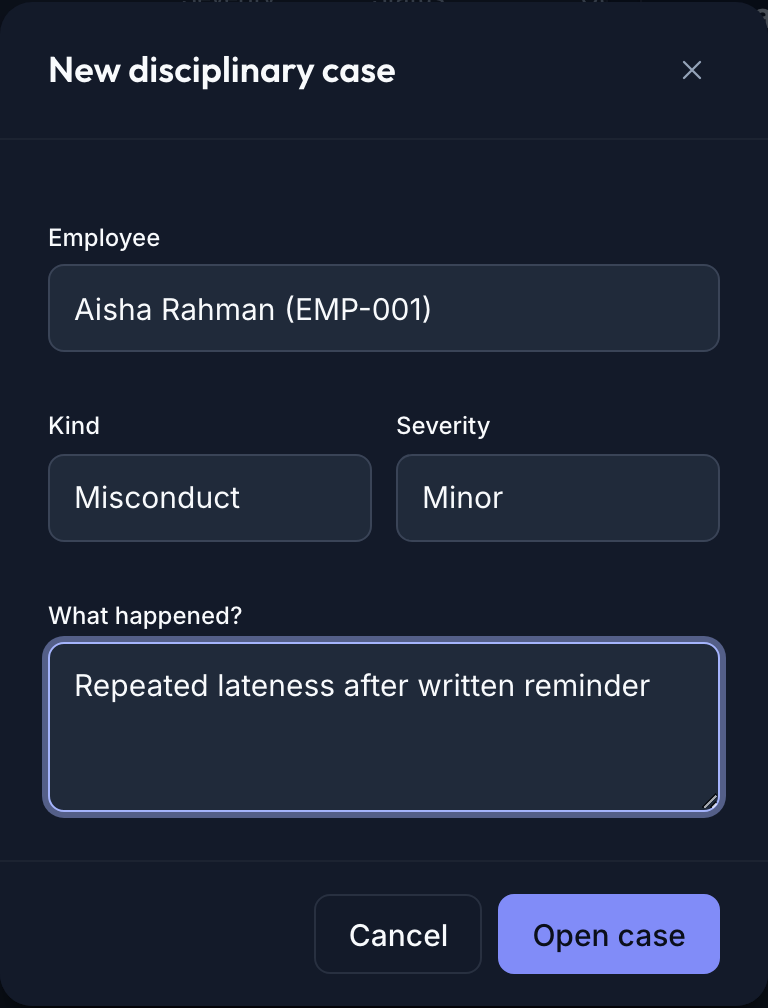
The New disciplinary case dialog — an employee, a Kind and Severity, and a 'what happened?' summary; opening the case starts its append-only log -
Document the due process. Open the case to see its append-only action log — opened, then each step you add: the investigation meeting, the employee's account, a written statement, a witness. Add to log records a step with your name and the time; it is then permanent — you can add more, never edit what's there. This is the documentation that makes the decision defensible.
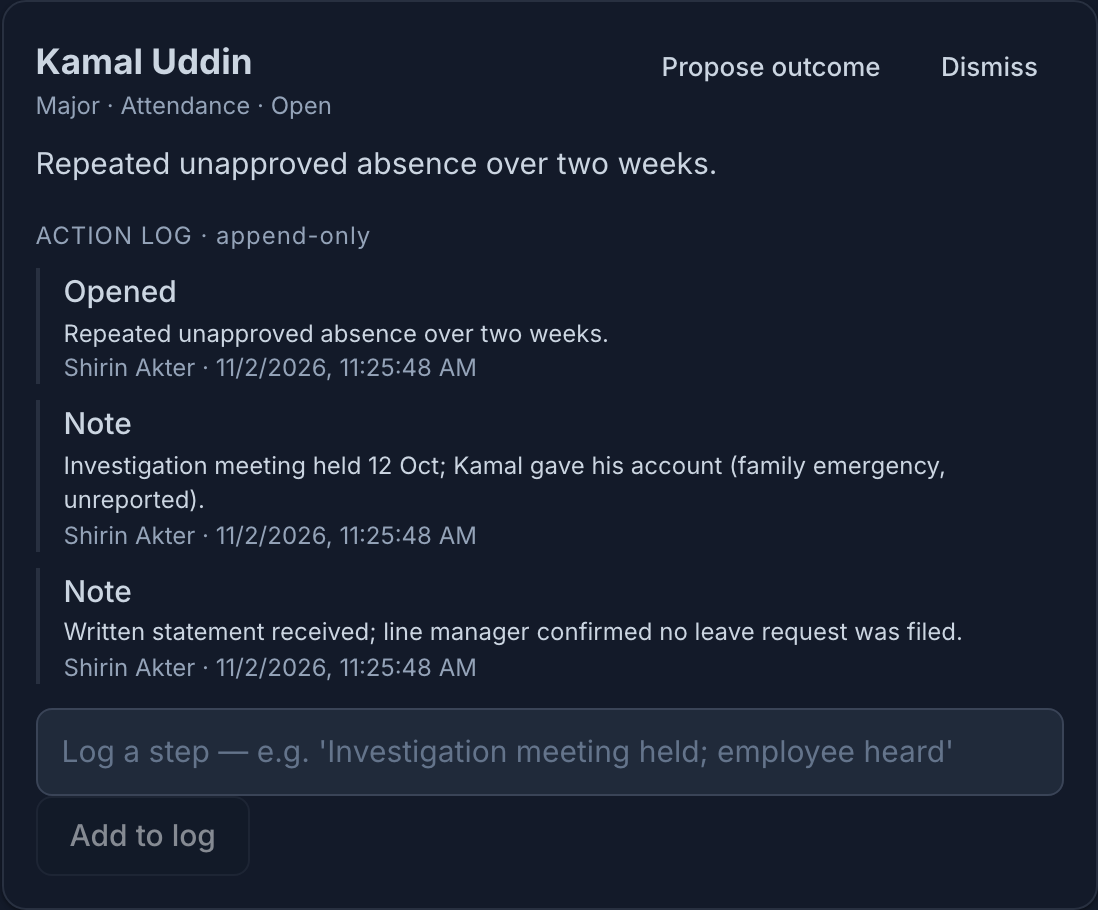
The case detail — the append-only ACTION LOG (opened · notes for the investigation and the employee's statement, each with actor and timestamp) and an 'Add to log' box to record the next due-process step -
Propose, then resolve — maker ≠ checker. When the facts are in, Propose outcome (warning · suspension · termination) moves the case to under review. A different person then Resolves it — the opener can't resolve their own case. A suspension outcome flags payroll (it records an employment-status change); it never computes pay here.
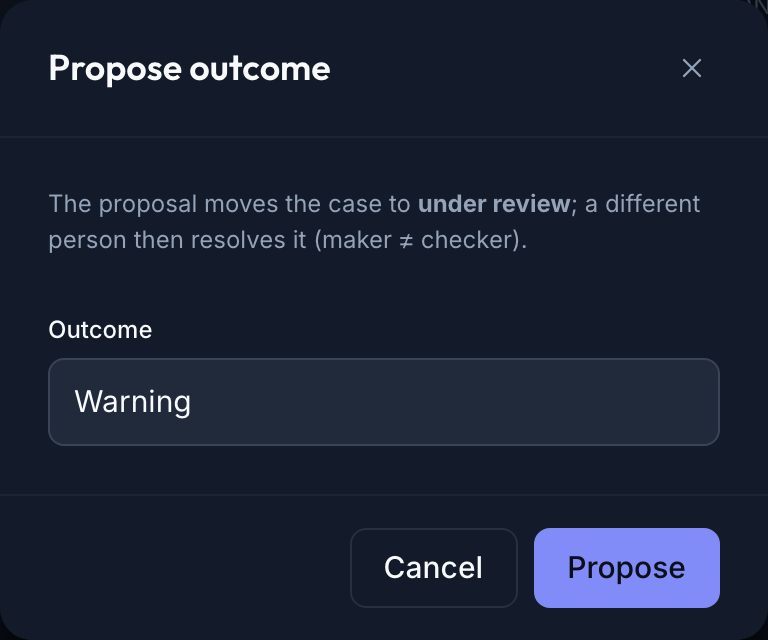
The Propose outcome dialog — a warning / suspension / termination choice, with a note that the proposal moves the case to 'under review' and a different person resolves it (maker ≠ checker); suspension is marked 'flags payroll' -
Grievances — the other direction. New grievance records a concern an employee raises (raised by · against · summary). It carries the same append-only trail and is worked to a resolution. The two lists — disciplinary cases above, grievances below — are the organisation's open ER load at a glance.
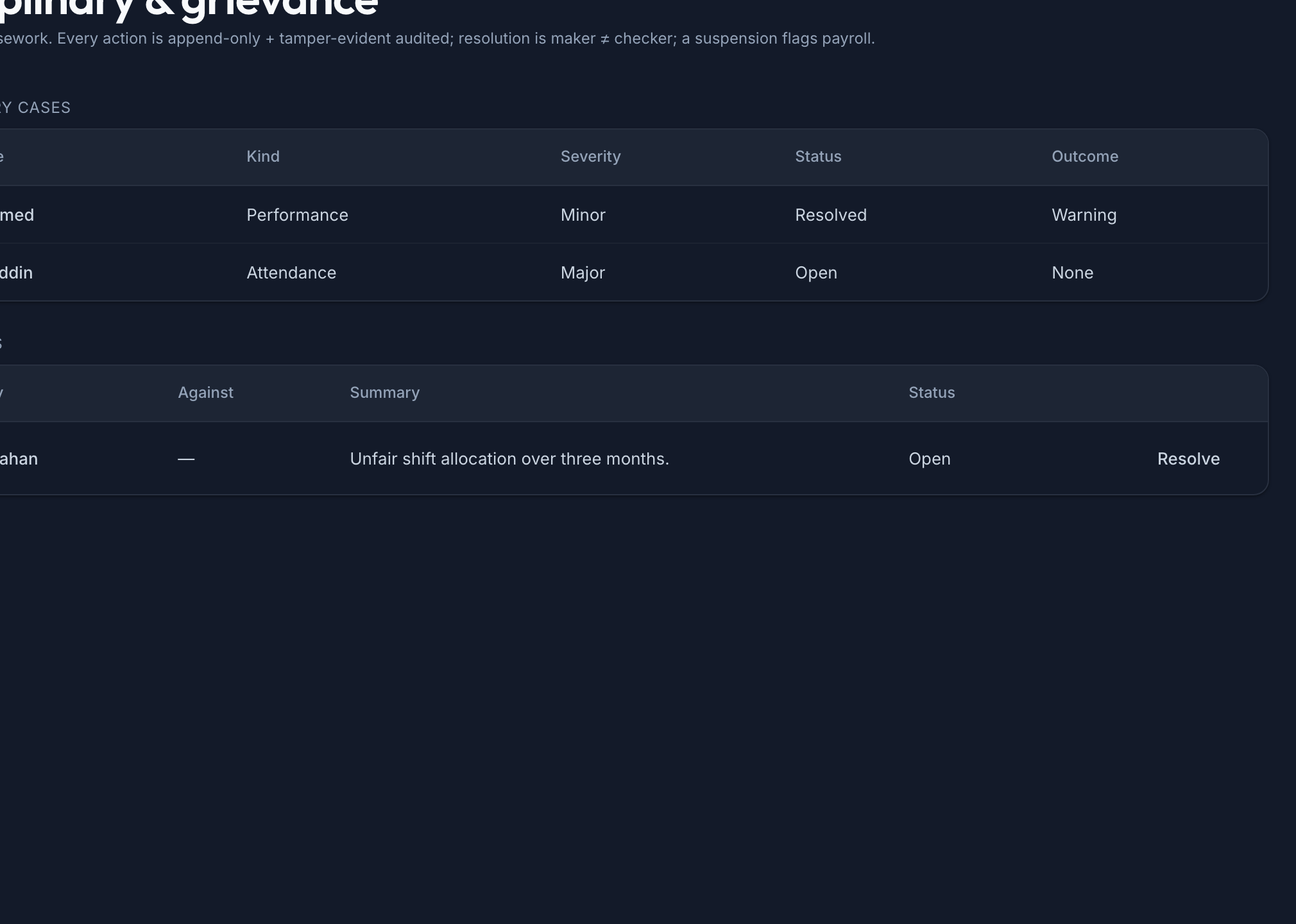
The casework overview — the Disciplinary cases table (employee · kind · severity · status · outcome) and the Grievances table (raised by · against · summary · status) below it
Walked example — three cases at Meridian
- Kamal Uddin — attendance, major, open. Opened on "repeated unapproved absence over two weeks." The log already carries two due-process steps: "Investigation meeting held 12 Oct; Kamal gave his account (family emergency, unreported)," and "Written statement received; line manager confirmed no leave request was filed." The facts are being built in the record before anyone proposes an outcome.
- Rafiq Ahmed — performance, minor, resolved (warning). A late compliance report. The log runs opened → note (employee acknowledged, corrective plan agreed) → outcome proposed: warning → resolved. Crucially, the person who opened it is not the person who resolved it — the system refused a same-person resolution. A clean, proportionate, documented warning.
- Nusrat Jahan — grievance, open. She raised "unfair shift allocation over three months." It's on the grievances list, worked on its own trail — the employee-voice direction of ER, not a disciplinary one.
Read together, they show the shape of the job: build the facts, let the person be heard, propose proportionately, and have someone else sign it off.
The records — what a case captures
| What it captures | Who reads it | |
|---|---|---|
| Disciplinary case | employee · kind · severity · status · proposed vs final outcome | HR & management — the decision and its basis; the employee — what was decided and why |
| Action log | every step: what · who · when · note — append-only | the audit trail — the complete, unrewritable story of how the case was handled |
| Grievance case | raised by · against · summary · status | HR — the employee-voice load; the raiser — that it's being worked |
| Status change (on suspension) | an EmployeeStatusChange(SUSPENDED) |
payroll later — the status hook; recorded here, computed there |
What an HR officer reads from it:
- The log before the outcome — a resolved case with no investigation notes behind it is a red flag; the steps should be there before the decision, not reverse-engineered after.
- Proposed vs final outcome — if they differ, the review did its job; if a gross-misconduct case resolved to "no action," the log had better explain it.
- Who opened vs who resolved — they must be different people; that's the control, visible on the record.
Controls & assurance
- Append-only log. Case actions cannot be edited or deleted once written — the model refuses it. The record grows; it never gets quietly rewritten.
- Maker ≠ checker on resolution. The opener cannot resolve their own case — a different person signs off the outcome.
- Tamper-evident audit. Every transition (opened, proposed, resolved, dismissed) is written to the CR-071 audit trail, so even the shape of the history is verifiable.
- Restricted access. Casework sits behind a dedicated
hr.casecapability — not everyone with general staff access can see or touch it. Sensitive by design. - Suspension is recorded, not computed. A suspension outcome writes an employment-status change that payroll later reads; the case module never changes pay itself. The decision and its payroll effect are kept separate and deliberate.
- Honesty box — process, not legal advice. VanillaPM documents and controls the process; it does not encode any jurisdiction's employment law. Whether a specific dismissal is lawful where you operate is a policy-and-legal question the tool can't answer — it gives you the defensible record, not the ruling.
Best practices & pitfalls
- Do write the log as you go, in the person's own words where you can — "employee stated X" beats "spoke to employee."
- Do let the person be heard before proposing an outcome; the note that says they were is often the most important line in the case.
- Do keep severity honest — labelling everything "gross" to justify a harsh outcome is the kind of inconsistency that comes back to bite.
- Pitfall: deciding the outcome first and documenting backwards. The log is supposed to lead to the decision; a trail written to justify a foregone conclusion fools no one, least of all a tribunal.
- Pitfall: the opener trying to resolve their own case. The control will stop you — but the instinct to "just close it myself" is the thing to unlearn.
- Pitfall: treating a grievance as a nuisance to close. An employee-raised concern worked without a visible, fair process is how a grievance becomes a resignation — or a claim.
Practise question
Q1. You opened a gross misconduct case, ran the investigation, and the employee has given their account. You believe termination is warranted and want to close it today. What does due process require, and what will the system let you do?
Answer: You can propose termination — that moves the case to under review and records the proposal in the append-only log. What you cannot do is resolve it yourself: the system enforces maker ≠ checker, so a second, authorised person has to review the proposal and resolve the case. That isn't bureaucracy for its own sake — on the most serious outcome, a second pair of eyes on the record is exactly the protection everyone needs. Before it's resolved, the log should already show the investigation and that the employee was heard; if it doesn't, the facts aren't in yet and proposing is premature. And note what resolving to a suspension or termination does and doesn't do: it records the status change for payroll to read — it doesn't compute anyone's pay, and it certainly doesn't tell you whether the dismissal is lawful in your jurisdiction. That's policy and legal advice; the tool gives you the clean, documented, two-person-signed record.
Your hands-on assignment
Work one case through due process — and try to break the controls. In a demo organisation — never your live records (your names and figures will differ from Meridian's):
- In Disciplinary & grievance, open a New case — employee, kind, severity and a plain summary.
- Add to log two due-process steps (an investigation meeting, the employee's account).
- Try to change an existing log entry — and notice you can only add, never edit.
- Propose outcome (a warning), then try to Resolve it as the same person — read the refusal; resolve it as someone else.
- Record a New grievance and note how it differs from a disciplinary case.
When you've done it, test yourself with the knowledge check below — a short quiz drawn from this lesson. Score 80% or more and the lesson is marked complete.
Terms used here
- Disciplinary case — an organisation-initiated case (misconduct · performance · attendance) with a severity and an outcome.
- Grievance — an employee-raised concern (against a person or the organisation), worked to resolution.
- Due process — the documented sequence (open → investigate → heard → propose → resolve) a case must run through to be fair and defensible.
- Action log — the append-only record of every step on a case (what · who · when); cannot be edited once written.
- Outcome — the disciplinary result: no action · warning · suspension · termination.
- Maker ≠ checker — the person who opens a case cannot be the one who resolves it.
- Related: Manage time, attendance & leave — the attendance that starts an attendance case · Offboard / separation — where a termination outcome leads.
What an auditor / HR lead expects
They expect the chain to hold: open → investigate → heard → propose → resolve, with the log showing each step, in order, and with the outcome traceable to the facts above it. Every resolved case shows an opener and a different resolver; every append to the log carries a name and a time and was never edited; every suspension or termination has an investigation and a hearing behind it, not just a summary line. A reviewer reads the log top-to-bottom and asks one question — would this have been fair to the person it's about? — and the record answers it. "Here's the case, here's who did what and when, here's where they were heard, here's the proposed and final outcome, and here's who signed it off" is a complete answer; an outcome with no process behind it is the opposite of one.
Sign in to track your progress and earn your track completion.
🎉 You finished the track — view your completion →