
Ethical recruiting in complex ops
Learn HR · Humanitarian / INGO HR · Task B6. The same recruitment pipeline you learned in A3, now under humanitarian scrutiny. In complex operations — where jobs are scarce, local, and sometimes life-changing — how you hire is itself an integrity test. This lesson is a deliberate two-parter: the structure that makes hiring fair is product; the ethics that make it ethical are policy, and knowing which is which is the whole competency.
What it is
Ethical recruiting is hiring in a way that is fair, transparent, non-discriminatory and free of undue influence — and, in the aid sector specifically, local-first and safe. It's grounded in CHS Commitment 8 (staff are managed fairly and equitably) and People in Aid (cited for orientation, never reproduced), and it has a few non-negotiables:
- A consistent, transparent process. Every candidate goes through the same stages against job-relevant criteria — not a shortcut for the favoured and a gauntlet for the rest.
- Structured, comparable assessment. A panel (not one person) scores each candidate on the same scale with job-relevant notes, so the decision is comparable and defensible rather than a gut call.
- Anti-nepotism & conflict of interest. Anyone on the panel with a personal connection to a candidate — family, close friend, prior relationship — declares it and recuses. Favouritism is the classic integrity failure in constrained job markets.
- Local-first hiring. Prioritising national and local staff over international hires where the role allows — a core humanitarian commitment, not an afterthought.
- Safe recruitment. The safeguarding layer: references, the misconduct-disclosure scheme, background checks — so a position of trust isn't handed to a known abuser.
The spine: a fair structure plus an ethical conduct — and in VanillaPM the first is largely product and the second is largely policy.
Why it matters
- In complex ops, a job is leverage. Where work is scarce, the pressure to hire a relative, a gatekeeper's nephew, or a "recommended" candidate is intense — and giving in corrodes trust in the whole organisation. Fair process is the defence.
- Unstructured hiring is where bias and fraud hide. A single interviewer's "they felt right" is unauditable and easy to game. A scored panel turns the decision into evidence you can stand behind.
- Donors and the sector audit it. CHS verification and donor due-diligence probe recruitment for fairness, anti-nepotism and local-first; a weak process is a finding.
- Safe recruitment protects beneficiaries. The PSEA story starts at the hiring gate — who you let in determines who's near the people you serve.
Where you do it in VanillaPM
Recruitment (apps/recruitment) gives you the structure that makes fair hiring possible — the
part that is product.
-
A consistent pipeline for everyone. A vacancy runs one funnel — applied → screen → interview → offer → hired — and every applicant moves through the same stages, each move recorded. No candidate gets a secret side-door; the process is the same for all, and visible.
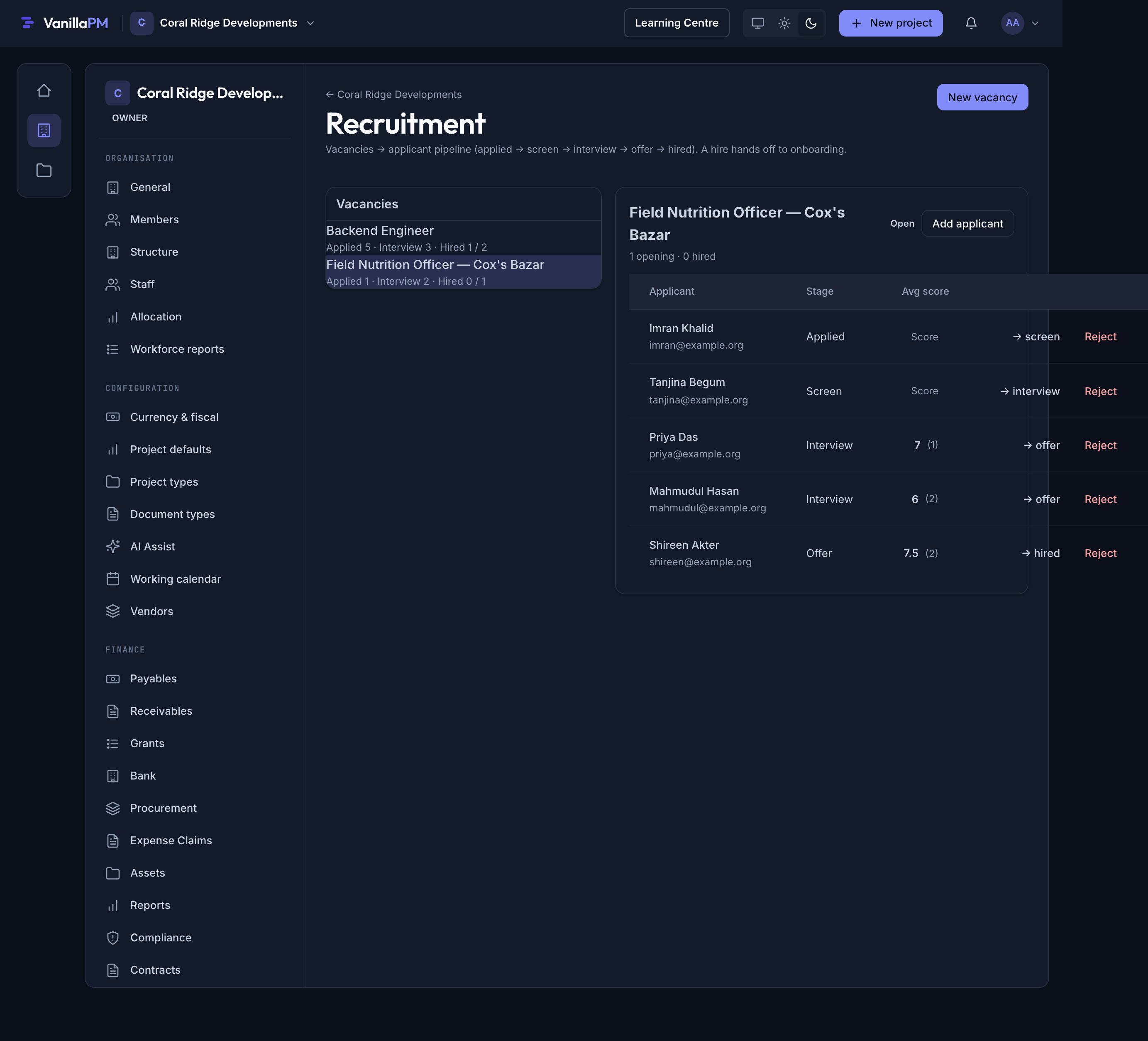
The Recruitment page — a 'Field Nutrition Officer — Cox's Bazar' vacancy with five applicants, each at a stage (applied / screen / interview / offer) with an average score and the same → next-stage / Reject actions; the header shows the funnel applied → screen → interview → offer → hired -
Structured, comparable scoring. Interview feedback is a panel exercise: each panelist scores the same candidate on the same 0–10 scale with a job-relevant note. That's what turns "we liked her" into "two panelists scored her 8 and 7 on community-nutrition experience and communication" — comparable across candidates, and defensible to an auditor.
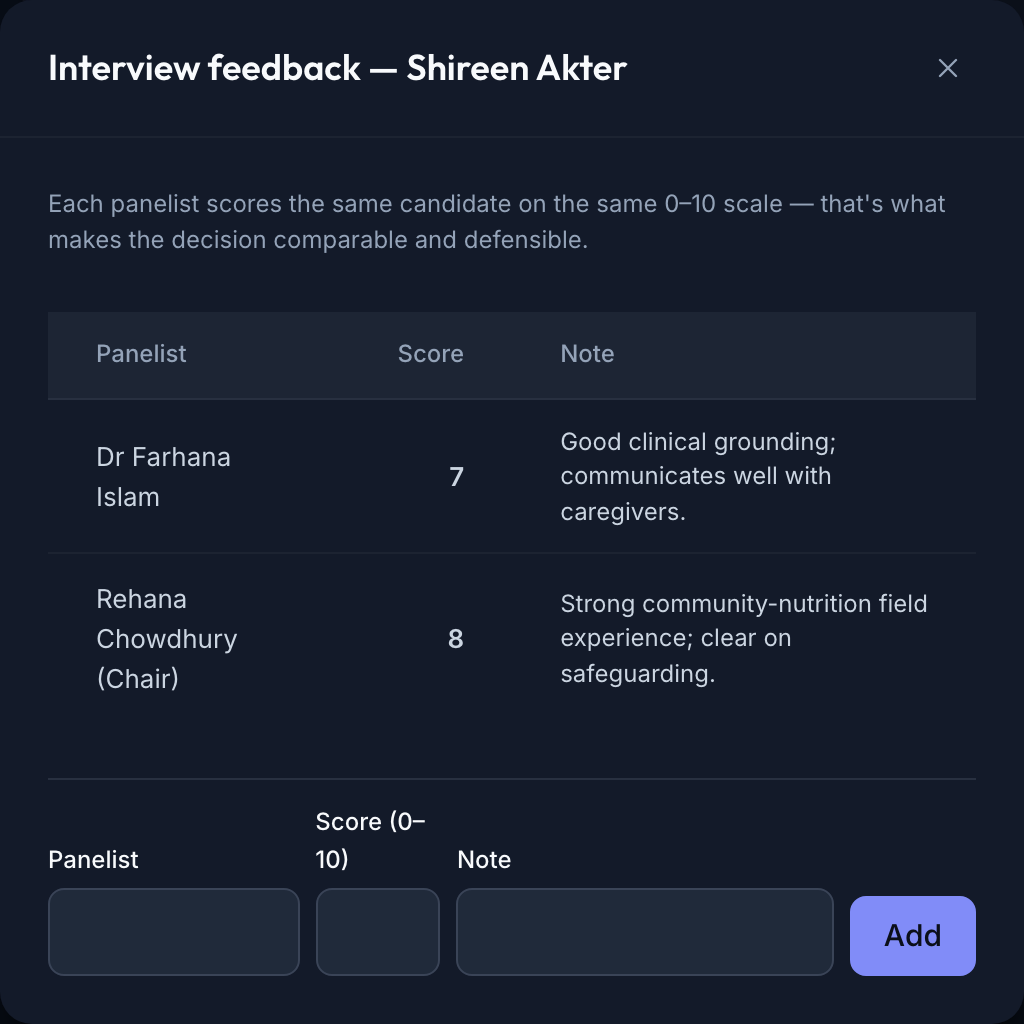
The Interview feedback dialog for Shireen Akter — two panelists (Rehana Chowdhury, Chair: 8; Dr Farhana Islam: 7) each with a job-relevant note, under the line 'each panelist scores the same candidate on the same 0–10 scale — that's what makes the decision comparable and defensible'
⚠️ Honesty box — the structure is product, the ethics are policy
This is the seam, stated plainly. What the product gives you is the structure of fairness: one consistent pipeline every candidate goes through, structured scored panel feedback that makes the decision comparable, and an audit trail of who moved whom and who scored what. That structure is genuinely most of what makes hiring auditably fair — and it's real. What the product does not have is the ethics as data: there is no conflict-of-interest / anti-nepotism declaration and no recusal in the recruitment module (unlike Speak-Up, which does have recusal); no local-first flag or rule; and no safe-recruitment checks (references, misconduct-disclosure, background checks — those belong to safeguarding and are policy). So the honest claim is: VanillaPM makes your hiring structured and auditable; it does not make it ethical for you. A panel that didn't declare its conflicts, or a process that skipped local-first, looks identical in the tool to one that did it right — the ethics live in the policy you run around the pipeline, and this lesson teaches that boundary rather than pretending a scored funnel is a code of conduct.
Walked example — a fair hire at Hilsa
The Hilsa Health Initiative recruits a Field Nutrition Officer for Cox's Bazar. The product side is clean: five candidates — all national/local applicants — run the same funnel; three reach interview, scored by a panel of Rehana Chowdhury (Chair) and Dr Farhana Islam on the same 0–10 scale. Shireen Akter scores 8 and 7 on job-relevant criteria (community-nutrition experience; communication with caregivers), is moved to offer, and the pipeline records every step. That's a decision Hilsa can defend: same process, scored panel, documented reasons.
Now the ethics — which the tool shows nothing about, because they're policy:
- Anti-nepotism. Suppose Dr Farhana were related to one of the candidates. The right thing is that she declares it and recuses from scoring that candidate — but the recruitment module has no COI field and no recusal, so Hilsa must handle it in policy (a declaration before the panel sits, a note in the file, a replacement panelist). The tool won't stop her scoring a relative; the policy must.
- Local-first. That all five candidates are local is a Hilsa policy choice, not something the tool enforced or even flagged — there's no "national vs international" control.
- Safe recruitment. Before Shireen's offer is confirmed, Hilsa runs references and misconduct-disclosure checks (safeguarding) — entirely outside the pipeline, as policy and documents.
The honest reading: the pipeline gave Hilsa a fair, auditable structure; Hilsa's policy supplied the ethics that structure can't.
Product vs policy — the seam in one table
| Fairness element | Product (in VanillaPM) | Policy (the organisation runs) |
|---|---|---|
| Consistent process | ✔ one pipeline, same stages for all | define the stages & criteria |
| Structured assessment | ✔ scored panel, same scale, notes | choose job-relevant, non-discriminatory criteria |
| Audit trail | ✔ who moved whom, who scored what | review it; act on anomalies |
| Anti-nepotism / COI recusal | ✖ no declaration or recusal field | declare conflicts; recuse; replace panelist |
| Local-first hiring | ✖ no flag or rule | the hiring policy & the decision |
| Safe recruitment | ✖ not here (see B2) | references · misconduct-disclosure · background checks |
The ticks are real and worth having; the crosses are exactly where a lesson that over-claimed would mislead — so this one doesn't.
Controls & assurance
- Same funnel, recorded (product). Every candidate on the same stages, every move recorded — the structural guarantee that nobody got a side-door.
- Scored panel (product). Multiple panelists, one scale, job-relevant notes — the single most important anti-bias, anti-fraud control the tool offers, because it makes the decision comparable.
- The audit trail (product). Who scored what and who advanced whom is on the record; an anomaly (one candidate advanced with no score, say) is visible.
- COI declaration & recusal (policy). That panelists with a connection declared it and stepped aside is a policy control enforced around the pipeline — the module won't do it for you.
- Local-first & safe recruitment (policy). Prioritising local hires and running references / misconduct-disclosure are policy obligations; the pipeline neither flags nor performs them.
- Honesty box — structured ≠ ethical. The product proves the process was consistent and scored; it does not prove it was free of nepotism, local-first, or safely vetted. Those are attested in policy and documents, and a good HR officer never lets the scored funnel stand in for them.
Best practices & pitfalls
- Do put the whole shortlist through the same stages and a scored panel — consistency is the fairness you can prove in the tool.
- Do run an explicit COI declaration before the panel sits, and recuse anyone connected to a candidate — because the module won't, this has to be policy you actually run.
- Do keep the criteria job-relevant and the notes about the role, not the person — that's what keeps the scoring non-discriminatory.
- Do complete safe-recruitment checks before confirming an offer (B2).
- Pitfall: mistaking a scored funnel for an ethical process. It proves structure, not integrity — a nepotistic hire can have a tidy pipeline.
- Pitfall: a panelist scoring a relative or friend without declaring it. The tool won't catch it; only your COI policy will.
- Pitfall: fast-tracking a "recommended" candidate past the stages. The moment one person skips the funnel, the fairness the structure gave you is gone.
Practise question
Q1. A senior manager asks you to "move his cousin straight to offer" for the Field Officer role, saying "she's clearly the best, no need for the whole panel." Using what the product does and doesn't do, walk through how you handle it — and where the real control lives.
Answer: Two things are wrong, and the product only guards one of them. First, skipping the funnel breaks the consistency the pipeline exists to guarantee — everyone else went applied → screen → interview → offer with a scored panel, and moving one candidate straight to offer would leave her with no comparable assessment and an audit trail that visibly shows a side-door. You decline on that basis: she goes through the same stages and the same panel as everyone, and the record will show it. Second — and this is the part the tool won't catch — the manager is her cousin, which is a conflict of interest. The recruitment module has no COI declaration and no recusal, so nothing in the software stops him influencing the decision. That control is policy: he must declare the relationship and recuse from the panel and the decision entirely; you document the declaration, and a conflicted manager does not score or approve his own relative. If she is genuinely the strongest, a clean, conflict-free panel scoring her through the normal stages will show it — and that is a hire you can defend. The lesson in miniature: the product makes you run a consistent, scored process (use it); the ethics — no nepotism, declared conflicts, recusal — are policy you must run yourself, because the tool treats a nepotistic hire and a fair one identically.
Your hands-on assignment
Run a fair process — then name what the tool can't enforce. In a demo organisation — never live staff data (your names and figures will differ from Hilsa's):
- In Recruitment, run a vacancy through the same stages for every applicant.
- Have two panelists score the same candidate on the same 0–10 scale with job-relevant notes.
- Write the conflict-of-interest declaration a panelist would sign — the tool has no COI field, so this is your policy.
- Write down your local-first rule and where you'd evidence it.
- List the safe-recruitment checks (references, misconduct-disclosure) you'd complete before confirming the offer.
When you've done it, test yourself with the knowledge check below — a short quiz drawn from this lesson. Score 80% or more and the lesson is marked complete.
Terms used here
- Ethical recruiting — fair, transparent, non-discriminatory, anti-nepotism, local-first and safe hiring.
- Consistent pipeline — the same stages (applied → screen → interview → offer → hired) for every candidate; structural fairness (product).
- Structured / panel assessment — multiple panelists scoring the same candidate on the same scale with job-relevant notes; comparable and defensible (product).
- Anti-nepotism / conflict of interest (COI) — declaring a personal connection to a candidate and recusing; policy, not a product control here.
- Recusal — stepping aside from assessing a candidate you're connected to (a product feature in Speak-Up, a policy obligation in recruitment).
- Local-first hiring — prioritising national/local staff; policy.
- Safe recruitment — references, misconduct-disclosure, background checks; policy, see safeguarding & PSEA.
- CHS Commitment 8 / People in Aid — the standards ethical recruiting is grounded in (cited, not reproduced).
- Related: Run a recruitment pipeline — the pipeline mechanics (A3) · Safeguarding & PSEA — safe recruitment (B2).
What an auditor / donor expects
They expect both halves — and they know the tool only carries one. A CHS verifier or a donor's due-diligence asks: Was the process consistent (same stages for all) and scored by a panel on job-relevant criteria — can you show the pipeline and the feedback? And: were conflicts of interest declared and recused, was the role filled local-first, and were safe-recruitment checks done — can you show the policy records? The recruitment module answers the first with the pipeline and the scored panel; the second lives in declarations, policy and the safeguarding file. So the audit-ready position is: "here's the consistent, scored pipeline for this hire — and here's the conflict-of-interest declaration, the local-first rationale, and the references/misconduct-disclosure checks we ran as policy." "We have a scored recruitment system" answers only half; "structured in the tool, ethical in our policy, and here's the evidence for both" is the complete answer — and precisely the seam this lesson exists to make you fluent in.
Sign in to track your progress and earn your track completion.
🎉 You finished the track — view your completion →