
Staff voice & well-being
Learn HR · Humanitarian / INGO HR · Task B7. How you hear your people — and prove you created a safe way for them to speak. In a sector where staff carry real stress, well-being isn't a perk, it's a duty (CHS Commitment 8). This task is about the aggregate voice: anonymous surveys that make honest answers safe — and it's the natural companion to the individual voice you met in Speak-Up.
What it is
Staff voice is the set of channels through which an organisation hears its people, and well-being is one of the main things those channels listen for. VanillaPM gives you two, pointing in different directions:
- Engagement / well-being surveys (
apps/surveys) — the broad, aggregate voice. Management authors a survey; the whole team answers it anonymously via a shareable link (no login); the results are aggregate-only and hidden until enough people answer. It tells you how the team feels — on well-being, workload, psychological safety — as a trend, never a named opinion. - The confidential channel (Speak-Up, B3) — the individual voice: one person, one specific concern, handled in confidence.
The survey half has one idea that makes the whole thing work — k-anonymity:
- Anonymous by construction. A response carries no link to a user — it is unlinkable by design, not just "we promise not to look."
- The k threshold. Aggregates stay hidden until at least k people have answered (the survey's
min responses). Below that, results are suppressed — because in a small team, one or two responses could be traced to a person. - Aggregate-only. Even above k, you see distributions and averages, never individual rows.
The spine: make honesty safe, and the honest signal appears — grounded in CHS Commitment 8 (staff are supported and treated fairly; cited for orientation, never reproduced).
Why it matters
- Unsafe surveys get you lies. If people fear a negative answer can be traced back, they either don't answer or answer falsely. k-anonymity is what buys honesty — it's the whole reason the threshold exists.
- Well-being is a duty of care. Burnout, stress and moral injury are real in aid work; a regular well-being pulse is how you see the problem before it becomes attrition — which is a CHS Commitment 8 obligation, not a nicety.
- Aggregate and individual voice do different jobs. A survey tells you the team's workload is slipping; Speak-Up tells you this person has a specific concern. You need both — one for the trend, one for the case.
- It's auditable evidence of a listening culture. "We run a quarterly anonymous pulse, protected by a k-threshold, and we act on it" is exactly what a CHS verifier wants to see.
Where you do it in VanillaPM
Engagement surveys (apps/surveys) — authored by management, answered anonymously, read in
aggregate.
-
The surveys. Each survey shows its status, cadence, question and response counts, with a public link to share and a Results view. The intro says the quiet part out loud: answered anonymously via a link, results aggregate only, hidden until enough people answer.
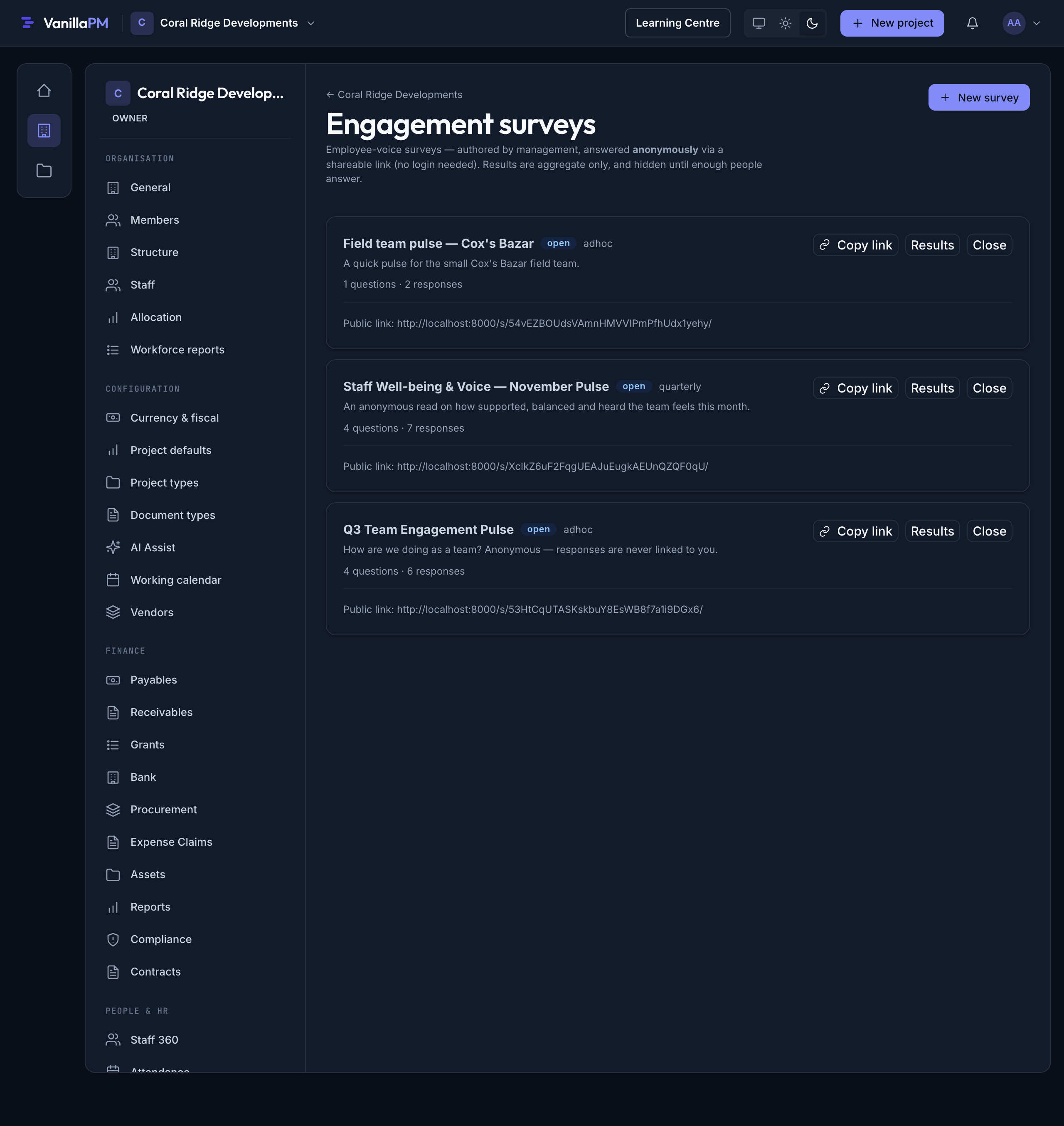
The Engagement surveys list — a 'Staff Well-being & Voice — November Pulse' (open, quarterly) and a 'Field team pulse — Cox's Bazar', each with question/response counts and Copy-link / Results / Close actions; the header explains answers are anonymous via a shareable link and results are aggregate-only, hidden until enough people answer -
The aggregate result — the voice. Once enough people answer, Results shows distributions and averages per question and the free-text comments — the team's sentiment on well-being, workload and psychological safety, as numbers you can act on, with no individual identifiable.
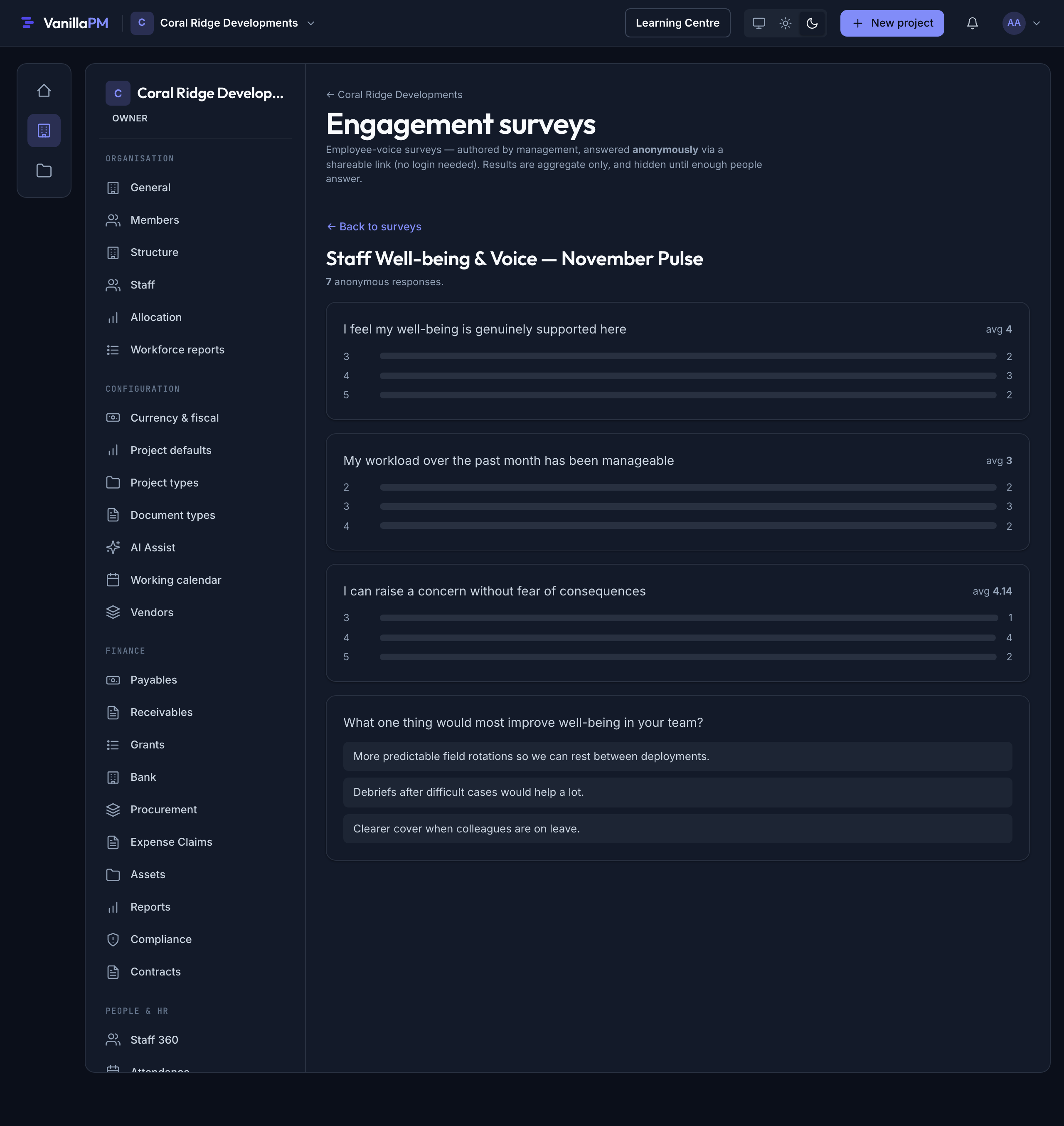
The results for the Well-being pulse — '7 anonymous responses', rating distributions and averages for 'I feel my well-being is genuinely supported here' (avg 4), 'my workload has been manageable' (avg 3), 'I can raise a concern without fear' (avg 4.14), plus free-text asking for predictable field rotations and post-case debriefs -
The k-anonymity guard — honesty made safe. When too few people have answered, results are suppressed with an honest message: not enough responses yet — N of k; hidden until at least k answer, so no one is identifiable. This is the trust mechanism, visible: a small field team's pulse won't expose anyone.
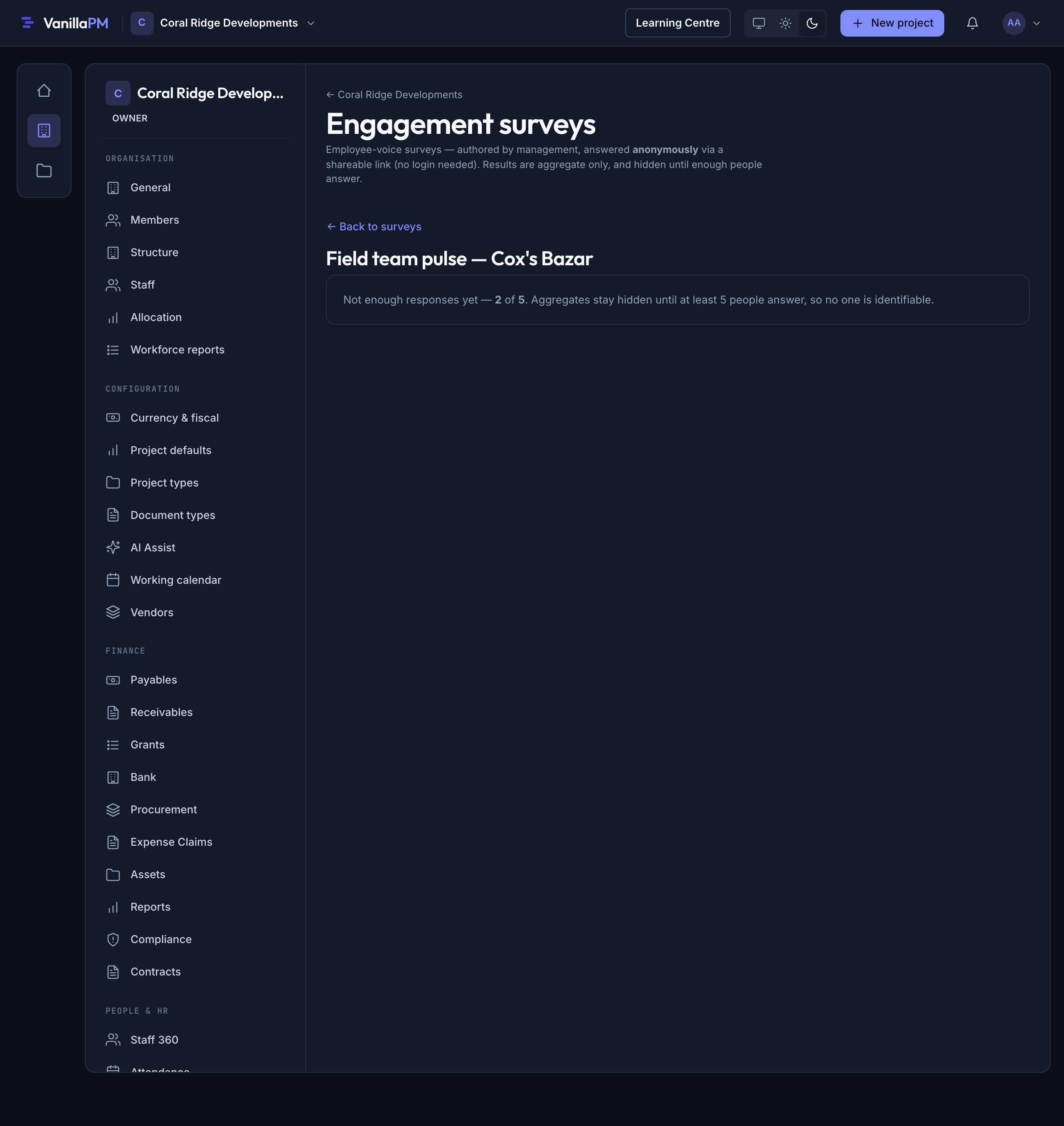
The suppressed result for 'Field team pulse — Cox's Bazar' — 'Not enough responses yet — 2 of 5. Aggregates stay hidden until at least 5 people answer, so no one is identifiable.'
⚠️ Honesty box — the tool gives you the voice, not the response
VanillaPM gives you a real, well-built voice mechanism: anonymous surveys, unlinkable responses, k-anonymity suppression, aggregate-only results — and the separate confidential channel. What it cannot do is act on what you hear. A well-being score that drops, a comment asking for post-case debriefs — the tool surfaces the signal; building the response (a workload change, a debrief routine, a well-being programme) is management action, not a feature. Two further honesties: the tool doesn't diagnose — "avg workload 3" is a signal you interpret, not a burnout alarm the software raises; and free-text is shown verbatim once k is met, so a highly specific comment could still hint at who wrote it — k-anonymity protects the counts, but respondents are trusted to self-protect in open text and handlers to treat it with care. The sharpest risk of all is asking and not acting: a survey you ignore erodes trust faster than never asking. This lesson teaches the mechanism and is honest that the mechanism is not the culture — the culture is what you do with the signal.
Walked example — a well-being pulse at Hilsa
Hilsa runs a quarterly Staff Well-being & Voice pulse. Seven people answer anonymously, and because that's above the k = 3 threshold, the aggregate appears. The read: well-being is broadly positive ("supported here" avg 4; "can raise a concern without fear" avg 4.14 — the Speak-Up culture showing up in the numbers), but workload is the soft spot ("manageable" avg 3, the lowest). The free-text points the same way: "more predictable field rotations so we can rest between deployments," "debriefs after difficult cases would help."
That's a signal, not a verdict — and crucially, acting on it is Hilsa's job, not the tool's: the honest response is a rotation policy and a post-deployment debrief routine, which management builds. Meanwhile the small Cox's Bazar field pulse has only 2 of 5 responses, so its results are suppressed — in a five-person team, showing two answers could point at individuals, and the k-threshold protects them. If Hilsa wants that team's voice, the answer is to get more responses or fold them into a larger survey — not to lower the threshold. The whole example is the lesson: the tool made honesty safe and the signal visible; the well-being response is Hilsa's to build.
The two voices — one system
| Engagement survey (this task) | Confidential channel (Speak-Up, B3) | |
|---|---|---|
| Direction | broad / aggregate — the whole team | individual — one person |
| Question | how does the team feel? | I have a specific concern |
| Identity | anonymous & unlinkable; k-anon on aggregates | named or anonymous (by tracking code) |
| Output | distributions, averages, trends | a handled, tracked case |
| Protects honesty via | the k threshold (suppress below k) | routing away from the line manager + recusal |
| The limit | the tool shows the signal — you act | the tool routes the report — you resolve |
The point: they're complementary, not alternatives. The survey finds that morale on workload is slipping; Speak-Up is where an individual raises a specific problem. A healthy voice system runs both.
Controls & assurance
- Unlinkable by design. A survey response has no user FK — anonymity is a data-model guarantee, not a policy promise someone could break.
- k-anonymity suppression. Aggregates are withheld below the threshold; you literally cannot see a result that could identify someone in a small group.
- Aggregate-only, always. Even above k, the API returns distributions and averages — never raw response rows.
- Authored by management, answered by all. The survey is created under permission; the answering is open via a tokenised link, so participation isn't gated by having an account.
- Honesty box — mechanism, not response. Every control above protects the voice; none of them acts on it. The assurance the tool gives is "we asked safely"; the assurance only you can give is "we listened and did something."
Best practices & pitfalls
- Do set the k threshold sensibly for your team size — high enough to protect anonymity in the smallest group you'll report on.
- Do run it on a cadence and trend the categories over time — a single pulse is a snapshot; the value is the direction.
- Do close the loop: tell the team what you heard and what you'll change. Acting visibly is what earns honest answers next time.
- Do pair it with Speak-Up — aggregate voice and an individual channel.
- Pitfall: surveying and not acting. The fastest way to kill staff voice is to ask, learn something, and do nothing — it's worse than silence.
- Pitfall: a k set too low for a small team, or slicing results so thin that a group is identifiable. Anonymity is only real if it holds at the size you report.
- Pitfall: treating a score as a diagnosis. "Workload avg 3" is a prompt to ask why, not a proof of burnout — the number starts the conversation, it doesn't end it.
- Pitfall: forgetting free-text can identify. A distinctive comment, shown verbatim, may hint at its author — handle open text with the same care as a confidential report.
Practise question
Q1. You run a well-being pulse for a 5-person field team and set the k-threshold to 1 so you "never miss any feedback." Three people answer, one of them very negatively about their manager. What's wrong with this setup, and what should you have done?
Answer: Setting k = 1 defeats the entire point of anonymity, and in a five-person team it's actively dangerous. With the threshold at 1, results appear after a single response — so with three answers and one sharply negative, the manager (and anyone who can see results) is looking at a tiny set where the negative response is effectively attributable: in a team that small, people often know who was deployed, who was around, who'd say what, and the "anonymous" critic is exposed. That's exactly the harm the k-threshold prevents, and lowering it to "never miss feedback" trades the respondent's safety for your convenience — which will backfire, because once people realise a small survey can out them, they stop answering honestly. What you should have done: set k to a level that actually protects the smallest group you report on (for a team of five, a k of 3–4, or better, fold the field team into a larger survey so no group is reportable at an identifying size), and route individual grievances — like a specific complaint about a manager — to the confidential channel, which is built for one-person concerns with routing-away-from-the-implicated and recusal. The survey is for the aggregate signal, protected by a real threshold; a pointed individual concern belongs in Speak-Up. k-anonymity isn't red tape — it's the thing that makes the honest answer safe to give.
Your hands-on assignment
Run a pulse and see the anonymity guard working. In a demo organisation — never live staff data (your names and figures will differ from Hilsa's):
- In Engagement surveys, create a short well-being pulse (well-being, workload, voice) and open its public link.
- Answer it a couple of times, then open Results — read the suppression message (N of k).
- Get it above the threshold and read the averages and free-text in aggregate.
- Find the lowest-scoring question and write the management response you'd take — the tool won't take it for you.
- Say why you wouldn't lower the threshold to see a small team's results.
When you've done it, test yourself with the knowledge check below — a short quiz drawn from this lesson. Score 80% or more and the lesson is marked complete.
Terms used here
- Staff voice — the channels through which an organisation hears its people (aggregate surveys + individual confidential channel).
- Engagement / well-being survey — an anonymous, tokenised-link survey authored by management, answered without login, read in aggregate.
- k-anonymity — results are suppressed until at least k people answer (the
min responses), so no individual is identifiable in a small group. - Unlinkable response — a survey response carries no user FK; anonymity is built into the data model.
- Aggregate-only — only distributions/averages/free-text are shown, never raw per-person rows.
- Well-being signal — what you infer from the survey (a dropping score, a recurring comment); a prompt to act, not a diagnosis.
- CHS Commitment 8 — the standard staff voice & well-being is grounded in (cited, not reproduced).
- Related: Run a confidential whistleblowing channel — the individual voice (B3) · Safeguarding & PSEA — where serious concerns go (B2).
What an auditor / donor expects
They expect a safe, used, and acted-on voice system. A CHS verifier asks: Is there a regular, anonymous way for staff to give feedback? Is anonymity real — protected by a threshold so small teams aren't exposed? Is there a separate confidential channel for individual concerns (Speak-Up)? And — the one that matters most — what changed because of it? The surveys module answers the first three: a cadenced anonymous pulse, k-anonymity suppression you can point to, aggregate-only results, alongside the confidential channel. The fourth is on the organisation: the audit-ready position is "here's our anonymous well-being pulse and its k-protected results, here's the confidential channel beside it, and here's the rotation policy and debrief routine we introduced because the data told us workload was slipping." "We send a survey" answers a quarter of the question; "we ask safely, and we act on what we hear" answers all of it — and the acting is the part no tool, including this one, can do for you.
Sign in to track your progress and earn your track completion.
🎉 You finished the track — view your completion →