
Duty of care for a field posting
Learn HR · Humanitarian / INGO HR · Task B1. The first task where the stakes are literally life and limb. When an INGO sends a nurse to a flood-response camp or a logistician to a conflict-affected district, it takes on a duty of care — a real obligation to keep them safe, healthy and supported. This lesson teaches that standard honestly, including where the product helps and where it deliberately doesn't.
What it is
Duty of care is the employer's legal and moral obligation to take reasonable steps to protect the security, health and well-being of the people it deploys — especially into higher-risk field settings. It's a cornerstone of humanitarian HR: codified in CHS Commitment 8 ("staff are supported to do their job effectively, and are treated fairly and equitably") and the People in Aid principles (cited for orientation — never reproduced here).
It isn't one thing; it's a set of obligations that scale with the risk of the posting:
- Risk assessment — before anyone goes, assess the security, health and environmental risk of the location, and decide whether (and how) to proceed.
- Security briefing & protocols — the person is briefed on the context, the rules, comms, curfews, and who to call.
- Insurance & medevac — appropriate cover, including medical evacuation from a place that may have no hospital.
- Medical fitness & clearance — vaccinations, fitness to deploy, any condition that needs planning.
- Accommodation & movement safety — safe lodging and safe transport, not an afterthought.
- Well-being & mental health — the support for stress, trauma and isolation that field work brings.
- Emergency & evacuation plan — a concrete plan for when things go wrong, with emergency and next-of-kin contacts recorded.
- Informed consent — the person understands the risk and accepts the posting knowing it.
The through-line: the duty scales with the risk. A monitoring visit to a stable district and a deployment to an active-conflict zone are both "field postings," but they demand very different care.
Why it matters
- It's about lives, first. This isn't paperwork — it's whether the person you sent comes home safe. Everything else is downstream of that.
- Negligence is a real liability. An organisation that sends someone into danger without reasonable precautions is legally exposed if it goes wrong — duty of care is the standard a court or an inquiry measures against.
- Donors and the sector require it. CHS verification, donor due-diligence and partner assessments all probe duty of care; a weak answer costs funding and trust.
- It's how you keep good people. Staff who see that the organisation takes their safety seriously stay; a reputation for sending people out under-prepared is how you lose them.
Where you do it in VanillaPM
Here the honest answer matters more than a long click-path. VanillaPM's product touchpoint is the
field posting itself, recorded as a Travel request (apps/travel): who is going, the purpose,
the destination, and the dates. Creating it puts the deployment on the books; its approval
is the natural in-process gate — the moment a manager signs off the posting is exactly where a
duty-of-care sign-off belongs.
-
Record the field posting. New trip captures the person, the purpose (the assignment), the destination (the field site), and the start/end dates — the deployment as a record.
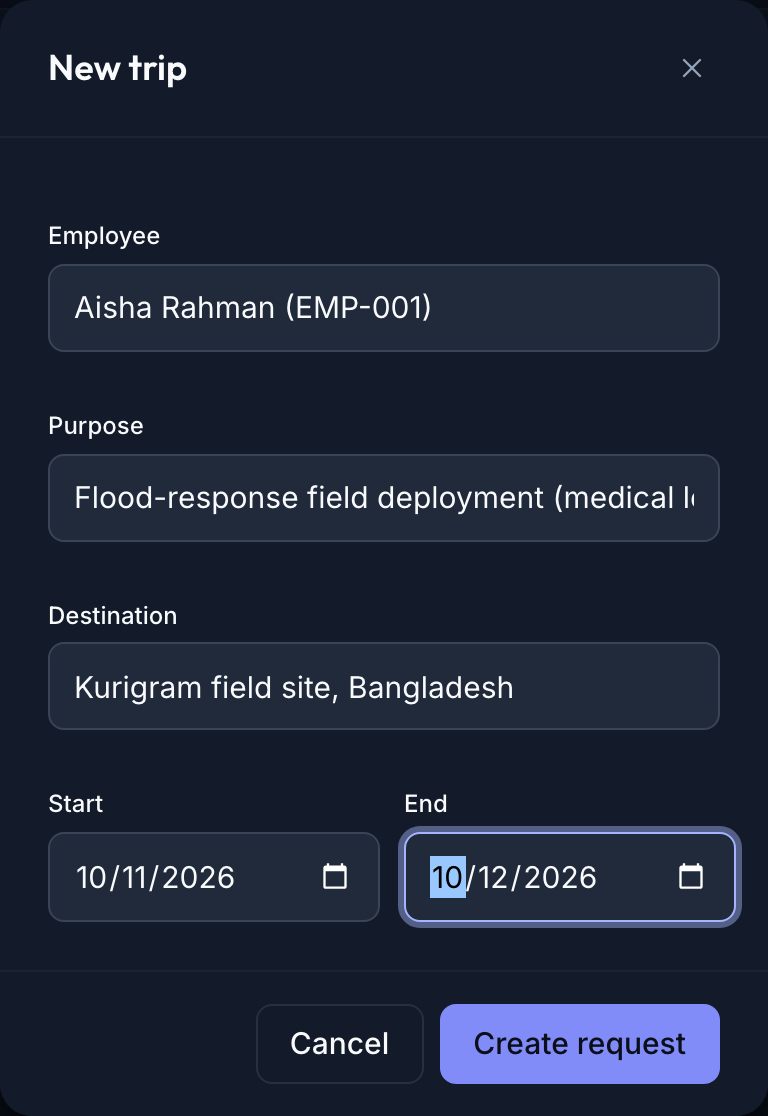
The New trip dialog — employee, purpose, destination and start/end dates; the field posting recorded as a travel request -
Route its approval. The posting lands as a draft and is approved by a manager before it proceeds — the control point where, in a well-run organisation, the duty-of-care checks are confirmed before anyone travels.

The field-posting register — deployments (employee · purpose · destination · status), e.g. a flood-response medical deployment to Kurigram and a nutrition-monitoring visit to Cox's Bazar, each a draft awaiting Approve
⚠️ Honesty box — this is largely policy, not product
VanillaPM records the field posting and routes its approval. It does not have a duty-of-care module: there are no fields for the risk assessment, the security briefing, the insurance/medevac cover, medical clearance, the evacuation plan, or next-of-kin contacts. Those live in the organisation's policy and its documents — the product holds the deployment record the policy wraps around, not the duty-of-care framework itself. A dedicated duty-of-care module (risk tiers, a pre-deployment checklist, insurance & medical tracking, emergency contacts) is a demand-driven future build — this lesson teaches the standard you must meet, and is clear that meeting it today is a process you run, not a button the tool ships. (The advance/per-diem side of a trip is finance — that's field per-diems & travel, task B4.)
The duty-of-care checklist (policy)
Because the product doesn't carry it, here's the checklist a field posting should clear — the thing your organisation runs as policy (a document, a form, a sign-off) alongside the travel record:
| Before deployment | Confirmed? |
|---|---|
| Risk assessment done for the location, and the posting approved on that basis | ✔ |
| Security briefing delivered; comms plan, curfews and check-in protocol understood | ✔ |
| Insurance in force, including medical evacuation | ✔ |
| Medical clearance — fit to deploy; vaccinations; any condition planned for | ✔ |
| Accommodation & transport assessed for safety | ✔ |
| Emergency & evacuation plan in place; next-of-kin / emergency contacts recorded | ✔ |
| Informed consent — the person accepts the posting understanding the risk | ✔ |
In VanillaPM today, that checklist is an attachment or a policy document linked to the posting, not structured data — and the lesson says so plainly rather than pretending otherwise.
Walked example — a deployment at Hilsa
The Hilsa Health Initiative deploys Dr Farhana Islam as medical lead to a flood-response site in Kurigram for a month. In VanillaPM, that's a Travel request: purpose "Flood-response field deployment (medical lead)," destination "Kurigram field site, Bangladesh," 10 Nov → 10 Dec, awaiting approval.
What the record shows: who, where, why, and when. What duty of care requires around it — and what Hilsa runs as policy before the approval is given: a risk assessment of a flood zone (water- borne disease, access, security), a security and comms briefing, insurance with medevac from a remote district, medical clearance for Dr Islam, a safe-accommodation plan, and an evacuation plan with her next-of-kin on file. The travel approval is only given once those are done — but the doing of them happens in policy and documents, not in the travel form. The honest lesson is exactly that seam: the tool holds the posting; the organisation holds the duty.
Controls & assurance
- The approval gate (product). A posting is a draft until a manager approves it — a real, recorded control point, and the right place to require that duty-of-care checks are complete first.
- The duty-of-care sign-off (policy). Whether the risk assessment, briefing, insurance and evacuation plan are actually done is a policy control the organisation enforces at that gate — the product records that the posting was approved, not that duty of care was discharged.
- Evidence by attachment. The risk assessment and consent can be linked documents on the posting (or in the knowledge base), so the deployment record points at the evidence even though it doesn't structure it.
- Honesty as a control in itself. The most important assurance here is not overclaiming: a lesson or a tool that pretended to "do duty of care" with a travel form would be worse than one that says plainly "this is policy — here's the standard, here's where the record lives, here's the gap."
Best practices & pitfalls
- Do make the travel approval conditional on the duty-of-care checklist in your policy — the gate is only a control if something real has to be true to pass it.
- Do attach the risk assessment and consent to the posting, so the record points at the evidence.
- Do scale the care to the risk — don't run a conflict-zone process for a stable-district visit, and never run a stable-district process for a conflict zone.
- Pitfall: treating the travel request as "duty of care handled." It records the trip, not the care — approving it doesn't mean anyone was briefed, insured or cleared.
- Pitfall: no next-of-kin / emergency contact on file for a field posting. It's the detail you never need until the one time you desperately do.
- Pitfall: a tool (or a vendor) claiming to "manage duty of care" with a travel form. Duty of care is a framework and a culture; a destination field is not it.
Practise question
Q1. A programme manager raises a travel request to send a field officer into a district with active flooding and reports of unrest, and asks you to approve it today. The record has the destination and dates. What do you check before approving, and where does that check live?
Answer: The travel record tells you where and when — it tells you nothing about whether it's safe to send this person, and that's the whole point. Before you approve, duty of care requires a risk assessment of a district that's both flooded and reporting unrest (the risk is high, so the care must be high), a security briefing and comms/check-in plan, insurance with medevac, medical clearance, a safe accommodation and movement plan, an evacuation plan, and next-of-kin details — and the officer's informed consent to the posting. Crucially: none of that lives in the travel form. It lives in your organisation's policy — a risk-assessment document, a pre-deployment checklist, a consent record — which you complete before you give the approval. So the honest answer is: you don't approve on the strength of the travel record; you approve once the policy checklist is done, and you attach the evidence to the posting. The product gives you the gate and the record; discharging the duty is the process you run at that gate. If the risk can't be mitigated to an acceptable level, the right answer is don't send them — duty of care includes saying no.
Your hands-on assignment
This one is part product, part policy — do both halves. In a demo organisation — never live staff data (your names and figures will differ from Hilsa's):
- In Travel, create a New trip for a field posting — person, purpose, destination and dates.
- Route it for approval and note the status change: this is the control point.
- Now the policy half: copy the lesson's duty-of-care checklist into a document and complete it for your trip — risk assessment, briefing, insurance incl. medevac, medical clearance, evacuation plan, consent.
- Mark which items the tool holds (the deployment record, the approval) and which live in your policy documents.
- Write the one-line sign-off you'd want the approver to confirm before approving.
When you've done it, test yourself with the knowledge check below — a short quiz drawn from this lesson. Score 80% or more and the lesson is marked complete.
Terms used here
- Duty of care — the employer's legal/moral obligation to protect the security, health and well-being of staff it deploys.
- Field posting / deployment — sending a staff member to a field location for an assignment; recorded in VanillaPM as a travel request.
- Risk assessment — the pre-deployment evaluation of a location's security/health/environmental risk that the posting is approved against.
- Medevac — medical evacuation; part of the insurance cover a field posting needs.
- Informed consent — the staff member's acceptance of a posting understanding its risk.
- CHS Commitment 8 / People in Aid — the humanitarian standards duty of care is grounded in (cited, not reproduced).
- Related: Field per-diems & travel — the finance of the same trip (B4) · Safeguarding & PSEA — the other half of keeping people safe (B2).
What an auditor / donor expects
They expect to see that duty of care was discharged, not just that a trip was logged. For a field posting, a CHS verifier or a donor's due-diligence asks: was there a risk assessment? Was the person briefed, insured (with medevac) and medically cleared? Is there an evacuation plan and a next-of-kin on file? Did they consent? The travel record alone answers none of that — so the honest, audit-ready position is: the posting is recorded and approved in the tool, and the duty-of-care evidence (assessment, briefing, insurance, consent) is held in policy and documents, linked to the posting. "Here's the deployment, and here's the duty-of-care file behind its approval" is a complete answer; "here's a travel request, so duty of care is handled" is exactly the overclaim a good HR officer — and this lesson — refuses to make.
Sign in to track your progress and earn your track completion.
🎉 You finished the track — view your completion →