
Safeguarding & PSEA
Learn HR · Humanitarian / INGO HR · Task B2. The other half of keeping people safe. Duty of care protects the staff you send out; safeguarding and PSEA protect the people your organisation serves — and its staff — from harm, exploitation and abuse. It is the single most consequential standard in humanitarian HR, and the one where honesty about product versus policy matters most. This lesson teaches the standard, and is clear about the one place the tool actually helps.
What it is
Safeguarding is an organisation's responsibility to prevent and respond to harm, abuse and exploitation of the people it comes into contact with — above all the affected populations it serves, and also its own staff and volunteers.
PSEA — Protection from Sexual Exploitation and Abuse — is the sharpest edge of safeguarding: preventing staff, partners and anyone associated with the organisation from sexually exploiting or abusing the very people they are there to help. It sits alongside sexual harassment of staff (SH), and the two are often run together as "PSEAH."
It is grounded in the Core Humanitarian Standard (CHS) — Commitment 3 (communities are not harmed by the action meant to help them) and Commitment 5 (people have access to safe, accessible ways to raise a complaint) — and in the IASC six core principles on PSEA (cited for orientation, never reproduced here).
It is not one control; it's a framework the organisation runs end to end:
- Zero tolerance. Sexual exploitation and abuse are never acceptable and are grounds for dismissal — stated, trained and enforced, not implied.
- Safe recruitment. Vetting before someone is hired into a position of trust: reference checks, the misconduct-disclosure scheme, background checks where lawful — so known abusers aren't hired or re-hired across agencies.
- Code of conduct. Every staff member signs a code that spells out the standards and the prohibitions, so no one can claim they didn't know.
- Prevention & training. Induction and refresher training so staff know what the standards are, what exploitation looks like, and how to report.
- Reporting routes. Safe, accessible, confidential channels — for both staff and affected communities — to raise a concern without fear of retaliation.
- Survivor-centred response. When a report comes in, the survivor's safety, dignity, choices and confidentiality come first; the investigation is handled carefully and the person is supported.
The through-line: safeguarding is a culture and a system, enforced, not a poster on a wall.
Why it matters
- It is about preventing the gravest harm. An aid worker who abuses the people they serve, or a colleague, inflicts harm the organisation exists to prevent. There is no higher-stakes HR topic.
- Zero tolerance is a sector baseline, not a differentiator. Donors, the UN, and the CHS all require a credible PSEA framework. A weak answer doesn't just cost funding — it can end an organisation.
- The reporting route is the system's keystone. Abuse thrives where there is no safe way to report it. CHS Commitment 5 exists because a channel people trust and can reach is what turns a policy into protection.
- Survivor-centred isn't optional softness. Getting the response wrong — exposing a survivor, mishandling confidentiality, retaliating — re-traumatises the person and destroys the trust the whole system depends on.
Where you do it in VanillaPM
Here, as with duty of care, the honest answer is short and specific. VanillaPM's one
real safeguarding touchpoint is a confidential reporting route — the Speak-Up channel
(apps/speakup): a public, per-organisation page where anyone can raise a concern, named or
anonymously, routed to designated handlers rather than a line manager.
-
The reporting route. A per-organisation Speak-Up link opens a page that states the organisation's commitment, lets the reporter pick a type of concern (including sexual harassment), describe what happened, and choose to report anonymously — then submit. It is reached without a login, which is the point: a channel only protects if the people who need it can actually get to it.
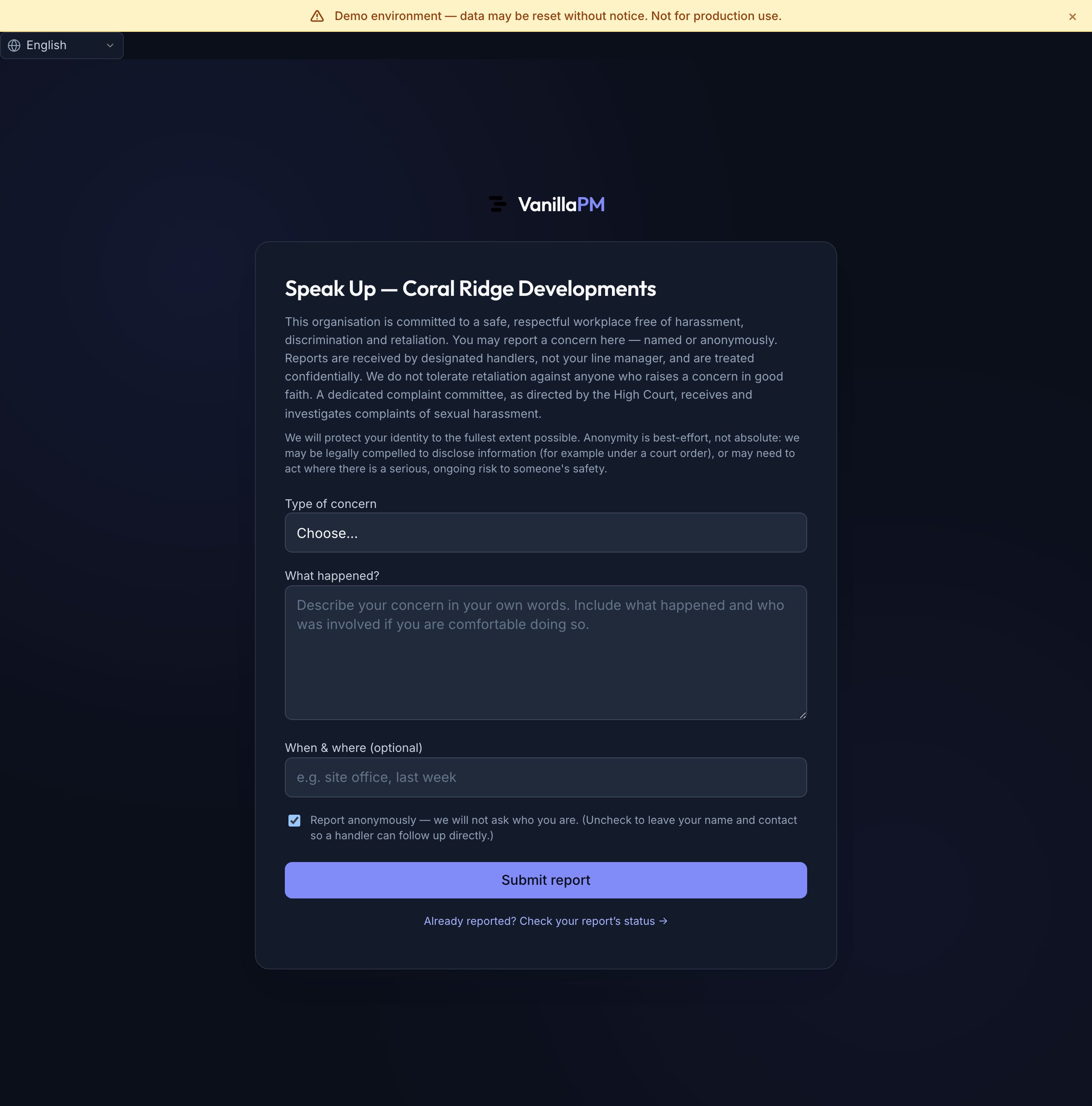
The public Speak-Up reporting page — a confidential 'report a concern' form with a type-of-concern selector (including sexual harassment), a 'what happened?' box, an optional when/where field, and a 'report anonymously' checkbox that is on by default, with an honest note that anonymity is best-effort, not absolute
⚠️ Honesty box — one touchpoint, not a safeguarding system
VanillaPM provides a confidential reporting route and (covered in the next task) the console that triages what comes in. It does not ship a safeguarding / PSEA module. There is no safe-recruitment vetting (reference checks, the misconduct-disclosure scheme, background checks), no PSEA training records, no code-of-conduct sign-off register, no survivor support case management, and no investigation workflow. Just as important: the reporting channel's concern types are workplace-oriented (sexual harassment, discrimination, safety, ethics) — it is a whistleblowing / staff-grievance channel, not a beneficiary-facing community feedback mechanism, which is the heart of PSEA under CHS Commitment 5 and is a distinct, demand-driven future build. So the honest position is: the tool gives you a safe reporting route, which is real and valuable — but the safeguarding framework (prevent · recruit safely · train · respond survivor-centred) is policy the organisation runs, and this lesson teaches that standard rather than pretending a form is it. (How a report is then handled — recusal, confidentiality, k-anonymity, sign-off — is run a confidential whistleblowing channel, task B3.)
The safeguarding / PSEA checklist (policy)
Because the product carries only the reporting route, here's the framework the organisation must run as policy around it — the thing a CHS verifier or a donor will probe:
| The safeguarding framework | In place? |
|---|---|
| Zero-tolerance policy on SEA, stated and enforced (dismissal as an outcome) | ✔ |
| Safe recruitment — reference checks, misconduct-disclosure scheme, background checks where lawful | ✔ |
| Code of conduct signed by every staff member and associate | ✔ |
| Induction & refresher training on safeguarding / PSEA for all staff | ✔ |
| Reporting routes — safe, accessible, confidential — for staff and affected communities | ✔ (staff route in-product) |
| Survivor-centred response — safety, dignity, choice, confidentiality; support offered | ✔ |
| Designated safeguarding focal point and a referral pathway | ✔ |
In VanillaPM today, only the staff reporting route is product; everything else is a policy document, a training record, a signed code — held in the knowledge base or offline, not structured data — and the lesson says so plainly.
Walked example — Speak-Up at Hilsa
The Hilsa Health Initiative runs field programmes where staff work directly with flood- and conflict-affected communities — exactly the setting PSEA exists for. Hilsa enables its Speak-Up page and publishes the link in offices, on ID cards and in community spaces, so a staff member who witnesses misconduct, or who is themselves harassed, has a route that doesn't go through the person they might be reporting.
A field nurse submits a concern through the page — type: sexual harassment, anonymously — about a supervisor's conduct. The channel routes it to Hilsa's designated handlers, not the supervisor's chain. That report existing at all is the product's contribution.
But read what the example also shows: the thing Hilsa most needs for PSEA — a community member, not a staff member, reporting that an aid worker demanded something in exchange for assistance — has no dedicated route here; that beneficiary-facing mechanism is policy Hilsa runs in the field. And everything upstream — that the supervisor was safely recruited, trained, and signed the code — lived in policy long before the report. The product gave Hilsa the one channel; Hilsa runs the safeguarding system the channel reports into.
Controls & assurance
- The reporting route (product). A confidential, optionally-anonymous channel to designated handlers is a real control — CHS Commitment 5 made concrete for staff. It is recorded, it bypasses the line manager, and it protects against retaliation by design.
- Anonymity is best-effort, stated honestly (product). The page itself says anonymity is not absolute — the organisation may be legally compelled to disclose, or must act on serious ongoing risk. Over-promising anonymity would be its own safeguarding failure; the tool doesn't.
- Everything else is a policy control. Zero tolerance, safe recruitment, the signed code, training completion, the survivor-centred response and the focal point are controls the organisation enforces — the product does not evidence them, and this lesson doesn't pretend it does.
- Honesty as the first safeguarding control. The worst thing a tool (or a lesson) could do here is imply that "we have a Speak-Up form" means "we do PSEA." A reporting route is necessary and not sufficient; naming that gap is the safeguarding-literate position.
Best practices & pitfalls
- Do publish the reporting route where the people who need it will actually find it — staff and, for true PSEA, the communities you serve (through the mechanisms your policy runs in the field).
- Do keep the channel genuinely independent of line management, and treat every report as survivor-centred from the first contact.
- Do run the rest of the framework — vetting, the signed code, training — as policy, and keep the evidence (even if that's documents, not structured data).
- Pitfall: mistaking the Speak-Up form for a PSEA system. It's a staff whistleblowing route; beneficiary-facing community feedback, safe recruitment, training and survivor support are not in it.
- Pitfall: promising absolute anonymity. The tool is honest that anonymity is best-effort; a handler who promises more than the system can deliver breaks trust the moment it can't be kept.
- Pitfall: "zero tolerance" on paper with no safe way to report. A policy no one can safely invoke protects no one — the route is what makes the standard real.
Practise question
Q1. An INGO states it has "zero tolerance for sexual exploitation and abuse" and points to its Speak-Up reporting page as evidence of its PSEA framework. A donor's due-diligence asks you whether that's a complete answer. What do you tell them, and what does the Speak-Up page actually prove?
Answer: It is not a complete answer, and saying so is the safeguarding-literate response. The Speak-Up page proves one thing: there is a safe, confidential reporting route for staff to raise a concern — named or anonymously — to designated handlers rather than their line manager. That's real, and it's CHS Commitment 5 made concrete for staff; a framework without a reporting route is hollow, so this matters. But PSEA is a framework, and a reporting form is only part of it. A complete answer needs the rest, which lives in policy, not this product: a stated and enforced zero-tolerance policy; safe recruitment (reference checks, the misconduct-disclosure scheme, background checks) so known abusers aren't hired; a signed code of conduct; training so staff know the standards and how to report; a survivor-centred response when a report comes in; and — crucially for PSEA specifically — a beneficiary-facing community feedback mechanism, because the people most at risk of sexual exploitation are the affected communities, and the staff Speak-Up page is not a route for them. So you tell the donor: "Here is our reporting route — and here is the policy framework (zero tolerance, safe recruitment, code, training, survivor-centred response, community feedback) it reports into." The reporting route is necessary; the framework is what makes it sufficient — and conflating the two is exactly the overclaim a good HR officer refuses to make.
Your hands-on assignment
Test the reporting route, then audit the framework around it. In a demo organisation — never live staff data (your names and figures will differ from Hilsa's):
- Open your demo organisation's Speak-Up link in a private browser window — no login — and walk the form (don't submit a real-looking report).
- Note the types of concern and the anonymous option.
- Work through the lesson's safeguarding / PSEA checklist for your organisation as a written exercise.
- List the items the tool does not carry — safe-recruitment checks, PSEA training records, code-of-conduct sign-off, survivor support, investigations.
- Write down how affected communities (not just staff) would raise a concern in your organisation today.
When you've done it, test yourself with the knowledge check below — a short quiz drawn from this lesson. Score 80% or more and the lesson is marked complete.
Terms used here
- Safeguarding — the responsibility to prevent and respond to harm, abuse and exploitation of the people an organisation serves and its own staff.
- PSEA — Protection from Sexual Exploitation and Abuse (of affected populations by staff/associates).
- SEA / SH / PSEAH — sexual exploitation & abuse (of beneficiaries); sexual harassment (of staff); the two run together.
- Zero tolerance — SEA is never acceptable and is grounds for dismissal; stated, trained, enforced.
- Safe recruitment — vetting (references, misconduct-disclosure scheme, background checks) to keep known abusers out of positions of trust.
- Survivor-centred — a response that puts the survivor's safety, dignity, choice and confidentiality first.
- Reporting route / whistleblowing channel — a safe, confidential way to raise a concern; in VanillaPM, the Speak-Up page (staff-oriented).
- Community feedback mechanism — a beneficiary-facing complaints channel (CHS Commitment 5); policy, not a product module here.
- CHS Commitments 3 & 5 / IASC six core principles — the standards safeguarding & PSEA are grounded in (cited, not reproduced).
- Related: Duty of care — protecting the staff you send out (B1) · Run a confidential whistleblowing channel — how a report is triaged & handled (B3).
What an auditor / donor expects
They expect a framework, and they will not accept a form as a substitute for it. A CHS verifier or a donor's PSEA due-diligence asks: Is there a zero-tolerance policy? Safe recruitment with the misconduct-disclosure scheme? A signed code of conduct and training records? Safe, accessible reporting routes for staff and affected communities? A survivor-centred response and a designated focal point? The Speak-Up reporting route answers one of those — the staff channel — and answers it well. So the honest, audit-ready position is: "Here is our in-product reporting route; here is the policy framework — zero tolerance, safe recruitment, code, training, survivor-centred response, community feedback mechanism — that it sits inside, with the evidence held in our documents and training records." "We have a Speak-Up form, so we do PSEA" is precisely the overclaim that fails a CHS verification — and exactly the one this lesson is written to prevent.
Sign in to track your progress and earn your track completion.
🎉 You finished the track — view your completion →