
Equitable reward across a multi-currency workforce
Learn HR · Humanitarian / INGO HR · Task B8 — the last task in the track. Pay is where fairness gets real and uncomfortable. An INGO often pays national staff in local currency and international staff in hard currency, on different structures — and "is that equitable?" is one of the hardest questions in the sector. This task teaches the structure that makes reward transparent and defensible, and is honest that transparent is not the same as equitable.
What it is
Equitable reward is paying people fairly, consistently and transparently for the work they do — and in a multi-currency workforce, doing so across currencies. VanillaPM models it with a grade/step structure:
- Salary grade. A pay band — a level in the structure (e.g. Field Assistant, Programme Officer, Programme Manager). Pay attaches to the grade, not the person's negotiating power.
- Steps. The transparent pay points within a grade — progression (#1, #2, #3…), each with a base amount and, crucially, its own currency. A national grade's steps are in BDT; an international grade's steps are in USD; they sit side by side in the same structure.
- Employee compensation. An employee's placement on a grade/step — effective-dated (never
overwritten, so payroll can reproduce any historical run) and field-secured (pay figures need the
staff.salarypermission; not everyone who can see the structure can see individual pay).
Two ideas make it equitable rather than just recorded:
- Rule-based, not negotiated. When pay is defined by grade + step, two people doing the same job at the same step earn the same base — equal pay for equal work, by construction, not by who bargained harder.
- Transparent by design. The structure is visible (grades, steps, currencies); reward isn't a secret each manager sets. Transparency is the precondition for fairness.
Grounded in Humentum (reward; cited for orientation, never reproduced). The currency-conversion side is a finance concern (payroll FX) — the seam this lesson is careful about.
Why it matters
- Pay is the fairness people feel most. Nothing corrodes trust faster than a sense that reward is arbitrary or secret. A transparent grade structure is the single best defence against "why does she earn more than me for the same job?"
- Multi-currency is the INGO reality. National and international staff, paid in different currencies on different structures, is normal — and is exactly where perceived inequity lives. You can't manage it if you can't see both structures together.
- Effective-dating protects the record. Pay changes over time; an effective-dated compensation history means a payroll run from six months ago can be reproduced exactly — essential for audits, disputes and back-pay.
- Field-security is a dignity issue. Individual salaries are sensitive; gating pay figures behind a permission means the structure can be open while individual pay stays private.
Where you do it in VanillaPM
Compensation & rates (apps/workforce) — the grade/step structure, with pay figures gated behind
the salary permission.
-
The transparent, multi-currency structure. The salary-grades table lists each grade and its steps with base amounts and currency — national grades in BDT, an international grade in USD, in one view. That side-by-side is the whole point: the structure is visible and rule-based, and the per-step currency makes the multi-currency reality explicit rather than hidden.
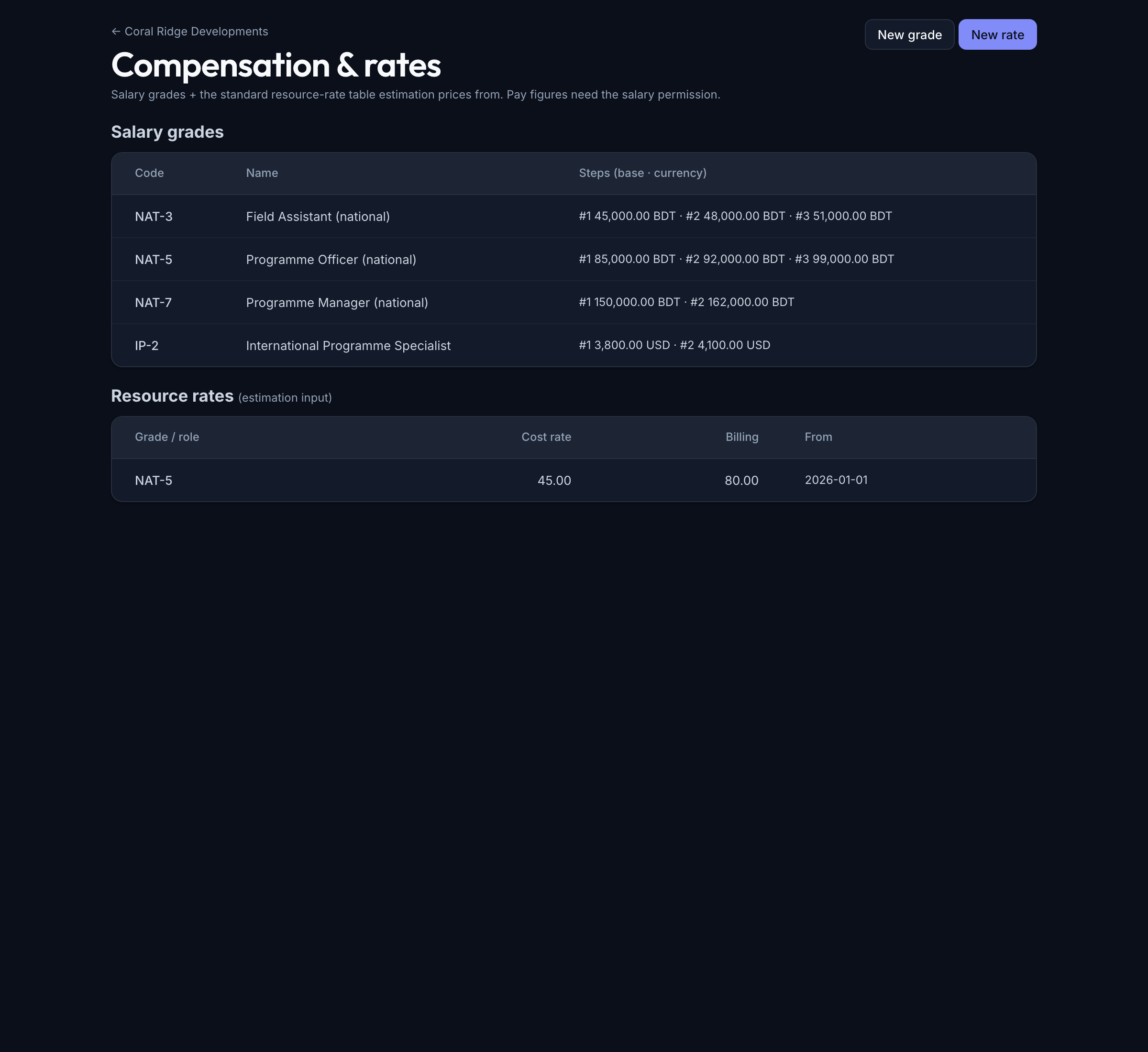
The Compensation & rates page — a Salary grades table with NAT-3 / NAT-5 / NAT-7 (national) steps in BDT and IP-2 (International Programme Specialist) steps in USD, each step shown as base amount · currency; a note that pay figures need the salary permission -
Defining a grade and its pay points. New grade captures the code and name, then its steps — each a base amount with its own currency — so you can stand up a national grade in BDT or an international grade in USD in the same place. This is the structure that makes pay rule-based instead of individually negotiated.
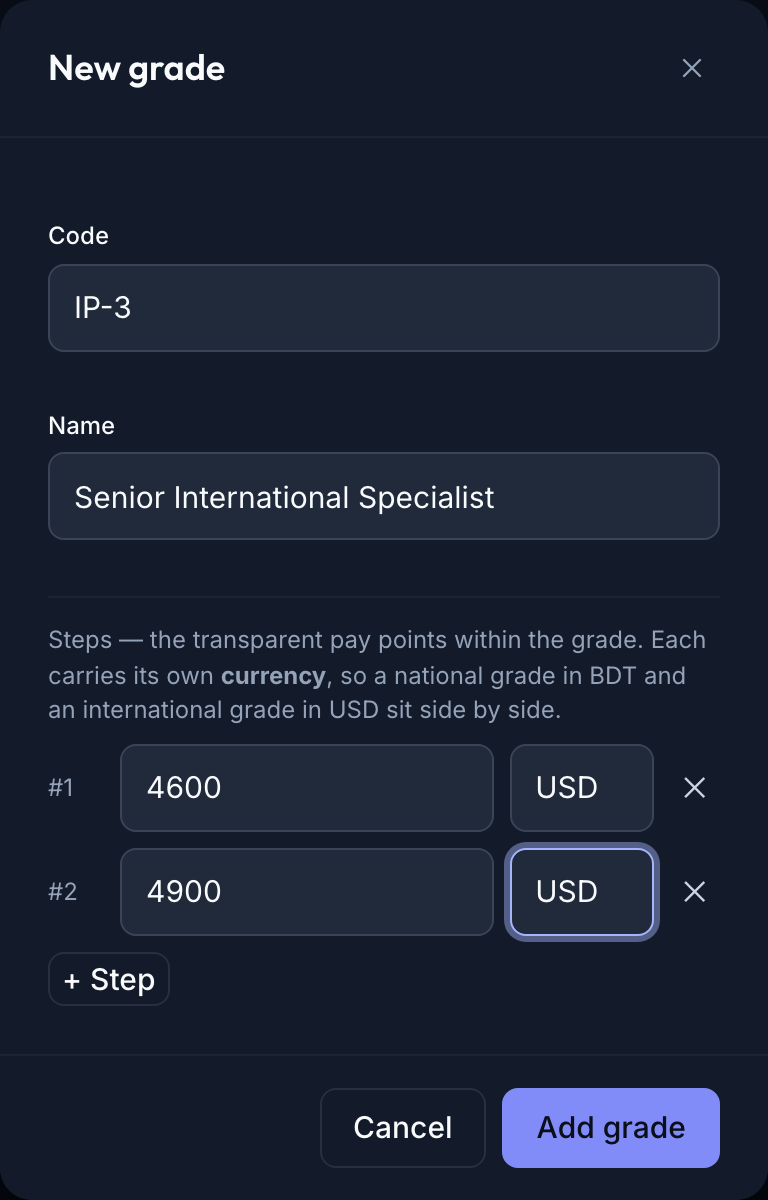
The New grade dialog — code (IP-3), name (Senior International Specialist), and a Steps editor where each pay point has a base amount and its own currency (USD), with the note that a national grade in BDT and an international grade in USD sit side by side
⚠️ Honesty box — transparent ≠ equitable, and the FX lives in payroll
The product gives you a transparent, rule-based, multi-currency structure — grades, steps, per-step currency, effective-dated placement, field-secured pay figures. That is most of what "transparent reward" means, and it's real. But three honest boundaries. First, transparent is not equitable. You can build a perfectly transparent structure that is inequitable — the tool shows the grades; whether paying a national Programme Officer a fraction of an international specialist for comparable work is fair is a policy judgment (the sector's "localisation" debate), and no software makes it for you. (Same lesson as B6: structure enables fairness, it doesn't guarantee it.) Second, comparing across currencies is FX — and FX lives in payroll. Putting a BDT salary and a USD salary on the same footing to judge equity needs a conversion rate (PayrollFxRate, the finance side — Finance B6); the compensation page holds each structure in its own currency and does not convert them for you. Third, this is the structure, not the payrun. Gross→net, withholding and the actual cash are payroll's job; this defines what people are paid against, not what lands in their account. The lesson teaches the structure and is clear that equity is a judgment, conversion is finance, and the payrun is next door.
Walked example — one structure, two currencies at Hilsa
Hilsa runs a national grade ladder in BDT — NAT-3 Field Assistant (steps 45,000 → 51,000), NAT-5 Programme Officer (85,000 → 99,000), NAT-7 Programme Manager (150,000 → 162,000) — and an international grade in USD, IP-2 International Programme Specialist (3,800 → 4,100). In one table, the whole structure is visible: anyone with the salary permission can see that pay is rule-based — a Programme Officer at NAT-5 step 2 earns 92,000 BDT, full stop, not whatever they negotiated.
That transparency is genuinely valuable — and it also makes the hard question unavoidable, which is
the point. An IP-2 specialist on ~4,000 USD/month and a NAT-5 officer on ~92,000 BDT
(~750 USD) are both in the structure, side by side. Is that equitable? Converting them to a common
currency to even ask needs an FX rate — which is payroll's PayrollFxRate, not this page. And
the answer — whether the national/international gap is justified by market, contract type, and
mobility, or whether it's an inequity to close — is a Hilsa policy decision, not something the tool
resolves. The honest reading of the whole task: VanillaPM makes the structure transparent (so the
question can even be asked honestly) and reproducible (effective-dated, field-secured); making it
equitable, and converting currencies to judge it, are policy and finance respectively.
The structure — and where the rest lives
| Element | In VanillaPM (Compensation) | Lives elsewhere |
|---|---|---|
| Grade / step | ✔ the transparent pay band + pay points | — |
| Per-step currency | ✔ BDT / USD side by side | — |
| Placement | ✔ effective-dated EmployeeCompensation, field-secured |
— |
| Currency conversion (equity comparison) | ✖ | payroll FX (PayrollFxRate, Finance B6) |
| Gross → net, withholding, cash | ✖ | payroll run |
| Is the structure fair? | ✖ | policy judgment (localisation) |
The ticks are a real, transparent, multi-currency structure. The crosses are exactly where a lesson that over-claimed would mislead — so this one points at where each actually lives.
Controls & assurance
- Rule-based pay (structure). Pay attaches to grade + step, so equal work at equal step means equal base — equity by construction, visible to anyone with the permission.
- Effective-dated, never overwritten. Compensation is history, not a single current value — a past payroll run reproduces exactly, and back-pay/disputes have a record.
- Field-secured pay figures. The structure can be open while individual amounts need
staff.salary— transparency of the system without exposing people. - Per-currency by design. Each step carries its own currency, so the multi-currency reality is explicit — no hidden assumption that everyone's on one currency.
- Honesty box — structure here, conversion in payroll, fairness in policy. The controls above make reward transparent and reproducible; they do not convert currencies (payroll FX) or decide whether the structure is fair (policy). Transparency is necessary for equity, not sufficient.
Best practices & pitfalls
- Do define pay as grades and steps and place people on them — rule-based pay is the structural defence against arbitrary or biased reward.
- Do keep each grade in its correct currency, and look at the national and international structures together — you can't manage equity you can't see side by side.
- Do use effective-dating: a raise is a new dated record, not an overwrite, so history stays reproducible.
- Do take the equity question to policy — use the transparent structure to ask "is this fair?" honestly, then decide it deliberately.
- Pitfall: mistaking a transparent structure for an equitable one. You can publish an unfair pay scale very clearly; visibility is the start of fairness, not the proof of it.
- Pitfall: eyeballing a BDT figure against a USD one. Without an FX conversion
(payroll's
PayrollFxRate) you're comparing nothing — judge equity on a common footing. - Pitfall: overwriting a salary on a change. You lose the history and break payroll reproducibility — add a new effective-dated record instead.
- Pitfall: treating the grade base as take-home pay. It's what pay is measured against; gross→net and withholding happen in payroll.
Practise question
Q1. A national Programme Officer (NAT-5) notices an international colleague (IP-2) doing similar work is paid far more, and asks you: "Is this fair, and how would the system even show it?" Walk through what the compensation structure can answer, and where the rest of the answer lives.
Answer: Start with what the structure can show, transparently: both are on a published
grade/step — NAT-5 in BDT, IP-2 in USD — so pay is rule-based, not negotiated, and the
officer can see she's paid the correct base for her grade and step (not shortchanged within the
national structure). That transparency is real and worth stating. But her actual question — "is the
gap between a national and an international package fair?" — the compensation page cannot answer on
its own, for two reasons this lesson is careful about. First, you can't even compare the numbers
as-is: one's in BDT and one's in USD, so to put them on a common footing you need an FX conversion,
which is payroll's PayrollFxRate (Finance B6), not this page. Second, once converted, whether the
remaining gap is fair — justified by labour market, contract type, mobility and benefits, or an
inequity the organisation should be closing — is a policy judgment (the sector's localisation
debate), not something the tool decides. So the honest answer to her is: "Here's the transparent
structure — you're paid correctly for your grade and step; the national/international gap is a real
question, it needs the currencies converted to compare properly, and whether it's fair is a decision the
organisation owns and should be able to explain." The tool made the question askable and honest;
answering it is finance (the conversion) and policy (the fairness) — which is exactly the seam,
and a fitting close to the track.
Your hands-on assignment
Build a two-currency pay structure and ask the hard question. In a demo organisation — never live staff data (your names and figures will differ from Hilsa's):
- In Compensation & rates, create a New grade with two steps, each with a base amount in BDT.
- Create an international grade with steps in USD.
- Read the grades table: is pay rule-based — the same step, the same base?
- Convert one USD step to BDT using a stated rate, and compare it with a national step.
- Write one sentence on whether the gap is justified — and note that the answer is policy, not the tool.
When you've done it, test yourself with the knowledge check below — a short quiz drawn from this lesson. Score 80% or more and the lesson is marked complete.
Terms used here
- Equitable reward — paying fairly, consistently and transparently for the work done, across currencies.
- Salary grade — a pay band / level; pay attaches to the grade, not negotiation.
- Step — a transparent pay point within a grade (#1, #2…), each with a base amount and its own currency.
- Employee compensation — an employee's effective-dated, field-secured placement on a grade/step.
- Effective-dating — pay history is dated and never overwritten, so any past payroll run reproduces.
- Multi-currency workforce — staff paid in different currencies (e.g. national BDT, international USD) on structures that sit side by side.
- PayrollFxRate — the payroll/finance conversion rate used to compare or consolidate across currencies (Finance B6) — not on the compensation page.
- Localisation (equity) — the policy question of whether national/international pay structures are fair; a judgment, not a product feature.
- Humentum — the sector standard for reward (cited, not reproduced).
- Related: Cross-project / multi-donor time allocation — the same multi-currency workforce, allocated (B5) · Ethical recruiting — structure enables fairness, doesn't guarantee it (B6).
What an auditor / donor expects
They expect reward to be structured, transparent and reproducible — and they know the fairness call is the organisation's. A Humentum-aligned reviewer asks: Is pay set on a documented grade/step structure (not case-by-case)? Are multi-currency structures held explicitly and correctly? Is compensation effective-dated so historical payroll reproduces? Are individual figures access-controlled? The compensation module answers all four: visible grades/steps, per-currency pay points, effective-dated field-secured placement. What it doesn't assert — and shouldn't — is that the structure is fair, or a cross-currency comparison, because those are policy and payroll FX. So the audit-ready position is: "here's our transparent, multi-currency grade structure and our effective-dated placements — and here's our policy on national/international reward and the FX basis payroll uses to compare." "We have salary grades" answers the structure; "transparent in the tool, equitable by policy, converted in payroll, and we can explain all three" answers the whole of it — and closes the Humanitarian-HR track where it should: honest about the line between what the product guarantees and what the organisation must own.
Sign in to track your progress and earn your track completion.
🎉 You finished the track — view your completion →