
Field per-diems & travel
Learn HR · Humanitarian / INGO HR · Task B4. The money side of the trip whose duty of care you met in B1. When an INGO sends someone to the field, it usually pre-pays them an advance, then settles against what they actually spent — measured against a per-diem policy. Getting that right is a core Humentum competency, and it's where HR hands the trip to finance. Where the UI was thin, this task built it out so the lifecycle is real, not notional.
What it is
A field trip isn't just a posting — it's a small financial lifecycle, and VanillaPM models it as one: request → approve → advance → claim → settle.
- Per-diem rate. The daily allowance the organisation pays for a given location — the policy a field claim is measured against. You set it per location (e.g. Kurigram, Cox's Bazar, Dhaka).
- The request. Who's going, where, when, the purpose, an estimated cost, and the coding (the project / cost centre / donor / grant the trip belongs to).
- The advance. A prepayment to the traveller before they go — because you can't expect a field officer to fund a month's deployment from their own pocket. Crucially, an advance is not an expense yet: it's money the employee owes back until they account for it, posted Dr 1220 Staff advance / Cr Bank.
- The claim. The actual expenses on return, entered as lines (per-diem × days, transport, supplies…), each coded to an expense account and the funding dimensions.
- Settlement (D-S2). The reconciliation: Dr each expense / Cr 1220 up to the advance (the advance clears first) / Cr 2130 the remainder owed to the employee if they spent more than the advance. This is the moment the trip becomes expense in the books and the advance is cleared.
The spine, in one line: a per-diem policy, an advance that's a receivable, a coded claim, and a settlement that clears the advance and squares up with the employee — grounded in Humentum (travel & per-diem practice; cited for orientation, never reproduced).
Why it matters
- An unsettled advance is money at risk. Cash out the door that no one has accounted for is exactly what auditors and donors chase. The advance → settle loop is how you prove every advance was either spent (and coded) or returned.
- "Advance ≠ expense" is the idea people get wrong. Booking an advance straight to travel expense overstates spend and hides a receivable. Posting it to 1220 Staff advance keeps the books honest until the claim lands.
- Per-diems are a control, not a perk. A published rate per location means a claim can be measured — not negotiated trip by trip. It's how you keep field spending fair and defensible.
- Donor coding rides on the trip. A field trip is usually charged to a project / donor / grant; if the travel isn't coded, the cost can't be reported to the funder who paid for it (which is the whole of B5).
Where you do it in VanillaPM
Travel & per-diem (apps/travel) — the lifecycle on one page, with the per-diem policy beneath it.
-
Set the per-diem policy, see the trips. The register lists each trip (employee · purpose · destination · status · advance), and below it the per-diem rates by location — the daily allowance a claim is measured against. A trip moves draft → approved → settled, and the advance column shows what's been pre-paid.
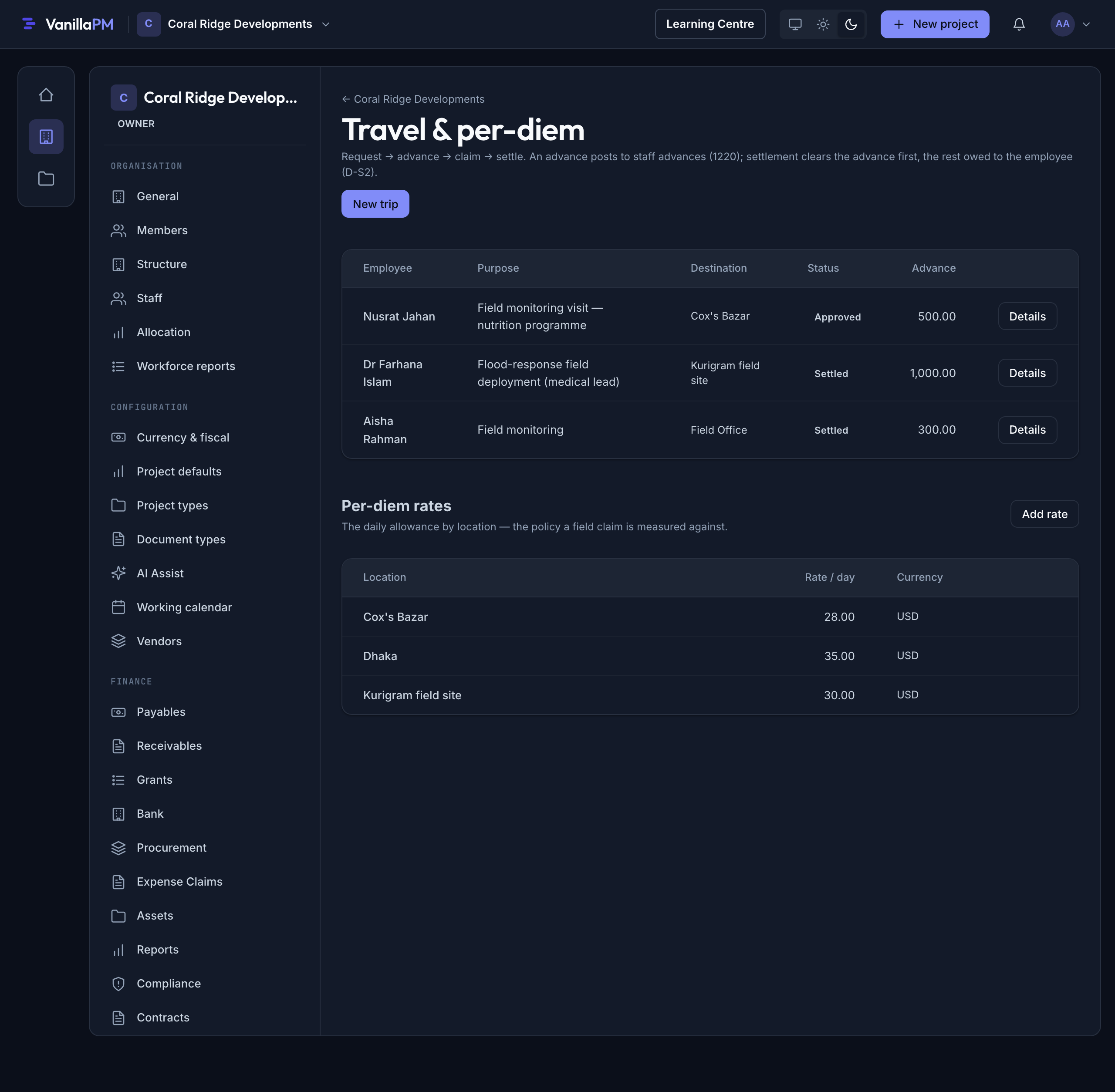
The Travel & per-diem page — a register of trips (Nusrat → Cox's Bazar approved with a 500 advance, Dr Farhana → Kurigram settled with a 1,000 advance, Aisha settled), and below it a Per-diem rates table (Cox's Bazar 28, Dhaka 35, Kurigram 30 USD/day); a header note that an advance posts to staff advances 1220 and settlement clears the advance first (D-S2) -
Work the trip — the claim. Opening a trip shows its status, dates, destination, project and advance, then the claim: the actual expense lines (per-diem, transport, supplies…) with a running total, which is what settlement reconciles against the advance. You add lines on an approved trip, then Settle (disabled until there's a claim to settle).
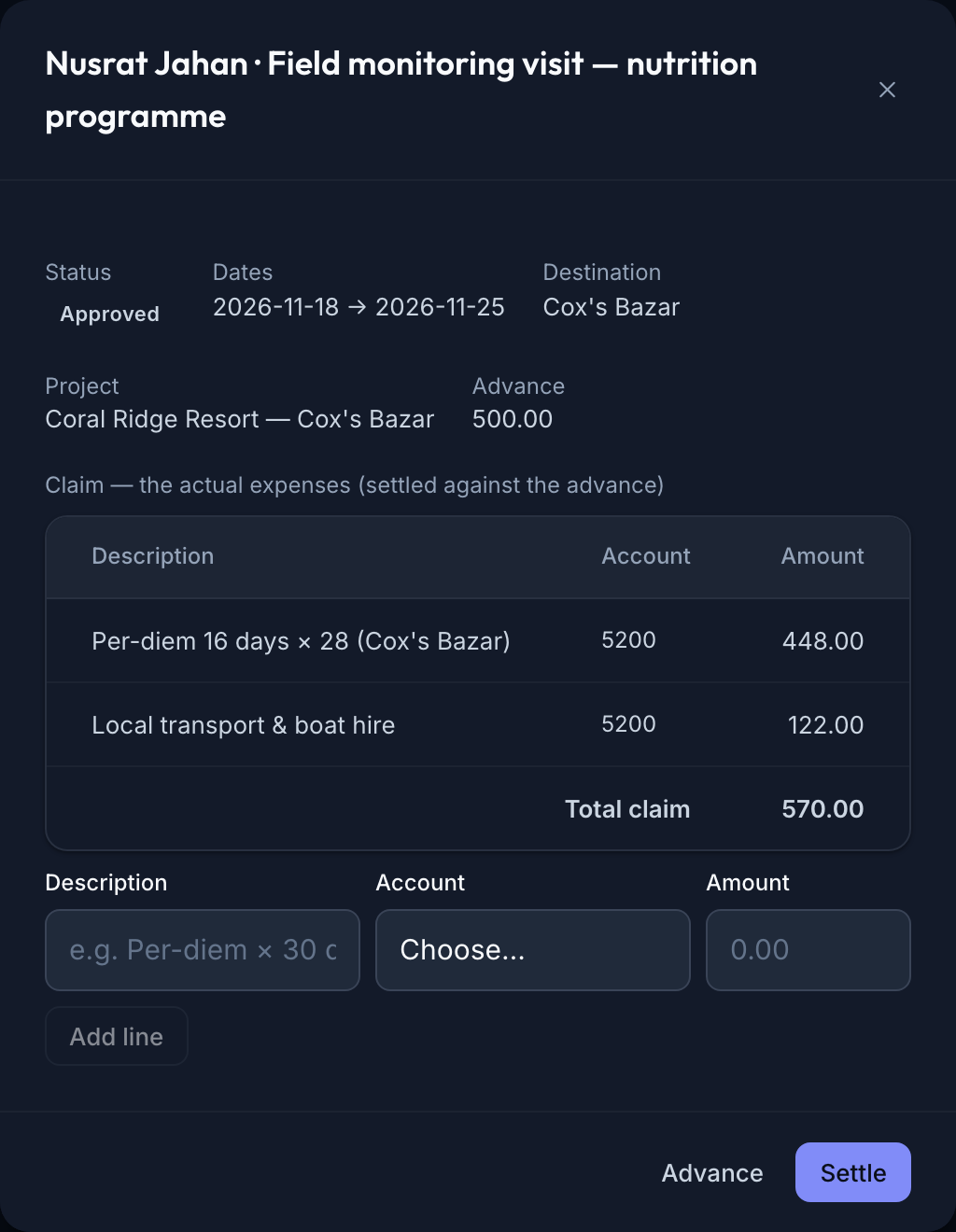
A trip opened — Nusrat's Cox's Bazar monitoring visit, Approved, advance 500.00, a Claim table (per-diem 16 days × 28 = 448, local transport & boat hire 122, total claim 570.00), an add-line row, and Advance / Settle actions in the footer -
Disburse the advance — the posting. The advance dialog records the amount and the bank account, and is explicit about the accounting: it posts Dr 1220 Staff advance / Cr Bank, and you cannot advance your own trip (maker ≠ checker). The amount pre-fills from the trip's estimate.
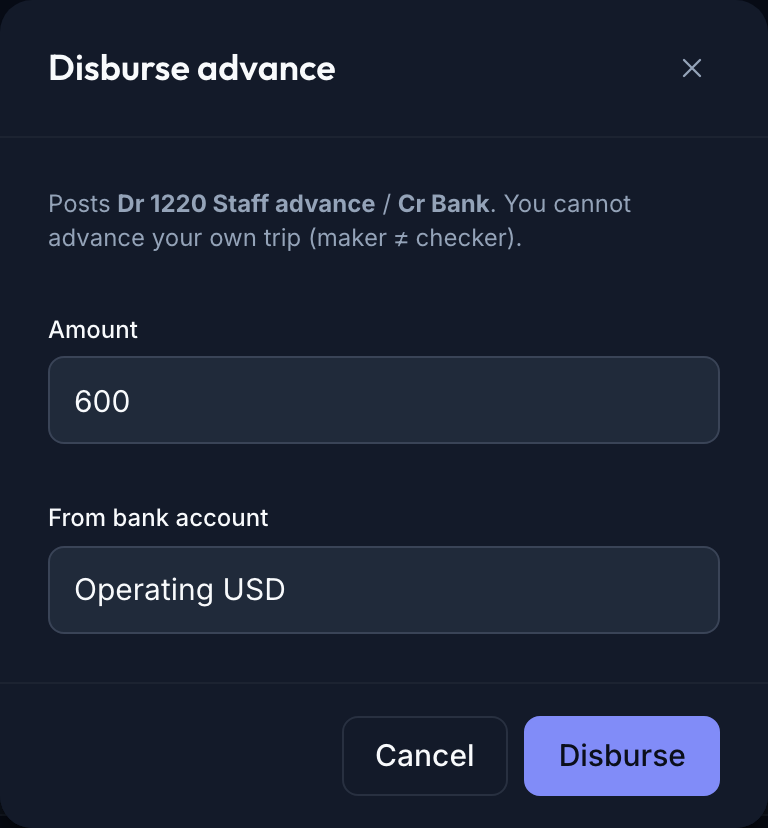
The Disburse advance dialog — an amount (pre-filled from the estimate) and a 'from bank account' select, with the note that it posts Dr 1220 Staff advance / Cr Bank and that you cannot advance your own trip (maker ≠ checker)
⚠️ Honesty box — HR hands the trip to finance (and the rate is a reference, not a calculator)
Two honest boundaries. First, this is where HR meets the ledger. The duty-of-care side of the trip (B1) is HR; the money here is finance — the advance and settlement post real double-entry to the native general ledger (CR-051/059): 1220 Staff advance, the expense accounts, 2130 owed to the employee. The travel page is the front door; the figures live in the GL, and the amount is computed and posted in accounting, not invented here. Second, the per-diem rate is a policy reference, not an auto-calculator. The rates table tells you the allowance for a location; you still enter the claim line yourself (e.g. "per-diem 16 days × 28 = 448") — the tool shows the rate, it doesn't multiply days × rate into the line for you. That's deliberate honesty: it's a register and a control, not a travel-booking engine, and this lesson says so rather than implying the per-diem is computed for you. (Splitting one trip's cost across several donors is cross-project / multi-donor allocation, B5.)
Walked example — two field trips at Hilsa
- Nusrat Jahan → Cox's Bazar (nutrition monitoring) — approved, advance out, not yet settled. Estimated 600; approved; a 500 advance disbursed (Dr 1220 / Cr Bank — Hilsa is now owed 500 by Nusrat). Her claim so far: per-diem 16 × 28 = 448 + transport & boat hire 122 = 570. When she's back and the claim is final, settling will clear the 500 advance and owe her the 70 she spent over it (Cr 2130). Right now the money is out and accounted-for-but-not-settled — exactly the state an advance register exists to make visible.
- Dr Farhana Islam → Kurigram (flood-response, medical lead) — settled. Estimated 1,200; a 1,000 advance; claim per-diem 30 × 30 = 900 + medical supplies 250 = 1,150. Settled: Dr 900 + 250 expense, Cr 1,000 clears the advance, Cr 150 owed to Dr Farhana. The trip is now expense in the books, coded to the project/field office, and her advance is zeroed. A clean, closed loop.
Read together they're the advance-control story: one trip settled (loop closed, expense booked, employee squared up), one advance outstanding (money out, claim building, settlement pending) — and the register shows exactly which is which.
The postings — what actually hits the ledger
| Step | Posting | Meaning |
|---|---|---|
| Advance | Dr 1220 Staff advance / Cr Bank | money pre-paid; a receivable from the employee, not an expense |
| Settle — expenses | Dr each expense account (per line, coded) | the trip becomes expense, on the right project/donor |
| Settle — clear advance | Cr 1220 up to the advance | the advance is cleared first (D-S2) |
| Settle — remainder | Cr 2130 the excess | what the employee spent over the advance, now owed to them |
Three numbers an HR/finance officer reads off it:
- Advance still on 1220 — an outstanding advance is money owed to the org; it shouldn't sit there after the trip is done.
- Claim vs advance — claim > advance ⇒ reimburse the employee (2130); claim < advance ⇒ the employee owes the difference back.
- The coding — which project / donor / grant the settled expense landed on, because that's what gets reported to the funder.
Controls & assurance
- Maker ≠ checker. You cannot approve, advance, or settle your own trip — the person spending the money can't also authorise or account for it. Enforced in the service, not left to good manners.
- The approval gate. A trip is a draft until approved; you can only disburse an advance on an approved trip. No advance on an unapproved trip.
- Settlement needs a claim. You can't settle a trip with no expense lines — the reconciliation has to reconcile against something. (The UI disables Settle until there's a claim.)
- Double-entry, always balanced. Every advance and settlement is a balanced journal entry on the native ledger; the postings can't be lopsided, and they carry the trip's coding dimensions.
- Per-diem as the measuring stick. The rate table is the policy a claim is checked against — "per-diem 16 × 28" is verifiable against the published Cox's Bazar rate, not a number pulled from air.
- Honesty box — recorded & posted here, owned by accounting. The travel page initiates the postings, but they live in the GL alongside the rest of the books; final figures are accounting's, and the per-diem rate is a reference the officer applies, not a calculator the tool runs.
Best practices & pitfalls
- Do set a per-diem rate for every field location before trips start — it's the control that makes claims measurable instead of negotiable.
- Do code the trip to its project / donor / grant so the settled travel lands on the funder who paid for it (and reconciles in B5).
- Do settle promptly on return — an advance that lingers on 1220 is money unaccounted for.
- Pitfall: booking the advance to travel expense. It's not an expense until settled — it's a receivable on 1220; expensing it early overstates spend and hides money owed.
- Pitfall: approving or settling your own trip. Maker ≠ checker blocks it, and for good reason.
- Pitfall: treating the per-diem rate as the claim. The rate is the allowance; the claim is what you enter (days × rate + the other costs). The tool shows the rate — it doesn't auto-fill the line.
- Pitfall: settling with no claim lines, or forgetting the remainder. If the employee spent over the advance, the excess is owed to them (2130) — don't leave them out of pocket.
Practise question
Q1. A field officer was given a 500 advance for a monitoring visit. She's back and submits a claim of 570 (per-diem 448 + transport 122). A colleague says "just book 570 to travel expense and we're done." Walk through what actually happens when you settle, account by account, and what's still owed to whom.
Answer: "Book 570 to travel expense" is wrong on two counts — it ignores the advance already paid and it leaves the officer out of pocket. Here's the real settlement (D-S2). First, the expenses go in: Dr travel expense 570 (the 448 per-diem + 122 transport, each coded to the project/donor the trip belongs to) — now the trip is expense in the books. Second, the advance clears first: Cr 1220 Staff advance 500, which zeroes the receivable the advance created when it was disbursed (Dr 1220 / Cr Bank 500) — so the officer no longer "owes" the 500; she accounted for it. Third, the remainder: she spent 70 more than the advance, so Cr 2130 70 — that's owed to her, to be reimbursed. Net effect: travel expense +570 (correctly coded), the 500 advance cleared off 1220, and 70 payable to the employee. The colleague's shortcut would have expensed 570 and left the 500 advance sitting on 1220 forever (money "owed" by someone who already spent it) and never paid the officer her 70. The discipline is exactly that the advance is a receivable that must be cleared, and settlement is what clears it and squares up — not a single lazy expense booking.
Your hands-on assignment
Run one trip from estimate to settlement and follow the money. In a demo organisation — never live staff data (your names and figures will differ from Hilsa's):
- In Travel & per-diem, read the per-diem rates for a field location.
- Create a trip with an estimate, get it approved, then disburse an advance — note it posts Dr 1220 Staff advance / Cr Bank.
- Try disbursing an advance on your own trip and read why it's refused.
- Add claim lines (per-diem days × rate, transport) so the claim exceeds the advance.
- Settle — and work out what's now owed to the traveller.
When you've done it, test yourself with the knowledge check below — a short quiz drawn from this lesson. Score 80% or more and the lesson is marked complete.
Terms used here
- Per-diem — the daily allowance for a location; the policy a field claim is measured against.
- Travel request / trip — the field trip as a record: employee · purpose · destination · dates · estimate · coding.
- Advance — a prepayment to the traveller; a receivable (Dr 1220 Staff advance / Cr Bank), not an expense until settled.
- Claim — the actual expenses, entered as coded lines (per-diem, transport, supplies…).
- Settlement (D-S2) — Dr expense / Cr 1220 up to the advance (clears first) / Cr 2130 remainder owed to the employee.
- 1220 Staff advance — the GL account an advance sits on until it's accounted for.
- 2130 — what the employee is owed when the claim exceeds the advance.
- Maker ≠ checker — you can't approve / advance / settle your own trip.
- Humentum — the sector standard for travel & per-diem practice (cited, not reproduced).
- Related: Duty of care — the safety side of the same trip (B1) · Cross-project / multi-donor allocation — splitting the trip's cost across funders (B5).
What an auditor / donor expects
They follow the cash: every advance is either accounted for (settled, with a coded claim) or returned — nothing left dangling on 1220. For a field trip, a Humentum-aligned reviewer or a donor's finance due-diligence asks: Was there an approved request? Was the advance posted as a receivable (not expensed early)? Is there a claim measured against the per-diem policy? Did settlement clear the advance and book the expense to the right project/donor? And was maker ≠ checker respected throughout? The register plus the ledger answer all of it: "here's the trip, here's the advance on 1220, here's the claim against the published per-diem, here's the settlement that cleared the advance and coded the expense to the grant, and a different person authorised each step." "We paid them some money for travel" is the answer that fails an audit; "every advance is on 1220 until a coded claim settles it, maker-checker enforced" is the one that passes — and exactly what this lifecycle, and this lesson, are built to produce.
Sign in to track your progress and earn your track completion.
🎉 You finished the track — view your completion →