
Manage training & development
Learn HR · Generalist HR Lifecycle · Task A8. Two jobs under one roof: keeping people compliant (the mandatory training and certifications that expire and must be renewed) and keeping them growing (the development the organisation invests in). Both are tracked so that "is everyone current?" and "what did we spend developing our people?" have real answers.
What it is
Learning & development (L&D) has two halves:
- Training records — the compliance-and-capability ledger. A course (name · provider) is a thing people can take; a training record is one person's enrolment in it, moving planned → enrolled → completed. A completed record can carry a certificate (a link to the document), an expiry date (for renewable certifications), and a cost that rolls up to the training budget.
- Development plans — what each person is working towards. In VanillaPM the development plan isn't a separate form: it lives as the weighted goals in the performance cycle (see Run a performance cycle). Training is how you fund and evidence the growth; the goals are where the growth is aimed.
Two ideas make the training side a discipline:
- Expiry drives the work. A first-aid certificate that lapsed is a compliance gap, not a filing detail. Completed records with an expiry feed a renewals-due list — and anything past its date is flagged overdue, loudly.
- Cost is visible, not buried. Every record carries what it cost, and the total rolls up — so L&D is a budget line you can defend, not a vague "we spend something on training."
Grounded in SHRM Learning & Development and HRCI competency areas (cited for orientation, never reproduced).
Why it matters
- Compliance is binary and dated. For safeguarding, first aid, anti-fraud and the like, "trained" isn't enough — it has to be current. An expired certification is the same as none when an auditor or a donor asks.
- Capability is an investment you should be able to show. "We developed our people" is a claim; a training ledger with courses, completions and cost is the evidence.
- Renewals are easy to miss and expensive to miss. The whole point of tracking expiry is to chase the renewal before it lapses, not to discover the gap during an incident.
- Development ties the money to the goal. Funding a course that maps to someone's performance goal is deliberate growth; funding training nobody asked for is waste.
Where you do it in VanillaPM
Learning & training (apps/learning). A step-by-step:
-
Define a course. New course — its name and (optionally) the provider and a short description. A course is the reusable thing; people get enrolled in it.
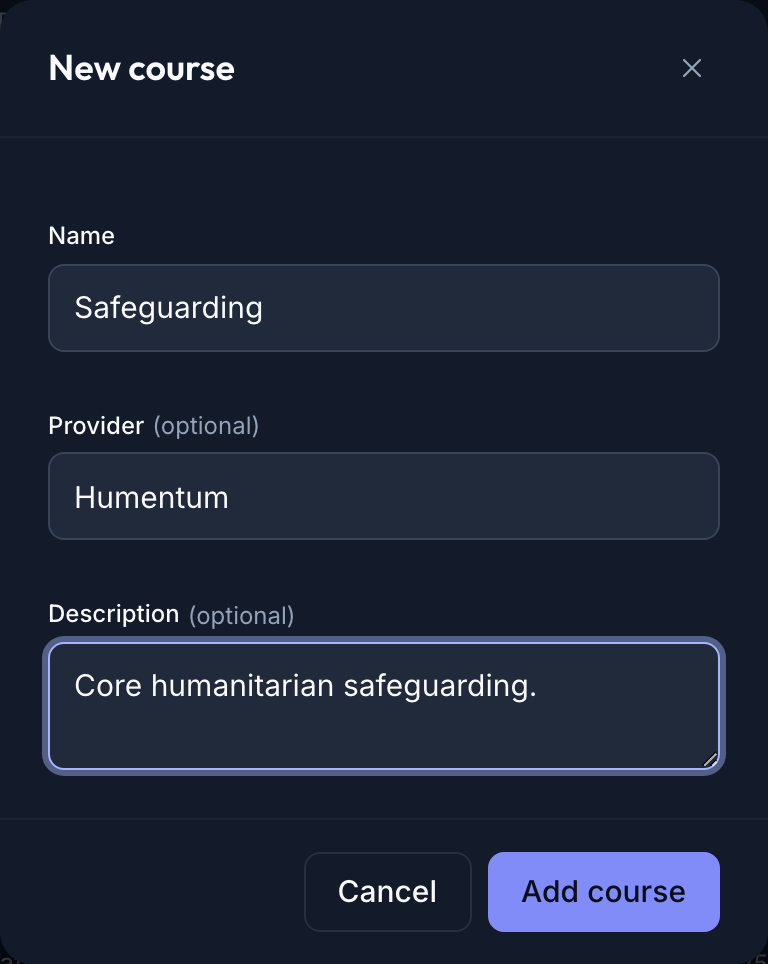
The New course dialog — a name, an optional provider and description; the reusable course people are enrolled in -
Enrol a person. Enrol records one employee in a course. Leave the planned date blank to enrol them now, or set it to schedule it (planned). Capture the cost here so the budget roll-up is right from the start.
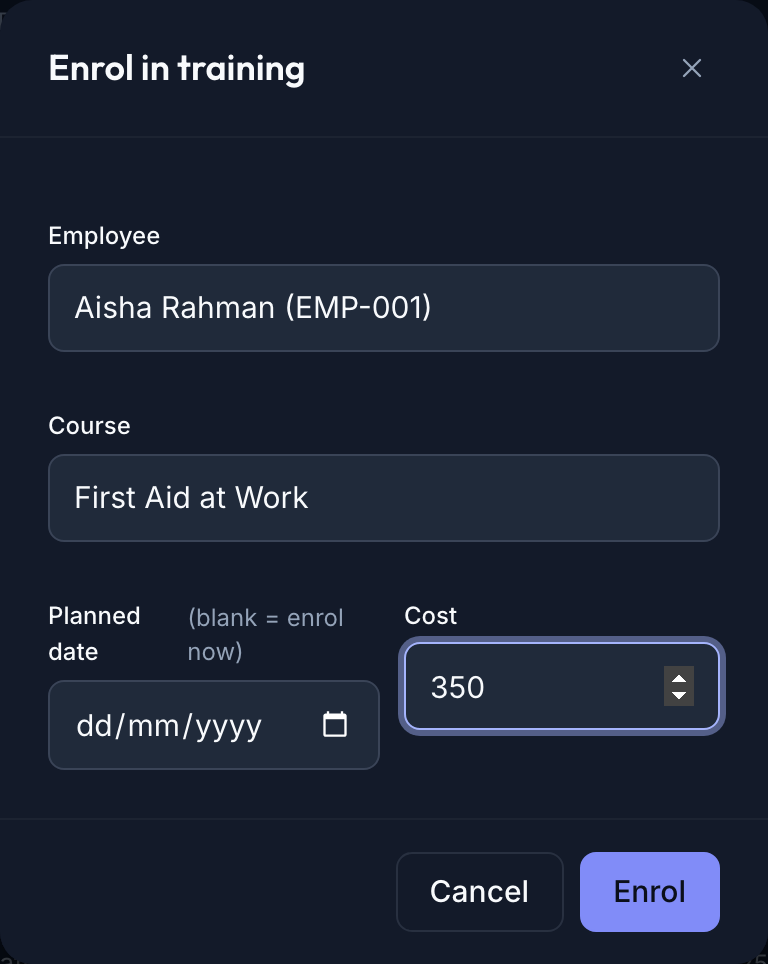
The Enrol dialog — an employee, a course, an optional planned date (blank = enrol now) and a cost that rolls up to the training budget -
Complete — certificate, renewal, cost. When someone finishes, Complete the record: the completed date, a certificate link (to the document), an expiry date if the certification is renewable, and the final cost. The expiry is what puts it on the renewals radar later.

The Mark completed dialog — a completed date, a renewable 'expires on' date, a certificate link and the cost; the expiry drives the later renewal reminder -
Track the records & the renewals. The page summarises completed · enrolled · renewals due · total cost, lists any renewals due within 60 days (overdue in red), and shows every record with its status, dates, cost, and a link to its certificate. The development side lives next door, as goals in the performance cycle.

The Learning overview — the summary (completed / enrolled / renewals due / training cost), a 'Renewals due' panel with an overdue certification flagged in red, and the training-records table with cost and certificate links
Walked example — training at Meridian
Meridian's L&D ledger, four people, four shapes:
- Aisha Rahman — Safeguarding & PSEA (Humentum), completed. Done on 2025-12-01, certificate on file, expires 2026-12-15, cost 150. It's completed and current — but the expiry already puts it on the renewals-due list, so HR chases the refresher before it lapses.
- Kamal Uddin — First Aid at Work, completed but OVERDUE. Done back in 2023, expired 2026-10-01 — flagged overdue in red. On paper "completed"; in reality a compliance gap to close now. This is exactly what the renewals panel exists to catch.
- Nusrat Jahan — Fraud Awareness, planned. Scheduled for 2026-12-01, cost 100. Booked, not yet taken.
- Rafiq Ahmed — Project Management Fundamentals (PMI), enrolled. In progress, cost 500 — and it maps to his performance goal to run quarter-end cleanly. Training funding the goal.
The totals tell the budget story at a glance: 2 completed · 1 enrolled · 2 renewals due · 950 spent.
The records — what a training record captures
| What it captures | Who reads it | |
|---|---|---|
| Course | name · provider · description | HR — the catalogue of what people can take |
| Training record | employee · course · status · completed · expiry · cost · certificate | HR & the employee — "am I current?"; finance — the training spend |
| Renewals-due list | completed certs expiring within 60 days (overdue flagged) | HR — the chase list; compliance — the gap radar |
| Development plan | the person's weighted goals (in the performance cycle) | manager & employee — where the growth is aimed |
What an HR officer reads from it:
- Overdue first. A red "overdue" line is a live compliance gap — it jumps the queue over anything merely "due soon."
- Cost against budget. The total is the training-budget actuals; a course with no cost recorded is spend you can't see.
- Certificate or it didn't happen. A "completed" record with no certificate link is a claim without evidence — fine for internal training, not for a certification an auditor will ask to see.
Controls & assurance
- Expiry-driven renewals. Completed certifications with an expiry surface automatically as renewals due (and overdue past the date) — the reminder is a property of the data, not a sticky note.
- Cost rolls up to the budget. Every record's cost aggregates into the training total, so L&D spend is a defensible budget line.
- Certificates link out, not in. The certificate is a link to the document (the evidence lives in the documents module), so the training record references proof without duplicating it.
- Access-gated. Viewing and editing L&D needs the
learningcapability — training data isn't open to everyone with general staff access. - Honesty box — training records, light IDP. VanillaPM does training records fully (courses, completions, certificates, renewals, cost). The formal individual development plan (IDP) is lighter: it's represented by the weighted goals in the performance cycle, not a dedicated IDP artefact with competencies and milestones. If your instance needs a heavier, standalone IDP, that's a gap to name — the lesson doesn't pretend the goals are a full competency framework.
Best practices & pitfalls
- Do record the expiry the moment you complete a renewable certification — a completion with no expiry silently drops off the renewals radar.
- Do capture cost at enrolment, not "later" — later is how training spend goes untracked and the budget line becomes fiction.
- Do tie funded training to a performance goal where you can — it turns "a course" into "deliberate development."
- Pitfall: treating "completed" as "current." A completed-but-expired certification is a gap; the overdue flag is there precisely because people forget this.
- Pitfall: a certificate with no link. "Trust me, they did it" is not evidence; link the document.
- Pitfall: confusing the training ledger with the development plan. The ledger is what was taken and what it cost; the plan is what they're working towards — and that lives in the performance goals, not here.
Practise question
Q1. You run the renewals-due panel and see a first-aid certification flagged overdue and a safeguarding one due in six weeks. The training budget is tight. Which do you act on first, and what does "acting on it" actually require?
Answer: The overdue one first, without question — an expired certification is a live compliance gap right now, not a future risk, and no budget constraint changes that (an incident with a lapsed first-aider is the exact scenario the record exists to prevent). "Acting on it" means re-enrolling the person in the course and, when they complete it, recording the new completed date, a fresh expiry, the certificate, and the cost — which both closes the gap and updates the budget roll-up. The safeguarding one is due soon, so it's scheduled next, before its date — the whole value of the panel is acting ahead of the lapse, not after. And note the boundary: the tool tells you what's expiring and what it costs; whether a given certification is mandatory where you operate is a policy question — the record keeps you honest, it doesn't write your training policy for you.
Your hands-on assignment
Build a small training ledger with one thing that's gone stale. In a demo organisation — never your live records (your names and figures will differ from Meridian's):
- In Learning & training, create a New course (name and provider).
- Enrol one person now, and one with a planned date — capture a cost on each.
- Complete one record with a completed date, a certificate link and an expiry date within the next 60 days.
- Check it appears under renewals due.
- Read the summary totals — completed · enrolled · renewals due · total cost.
When you've done it, test yourself with the knowledge check below — a short quiz drawn from this lesson. Score 80% or more and the lesson is marked complete.
Terms used here
- Course — a reusable training offering (name · provider) people are enrolled in.
- Training record — one employee's enrolment in a course: planned → enrolled → completed, with a certificate, expiry and cost.
- Certificate — a link to the document that evidences a completed certification.
- Renewal / expiry — the date a certification lapses; drives the renewals-due reminder (overdue past the date).
- Training cost — the per-record cost that rolls up to the training budget.
- IDP (individual development plan) — where a person's growth is aimed; in VanillaPM this is the weighted goals in the performance cycle, not a separate artefact.
- Related: Run a performance cycle — the goals the development aims at · Plan and manage finance — the budget the training cost rolls into.
What an auditor / HR lead expects
They expect the chain to hold: course → enrolment → completion → certificate → (renewal), with every current requirement provably current and every lapse visible. A reviewer asks "show me everyone who needs safeguarding training and whether they're in date," and the answer is the records plus the renewals panel — with overdue certifications flagged, not buried. Every completed certification has a date and, where it matters, a linked certificate; every renewable one has an expiry that's actively chased; and the spend reconciles to the training budget. "Here are the courses, who took them, who's current, who's overdue, and what it cost" is a complete answer; a pile of "completed" records with no expiries and no certificates is not.
Sign in to track your progress and earn your track completion.
🎉 You finished the track — view your completion →