
Run a performance cycle
Learn HR · Generalist HR Lifecycle · Task A6. Once a year (or twice) the whole organisation stops to answer one question per person: how did this go, and what next? A cycle makes that answer evidence-based and comparable — goals set in advance, scored at the end, rolled into a rating a manager owns, with any promotion flagged for HR to act on — not auto-applied.
What it is
A performance cycle is a time-boxed container for appraisal. It has three moving parts:
- The review cycle — a named period (e.g. FY2026 Annual, Jan–Dec) that everyone's goals and appraisals hang from. It's open while you're setting goals and scoring, then closed once ratings are final.
- Weighted goals — each employee's objectives for the cycle, each with a weight (how much it matters relative to the others) and, at review time, a score (0–10). Weight is the judgement call: "ship the rollout" counts for more than "tidy the wiki."
- The appraisal — the manager's assessment that turns goals into a rating band (Outstanding → Unsatisfactory). The tool computes a weighted roll-up of the scored goals and suggests a band; the manager can accept it or override it, add a note, and — for a strong result — attach a promotion recommendation.
Two ideas make it a discipline, not a form-filling ritual:
- The roll-up suggests; the manager decides. A 9.8 roll-up suggests Outstanding, but the rating is the manager's call on the record — numbers inform judgement, they don't replace it.
- A promotion recommendation is a hook, never an action. Recommending Aisha for a higher grade records the recommendation; it does not change her grade or pay. HR acts on it through compensation and position — the appraisal only points.
Grounded in SHRM Performance Management and HRCI competency areas (cited for orientation, never reproduced).
Why it matters
- It makes pay and promotion defensible. "Why did she get the raise?" has a clean answer when there's a cycle, weighted goals, scores, a rating, and a note behind it — not a hallway opinion.
- Weighting is where fairness lives. Two people who both "hit their goals" aren't equal if one carried the goal that mattered. Weighting makes that explicit instead of hidden.
- It separates measurement from reward. The cycle produces a rating; what you do with it — raise, promotion, development plan — is a separate, deliberate act. Conflating them is how ratings get inflated.
- It surfaces your talent and your risk. A cycle read across the org shows who's ready for more and who needs support — before either becomes a resignation.
Where you do it in VanillaPM
Performance (apps/performance), one workspace per organisation. A step-by-step:
-
Open a review cycle. New cycle — name it and set the period (start / end). Everyone's goals and appraisals for the year will hang from this cycle; it stays open while you set goals and score, and is closed once ratings are final.
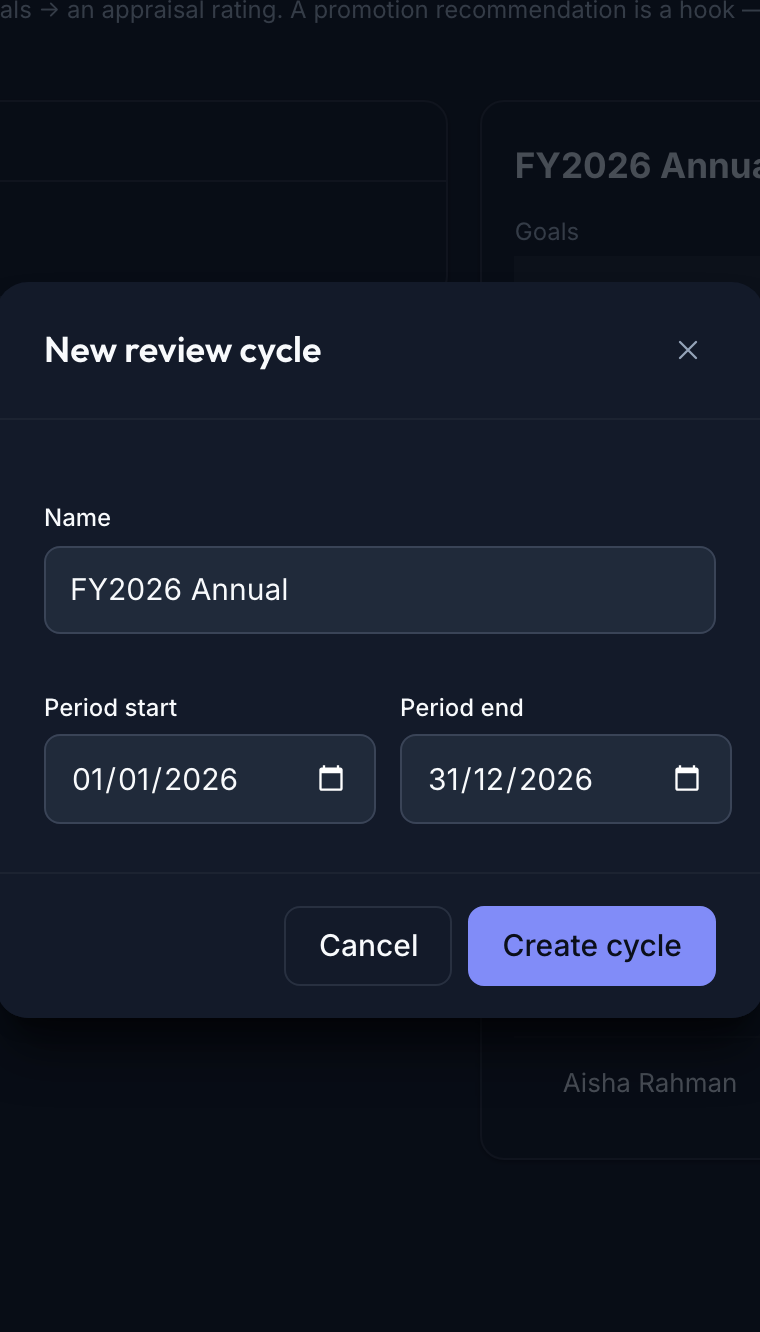
The New review cycle dialog — a name (e.g. FY2026 Annual) and a period start / end; the cycle is the container every goal and appraisal hangs from -
Set weighted goals. For each person, Add goal — the objective, its weight (relative importance, 1 = baseline), and, when you assess, a score (0–10, left blank until review). The weight is the honest part: say out loud which goal mattered most.
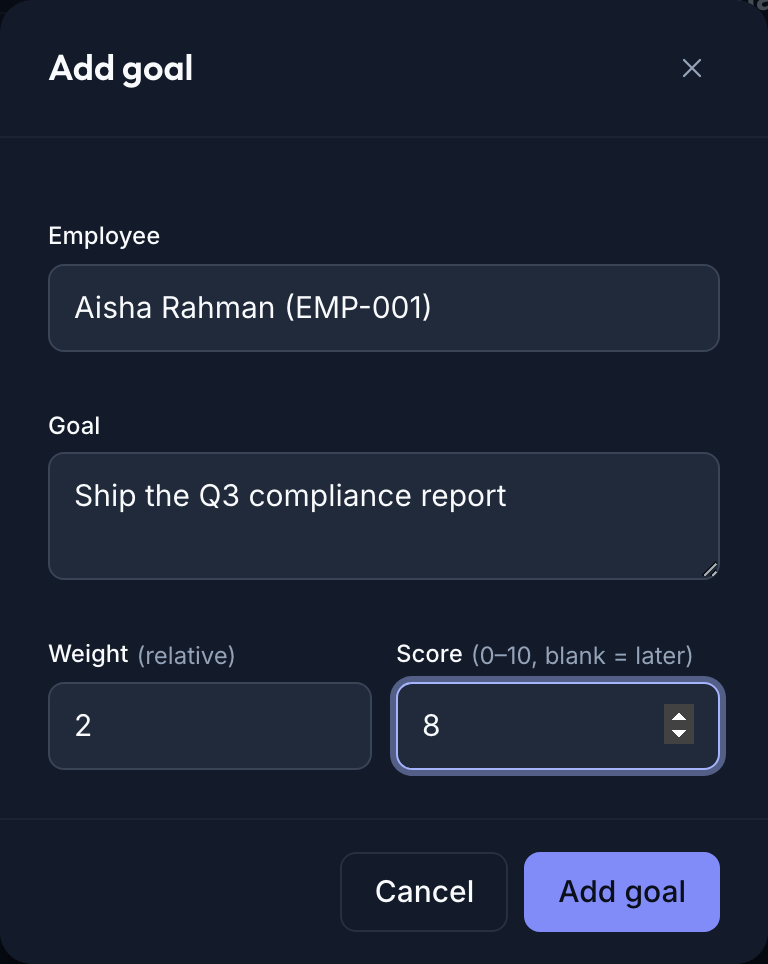
The Add goal dialog — an employee, the goal text, a relative Weight and a 0–10 Score (blank until review); weight makes 'which goal mattered' explicit -
Appraise — roll-up, then rating. Appraise an employee: the panel shows their weighted goal roll-up and the rating it suggests. Accept the suggestion or override it, add a manager score and a note, and — for a strong result — tick Recommend promotion (optionally to a grade). The recommendation is a hook: HR acts on it, it is never auto-applied.
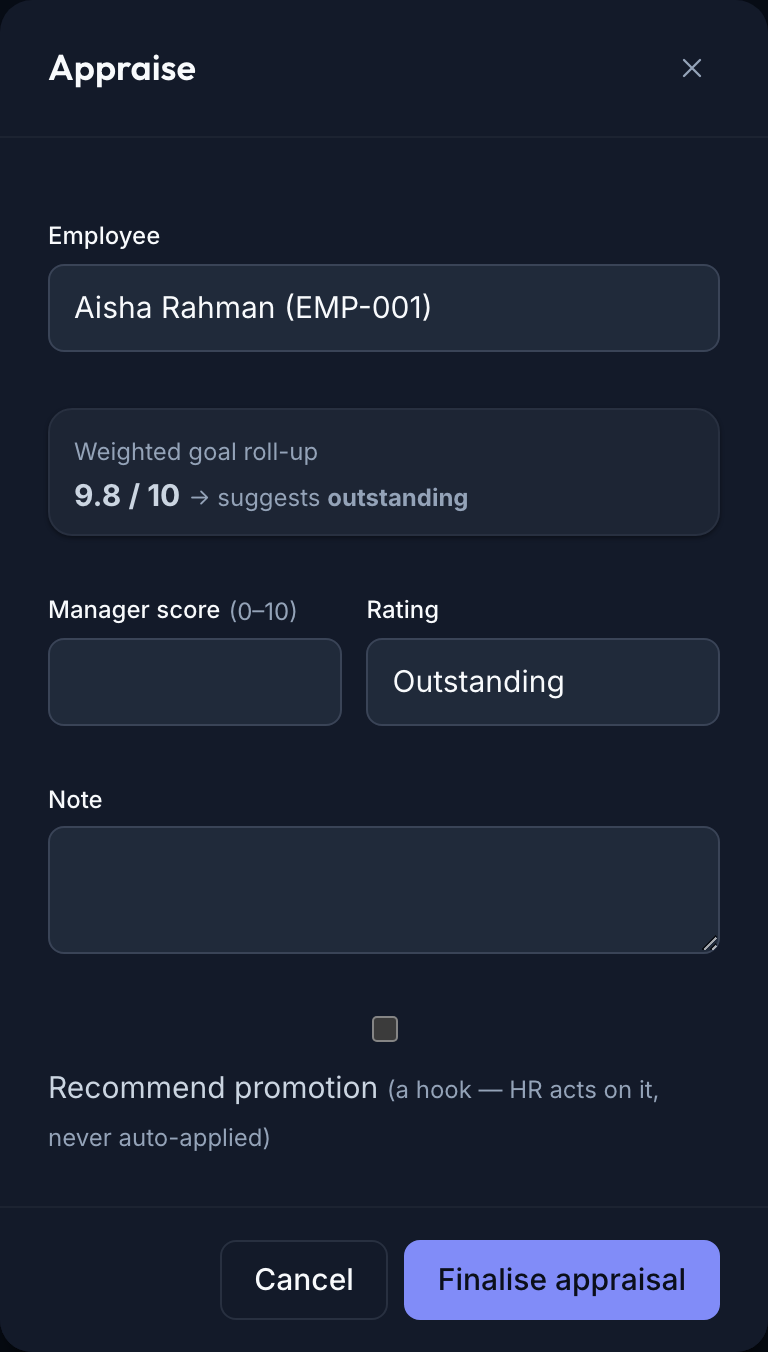
The Appraise dialog — the weighted goal roll-up (e.g. 9.8 / 10) with the rating it suggests (Outstanding), an overridable Rating, a manager note, and a 'Recommend promotion' hook marked 'never auto-applied' -
Read the cycle. The cycle shows the goals (per person, with weight and score) above the appraisals (each with its roll-up, final rating, and any promotion recommendation). This is the comparable picture you calibrate and act from.
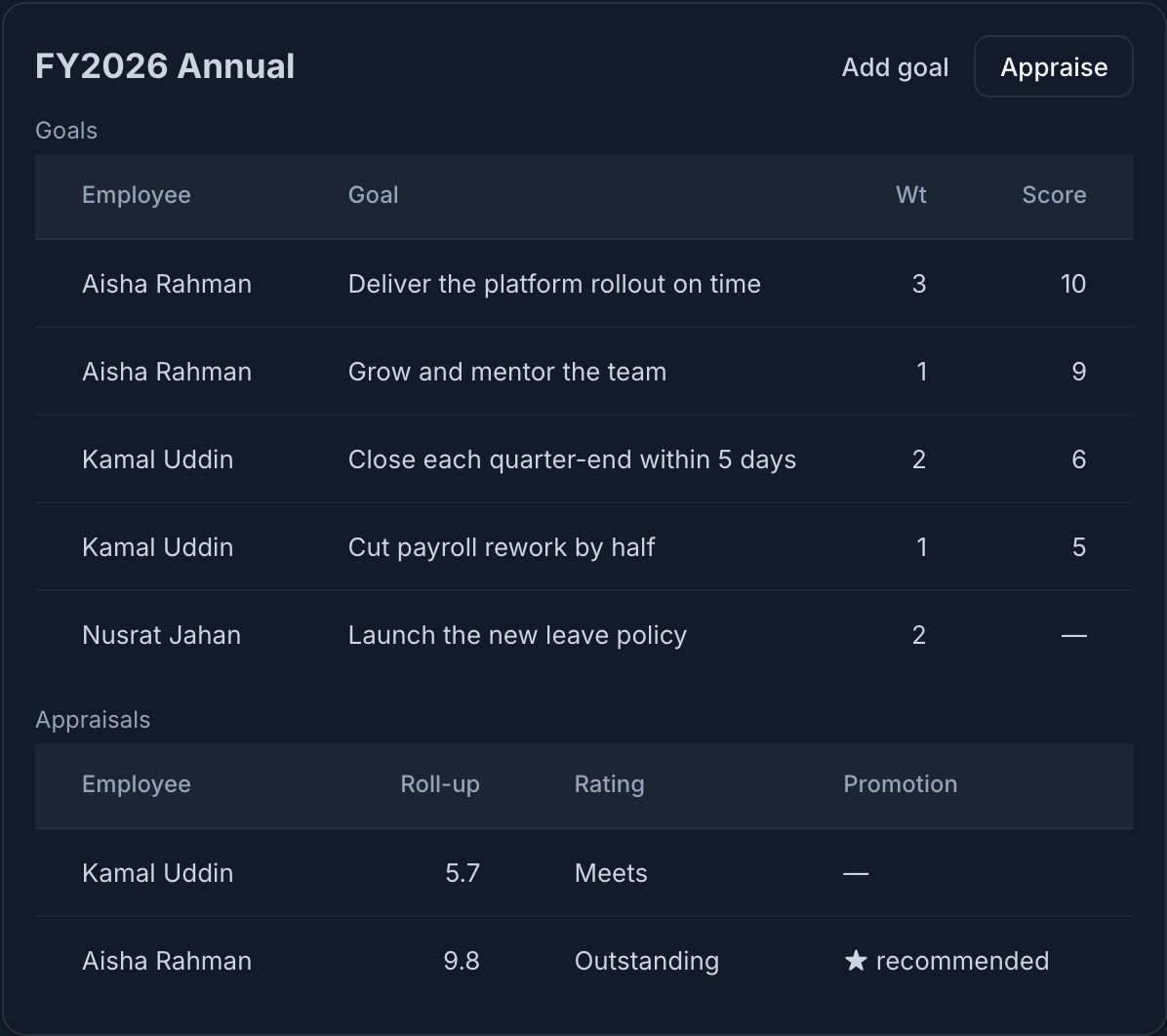
The FY2026 Annual cycle — the Goals table (employee · goal · weight · score) above the Appraisals table (employee · roll-up · rating · promotion), e.g. Aisha 9.8 → Outstanding ★ recommended, Kamal 5.7 → Meets
Walked example — a performance cycle at Meridian
Meridian runs its FY2026 Annual cycle. Three people, three shapes of year:
- Aisha Rahman carried the platform rollout. Two goals: "Deliver the platform rollout on time" at weight 3, scored 10, and "Grow and mentor the team" at weight 1, scored 9. The weighted roll-up is (10×3 + 9×1) / 4 = 9.8, which suggests Outstanding. Her manager accepts it, notes "exceptional delivery; ready for more scope," and ticks Recommend promotion to the next grade. Nothing about Aisha's grade or pay changes here — HR now has a recommendation to act on.
- Kamal Uddin had a solid, mixed year. "Close each quarter-end within 5 days" at weight 2, scored 6 and "Cut payroll rework by half" at weight 1, scored 5 roll up to (12 + 5) / 3 = 5.7 → Meets. The manager accepts Meets, notes "dependable; focus next on rework," and makes no promotion recommendation. A clean, honest "meets expectations."
- Nusrat Jahan has her goal set — "Launch the new leave policy," weight 2 — but it's not yet scored, so she has no appraisal. That's the cycle working: goals are set in advance; the rating waits for the evidence.
Read side by side, the three tell you where your scope, your steadiness, and your in-flight work sit — the raw material for a calibration conversation.
The records — what the cycle captures
| What it captures | Who reads it | |
|---|---|---|
| Review cycle | the named period + status (open / closed) everything hangs from | HR — "which year is this?"; everyone — the deadline |
| Goal | employee · objective · weight · score (0–10) | the manager & employee — "what were we measuring, and how much did it count?" |
| Appraisal | the roll-up, the final rating, a note, any promotion recommendation | HR & comp — the defensible basis for reward; the employee — "where did I land, and why?" |
What an HR officer reads from it:
- The roll-up vs the rating — if they diverge, the note should say why. An override without a reason is the thing to chase.
- Weighting across a team — two "Meets" ratings aren't the same story if one carried the heavy goal; the weights make that legible.
- Open recommendations — promotion recommendations are a to-do list for HR, not a done deal; they wait for comp and position to act.
Controls & assurance
- The rating is the manager's, on the record. The roll-up suggests; the manager sets the band and signs the note. The suggestion is a starting point, not an auto-decision.
- Promotion is a hook, never auto-applied. Recommending a promotion (and a grade) records intent; it changes nothing about the employee's grade, position or pay. Those happen deliberately, elsewhere — so a generous appraisal can't quietly move someone's salary.
- Goals are set before they're scored. Weight is agreed up front; scoring at review time can't retro-fit the weighting to the outcome.
- Calibration is a process the tool supports, not enforces. The cycle lays every rating and roll-up side by side so managers can calibrate — talk through whether one team's "Exceeds" means the same as another's — but VanillaPM does not force a distribution or a curve. That judgement stays with the people in the room; the tool makes it visible, honest work, not an algorithm.
- One appraisal per person per cycle. A cycle can't carry two conflicting ratings for the same employee.
Best practices & pitfalls
- Do set goals and their weights at the start of the cycle, not at review time — weighting after the fact is just justifying the score you already picked.
- Do write the note, especially on an override — "rated Exceeds despite a 9.8 roll-up because the rollout slipped a quarter" is the sentence that makes the rating defensible.
- Do calibrate across managers before finalising — the tool shows the spread; use it to catch one manager who rates everyone Outstanding and another who rates no one.
- Pitfall: treating the roll-up as the rating. The number is an input to a judgement, not the judgement — if you just rubber-stamp it, you didn't appraise, you averaged.
- Pitfall: letting the promotion recommendation feel like a promotion. It isn't one until comp and position act; promising it off a ticked box is how you create a broken commitment.
- Pitfall: flat weights on everything. If every goal is weight 1, you've opted out of saying what mattered — and two very different years will roll up to the same number.
Practise question
Q1. A manager scores an employee's two goals — a weight-3 goal at 4 and a weight-1 goal at 9 — and wants to rate them Exceeds. What does the roll-up suggest, and what should you check before the rating is final?
Answer: The weighted roll-up is (4×3 + 9×1) / 4 = 5.25, which suggests Meets, not Exceeds — the heavy goal (weight 3) dragged the average down even though the light goal scored well. So the manager is proposing an override one band above the suggestion. That is allowed — the rating is the manager's call. But an override needs a reason in the note — what does the manager know that the scores don't? If the answer is "they're a nice person" or "they'll be upset," that's rating inflation, and calibration across the team is where it should get caught. If the answer is a real, defensible fact the goal scores missed, record it and move on. The roll-up's job is to make you say why when you depart from it.
Your hands-on assignment
Run a cycle for one person and calculate the roll-up yourself first. In a demo organisation — never your live records (your names and figures will differ from Meridian's):
- In Performance, create a New cycle with a start and end date.
- Add goal twice for one person with different weights (e.g. 3 and 1).
- Score the goals, then work out the weighted roll-up on paper: Σ(score × weight) ÷ Σ weights.
- Appraise the person — does the app's roll-up and suggested rating match yours? Accept or override it, with a note.
- Add a goal for a second person but don't score it — and see that no appraisal appears yet.
When you've done it, test yourself with the knowledge check below — a short quiz drawn from this lesson. Score 80% or more and the lesson is marked complete.
Terms used here
- Review cycle — a named period (open → closed) that an org's goals and appraisals hang from.
- Goal — an objective for an employee in a cycle, with a weight (relative importance) and a score (0–10 at review).
- Weighted roll-up — the weight-weighted average of an employee's scored goals; the basis the rating is suggested from.
- Rating — the appraisal band (Outstanding · Exceeds · Meets · Below · Unsatisfactory); suggested by the roll-up, set by the manager.
- Calibration — managers comparing ratings across people/teams so a band means the same thing everywhere; a process the tool makes visible, not one it enforces.
- Promotion recommendation — a flagged intent to promote (optionally to a grade) that HR acts on via comp/position; never auto-applied.
- Related: Maintain the employee record — the grade this might change · Run a recruitment pipeline — how the role was filled.
What an auditor / HR lead expects
They expect the chain to hold: goal → weight → score → roll-up → rating → (recommendation), with no gaps and no silent jumps. Every rating traces to scored, weighted goals in a defined cycle; every override traces to a note that explains the departure from the suggested band; and every promotion recommendation is visibly just that — a recommendation HR still has to action, not a pay change the appraisal made by itself. A reviewer reads the cycle across people to check the spread is calibrated, not one manager's generosity. "Here are the goals and their weights, here's the roll-up, here's the rating and why it differs, and here's the recommendation HR will act on" is a complete answer; a rating with no goals and no note behind it is not.
Sign in to track your progress and earn your track completion.
🎉 You finished the track — view your completion →