
Reconcile the bank & close the period
Learn Finance · Fund & Financial Accounting · Task B8. Tie the books to the bank, complete the period-end entries, and close the month so every report drawn from it is final.
What it is
Bank reconciliation proves that the cash the ledger says you have matches what the bank says you have. They rarely agree on the day — because of timing: - Outstanding payments — you recorded a cheque/transfer the bank hasn't cleared yet. - Deposits in transit — money received that hasn't hit the statement yet. - Bank-only items — charges, interest, or fees you didn't know about until the statement.
Closing the period is the step after: finish the entries that only happen at month-end (accruals, FX revaluation, depreciation), confirm everything reconciles, then lock the month so no one can post into it.
Why it matters
- Reconciliation catches what nothing else does — a missing transaction, a duplicate, an unauthorised withdrawal. It's the single most important routine control in finance.
- An unreconciled bank account means you don't actually know your cash. Every budget-vs-actual and donor report built on top is suspect.
- Closing makes numbers final. "The September accounts" only mean something if September can't change after it's reported. The lock is that guarantee.
Where you do it in VanillaPM
The reconciliation is in Finance → Bank (Reconcile on the account); the period close is in Finance → Accounting → Periods. A step-by-step:
-
Reconcile the bank. In BankReconciliation, match ledger entries to the bank statement, identify the reconciling items (timing differences, bank charges), and confirm the adjusted balances agree. CashCount does the same for physical cash / petty cash.
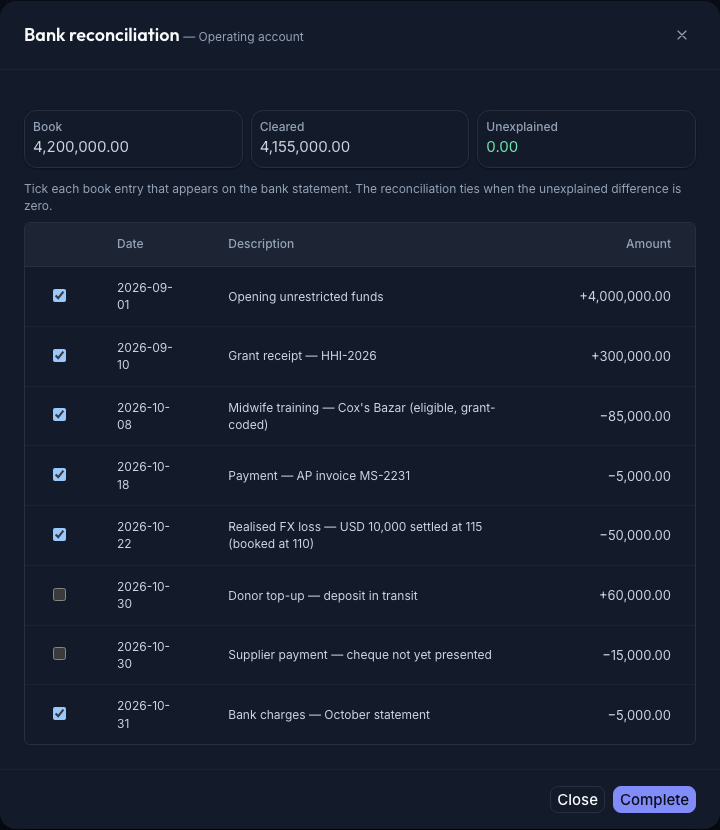
Step 1 — the October reconciliation: everything on the statement is ticked, the deposit in transit and the unpresented cheque are left open, and the unexplained difference is zero -
Capture the period-end entries. Before you close, book what the month owes but hasn't yet recorded: the FX revaluation of open monetary items (B6), accruals for goods received not invoiced, and the grant income recognised by matching (B3).
-
Close the period. Flip the AccountingPeriod open → closed. Posting into a closed month is then blocked (B2), which is what makes a reported figure final.

Step 3 — Finance → Accounting → Periods: September closed (by whom, when), October and November open -
Re-opening is deliberate. Should you ever need to re-open a closed period, it's an explicit, logged decision — not a quiet edit — so the integrity of a signed-off month is never in doubt.
Walked example — Hilsa Health Initiative
At the end of October, Hilsa's operating account shows BDT 4,205,000 in the ledger (before the bank's charges are booked); the bank statement shows BDT 4,155,000. Reconcile both sides to the same true balance — each timing item goes on the side that hasn't caught up yet:
| Statement side | BDT |
|---|---|
| Balance per bank statement | 4,155,000 |
| + Deposit in transit (donor top-up — in the books, not yet on the statement) | 60,000 |
| − Outstanding cheque (supplier payment — not yet presented) | (15,000) |
| Adjusted bank balance | 4,200,000 |
| Ledger side | BDT |
|---|---|
| Balance per ledger, before month-end entries | 4,205,000 |
| − Bank charges (on the statement only — book them now) | (5,000) |
| Adjusted ledger balance | 4,200,000 |
Both sides land on BDT 4,200,000 — the month ties. The BDT 5,000 of bank charges becomes a new
journal entry (Dr 5600 Bank charges / Cr 1102 Bank); the deposit and the cheque need no entry —
they're already in the books and will clear on next month's statement. Now October can be closed.
The numbers
The reconciliation identity: ledger balance ± timing items ± bank-only items = statement balance. Anything left unexplained after timing and bank items is a real discrepancy — a missing or wrong entry to find before you close. You never close a period that doesn't reconcile.
Controls & evidence
- A reconciliation performed every month, reviewed by someone other than the preparer.
- Every reconciling item explained — no "unidentified differences" left hanging.
- A close checklist completed (reconciliations done, accruals and FX revaluation posted, grant income recognised) before the lock.
- Closed periods locked — the evidence that reported numbers are final.
Best practices & pitfalls
- Do reconcile monthly, not "when there's time." Discrepancies are cheapest to find fresh.
- Do post bank-only items (charges, interest) as you find them on the statement.
- Pitfall: forcing a reconciliation by writing off an unexplained difference. That difference is information — investigate it.
- Pitfall: closing before the period-end entries (FX revaluation, accruals) are in. A month closed with those missing is a month you'll have to re-open.
Practise question
Q1. Your ledger shows BDT 1,000,000; the bank statement shows BDT 1,020,000. You find an uncleared supplier payment of BDT 30,000 and bank interest of BDT 50,000 not yet in the ledger. Does it reconcile, and what entry (if any) do you post?
Answer: 1,000,000 − 30,000 (outstanding payment) + 50,000 (interest) = 1,020,000 = statement
✓ — it reconciles. The interest needs a journal entry (Dr Bank 50,000 / Cr Interest income
50,000); the outstanding payment is a timing item that clears next month, so no entry for it.
Your hands-on assignment
Tie one month to the bank, then lock it. In a demo organisation — never your live books (your figures will differ from Hilsa's):
- In Finance → Bank, click Reconcile on an account; enter the statement date and the statement closing balance.
- Tick each book line that appears on the statement and watch Unexplained move toward zero.
- Leave the timing items (deposits in transit, unpresented cheques) unticked — and say which side each adjusts.
- Book anything that's on the statement only (bank charges) as a journal, tick it, and Complete at zero.
- In Finance → Accounting → Periods, Close the month; try posting into it and read the refusal; then Reopen it with a reason.
When you've done it, test yourself with the knowledge check below — a short quiz drawn from this lesson. Score 80% or more and the lesson is marked complete.
Terms used here
- Bank reconciliation — proving ledger cash equals bank cash, explaining the differences.
- Reconciling item — a timing or bank-only difference between the two.
- Accrual — recognising a cost/income in the period it relates to, before the cash moves.
- Period close / lock — finalising and freezing a month's numbers.
- Related: Record a balanced journal entry — the period lock that close enforces.
How an auditor / donor expects this
They expect a monthly bank reconciliation, reviewed and signed, with every item explained, and closed periods that don't move. Reconciliations are among the first things an auditor asks for — a clean, reviewed monthly rec plus a locked period is the evidence that the organisation's cash and reported figures can be trusted. This is where the whole track lands: coded, balanced, matched, recovered, revalued — and finally, reconciled and closed.
Sign in to track your progress and earn your track completion.
🎉 You finished the track — view your completion →