
Handle multi-currency & FX gain/loss
Learn Finance · Fund & Financial Accounting · Task B6. Record foreign-currency transactions and the gains and losses the exchange rate creates — the right way, under IAS 21.
What it is
A donor funds you in USD; you spend in Bangladeshi taka (BDT). Between the day the grant is valued and the day you spend, the exchange rate moves — and that movement is a real foreign- exchange (FX) gain or loss you have to record.
IAS 21 (The Effects of Changes in Foreign Exchange Rates) sets the rules: - Record each transaction at the spot rate on its date. - Monetary items (cash, receivables, payables — things that are fixed amounts of money) are retranslated at period-end to the closing rate; the change is an FX gain/loss. - Non-monetary items (equipment, prepayments) stay at their original rate — they're not retranslated. - Realised gain/loss happens on settlement (you actually convert); unrealised happens at period-end revaluation (you still hold the item, but its taka value changed).
Why it matters
- The rate move is real money. If the dollar strengthens between receipt and spend, your taka go further — a genuine gain. Ignore it and your books don't reflect reality.
- Donor reports are usually in the grant currency. You must reconcile taka spend back to USD at the right rates, or the donor report won't tie to the award.
- Mixing the rate up distorts the project. Booking everything at today's rate, or at the budget rate, hides whether an overspend was real or just currency.
Where you do it in VanillaPM
Everything below is in Finance → Bank, Finance → Accounting, and the project's Budget tab. A step-by-step:
-
Freeze the project FX snapshot. Fix the project's rates at a point in time, so budget-vs-actual is compared on a consistent basis rather than drifting with every daily move. Re-baselining the rates is a deliberate, logged act.
-
Tag each bank with its currency. Every BankAccount records the currency it is held in (the USD grant account, the BDT operating account). The ledger itself is kept in the organisation's base currency — a USD account's balance is its BDT equivalent — so the currency tag is what tells you which accounts are exposed to rate moves. Payroll carries its own PayrollFxRate snapshot taken at calculate time, so a historical run reproduces exactly.

Step 2 — Finance → Bank: each account tagged with its currency (USD grant receipts, BDT operating, BDT petty cash) -
Pay at spot, and book the difference. When a foreign bill is settled at a different rate from the one it was booked at, the gap is a realised FX gain or loss. Post it as a journal entry in Finance → Accounting to the dedicated accounts FX gains (4300) / FX losses (5950) — so currency movement is visible as its own line, never buried in the programme expense. (Settlement doesn't compute the difference for you today; you post it.)
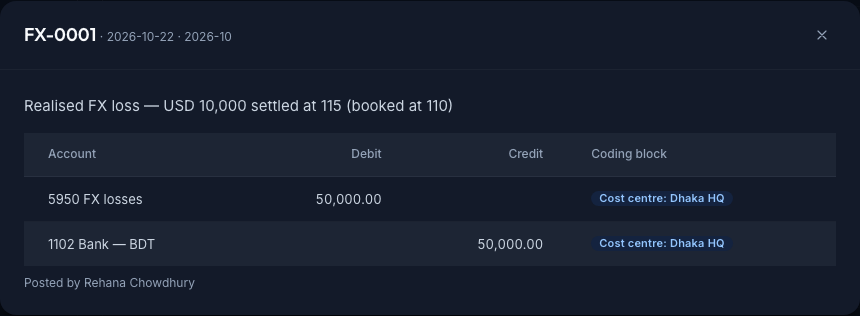
Step 3 — the realised FX loss, posted as its own journal: Dr 5950 FX losses 50,000 / Cr 1102 Bank — USD 10,000 settled at 115, booked at 110
Honest boundary: the project FX snapshot and the dedicated 4300/5950 accounts are solid, and the ledger enforces a balanced, coded FX entry like any other — but it is single-currency (base-currency) underneath: bank currencies are tags, and the realised difference is posted by you, not calculated on settlement. There is no period-end revaluation run either: retranslating open foreign-currency balances to the closing rate (IAS 21) is a month-end journal you post yourself — the concept below is what tells you what that entry should be.
Walked example — Hilsa Health Initiative
The grant is $300,000, recorded when USD 1 = BDT 110 → BDT 33,000,000 of funding value.
| Event | Rate | Effect |
|---|---|---|
| Grant valued at receipt | 110 | BDT 33,000,000 recognised as the taka equivalent |
| Pay a $10,000 supplier bill, settled when rate is 115 | 115 | you need BDT 1,150,000 to settle a bill carried at BDT 1,100,000 |
| Realised FX loss | Dr 5950 FX loss 50,000 (BDT) / Cr Bank — the 50,000 extra taka |
The dollar got more expensive in taka, so settling the dollar bill cost more taka than it was booked at — a BDT 50,000 realised loss, recorded to 5950, separate from the programme cost.
The numbers
FX gain/loss = amount × (settlement rate − booking rate), in your reporting currency.
$10,000 × (115 − 110) = BDT 50,000. Because you paid out foreign currency that became dearer, it's a loss (5950). Had the rate fallen to 108, settling would have cost BDT 20,000 less than booked — a gain to 4300. The programme expense itself doesn't change; only the FX line moves.
Controls & evidence
- A documented rate source and the rate used on each foreign transaction (spot, dated).
- FX gains/losses booked to 4300/5950, kept out of programme cost lines.
- The project FX snapshot recorded, so budget-vs-actual is on a consistent basis.
- At period-end, monetary items retranslated (per IAS 21) — confirm the revaluation step.
Best practices & pitfalls
- Do book transactions at the rate on their date, not a single convenient rate.
- Do keep FX gain/loss in its own account — it's a financing effect, not a programme cost.
- Pitfall: retranslating non-monetary items (equipment, prepayments). IAS 21 says don't — they stay at historical rate.
- Pitfall: hiding a currency loss inside the programme line, making a project look overspent when it was really the rate. Separate the two so each is clear.
Practise question
Q1. You hold a $5,000 payable booked at BDT 110/USD. At period-end the rate is BDT 120/USD and the bill is still unpaid. Is there an FX gain or loss, is it realised or unrealised, and how much?
Answer: An unrealised loss (you still hold the monetary item, so it's a period-end revaluation, not a settlement). 5,000 × (120 − 110) = BDT 50,000 loss — the dollars you owe now cost more taka. It becomes realised only when you actually settle.
Your hands-on assignment
Find the currency exposure, then book a difference yourself. In a demo organisation — never your live books (your figures will differ from Hilsa's):
- Open Finance → Bank and read each account's currency tag: which are exposed to rate moves?
- On a project's Budget tab, find Lock exchange rates and read what the FX snapshot freezes.
- Take a foreign bill booked at one rate and settled at another; work out the difference in your base currency.
- Post it in Finance → Accounting → New journal entry: debit FX losses (5950) (or credit FX gains (4300)) against the bank.
- Open the entry in Journal and confirm the programme expense line itself never moved.
When you've done it, test yourself with the knowledge check below — a short quiz drawn from this lesson. Score 80% or more and the lesson is marked complete.
Terms used here
- Spot rate — the exchange rate on a transaction's date.
- Monetary vs non-monetary items — fixed amounts of money (retranslated) vs assets like equipment (not).
- Realised vs unrealised — gain/loss on settlement vs at period-end revaluation.
- FX snapshot — a frozen set of rates for consistent comparison.
- Related: Reconcile the bank & close the period — where period-end revaluation happens.
How an auditor / donor expects this
They check transactions were booked at dated spot rates, monetary items were retranslated at period-end, gains/losses sit in 4300/5950 (not buried in programme cost), and taka spend reconciles to the grant currency at the right rates. Currency is a common place for errors to hide; keeping the FX effect on its own line is what makes the donor report defensible.
Sign in to track your progress and earn your track completion.
🎉 You finished the track — view your completion →